
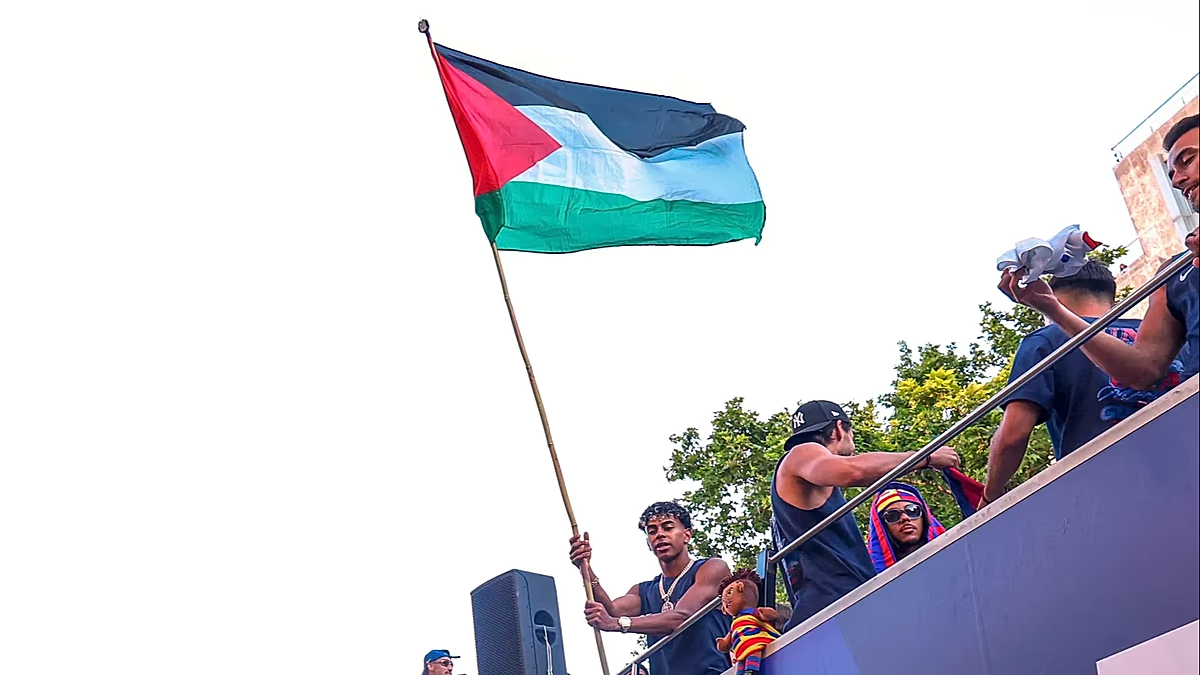


The political and humanitarian crisis in Gaza has once again spilled onto the global stage, this time finding a powerful symbol in the figure of an 18-year-old football prodigy. During Barcelona’s open-top bus parade celebrating their La Liga title, forward Lamine Yamal waved a Palestinian flag, a gesture that resonated far beyond the cheering crowds in Catalonia. This simple act, a moment of youthful expression amidst celebration, ignited an international diplomatic controversy, revealing the deep and painful fissures in international opinion regarding the ongoing conflict. For many watching, Yamal’s choice was a poignant, if silent, statement of solidarity from one of Europe’s most promising young athletes.
The reaction from Israeli authorities was swift and severe. Israeli Defence Minister Israel Katz publicly condemned the teenager, accusing him of choosing to “incite hatred” against Israel. In a Spanish-language post on the social media platform X, Katz directly addressed FC Barcelona, expressing hope that the “great and respected club” would distance itself from such remarks and make an “unambiguously clear” statement that there is “no place for incitement or support for terrorism.” This framing of the gesture—equating the display of a national flag with incitement and terrorism—illustrates the intense sensitivity and zero-sum narrative battle that surrounds the Israel-Palestine issue on the world stage.
In a robust defence of his young compatriot, Spanish Prime Minister Pedro Sánchez delivered a forceful rebuttal. Sánchez, who has been an outspoken critic of Israel’s military campaign in Gaza—which he has previously described as a “genocide”—took to the same platform to champion Yamal’s action. “Those who think that waving the flag of a state is ‘inciting hatred’, they have either lost their minds or they have been blinded by their own disgrace,” he wrote. He reframed the narrative, stating, “Lamine just expressed the solidarity with Palestine that millions of Spaniards feel. Yet another reason to be proud of him.” This powerful endorsement from the nation’s leader highlighted the widespread popular sympathy for the Palestinian cause within Spain itself.
The resonance of Yamal’s gesture was perhaps most profoundly felt not in European government chambers or football stadiums, but amidst the ruins of Gaza itself. Artists in a refugee camp within the devastated territory responded by painting a mural on the rubble depicting the young footballer waving the Palestinian flag. This poignant image, captured by an AFP journalist, symbolizes how international acts of solidarity are received in Gaza: as rare beams of global attention and empathy in a landscape of profound suffering and isolation. It underscores that for Palestinians, such gestures from global figures are not seen as abstract political statements, but as vital acknowledgements of their struggle and humanity.
Back in Barcelona, the club’s new coach, Hansi Flick, offered a more measured, institutional perspective. He stated that he personally “didn’t like” Yamal’s actions, but accepted that “if he wants to do it, it’s his decision.” This delicate positioning reflects the tightrope that global institutions like FC Barcelona must walk, caught between the personal convictions of their stars, the expectations of a diverse global fanbase, and the pressures of geopolitical diplomacy. The incident lays bare the complex reality that modern athletes, especially those of immense fame, are increasingly viewed as political actors whether they intend to be or not.
Ultimately, the controversy surrounding Lamine Yamal’s flag is a microcosm of the severely deteriorated state of relations between Spain and Israel. Diplomatic ties have been in a downward spiral since the start of the Gaza war, initiated by the Hamas-led attack on October 7, 2023. The rift deepened dramatically when Spain, along with Ireland and Norway, formally recognized a Palestinian state in 2024, a move that prompted Israel to recall its ambassador. Spain subsequently dismissed its own top envoy in Tel Aviv in March. Within this charged context, a footballer’s gesture becomes a potent political flashpoint, a simple act woven into a larger tapestry of international condemnation, solidarity, and a deep-seated conflict that continues to defy resolution, all while the world watches, often divided, from the sidelines.