



The European VPN Debate: Unpacking the Misunderstanding
Recent weeks have seen a wave of concern ripple across social media, fueled by a potent question: What if the European Union moved to ban Virtual Private Networks (VPNs)? Alarming posts have painted this as an imminent threat to digital privacy and freedom, suggesting that Brussels is on the verge of outlawing a crucial tool used by millions to secure their online activity and access information. This anxiety, however, stems from a significant misinterpretation of ongoing policy discussions. At its core, the controversy is not about a war on VPNs themselves, but rather a parallel and complex EU effort to create safer online spaces for children through enhanced age-verification systems.
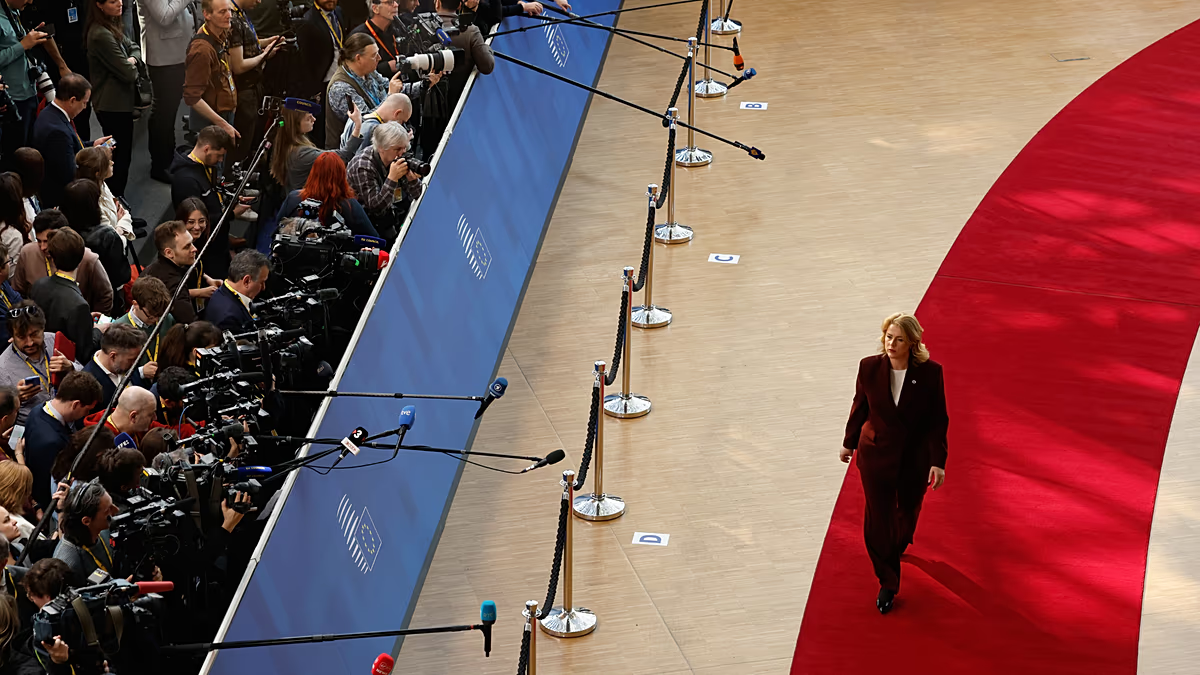
The origins of this confusion can be traced to January, when the European Parliamentary Research Service (EPRS) published an analytical briefing. This document, intended to inform lawmakers, factually explored how VPNs could theoretically be used to circumvent age checks, describing them as potential “loopholes.” While a standard research product, this briefing was quickly misrepresented online as evidence of an official legislative proposal to crack down on VPNs. This misinterpretation was compounded in late April when the European Commission announced plans for a new EU-wide age-verification app. In a subsequent press conference, Commissioner Henna Virkkunen, when pressed on how to stop minors from using VPNs to bypass such systems, acknowledged that no technology is “foolproof.” This reasonable statement was again misconstrued as signaling an anti-VPN agenda, requiring later clarifications that no crackdown was planned.
In reality, officials have been at pains to correct the record. Commissioner Virkkunen explicitly clarified to Finnish media that the goal is to make safeguards more robust and difficult to bypass—not to prohibit VPNs. Her office confirmed there is “absolutely no crackdown on VPNs,” a sentiment echoed by a European Commission spokesperson who reaffirmed the EU’s commitment to a free and open internet alongside the imperative of protecting minors. The discussion, therefore, exists in a nuanced space: policymakers are examining the technical challenges of effective age verification, acknowledging that VPNs present one such challenge, without advocating for the tool’s restriction. The dialogue is about strengthening one system, not dismantling another.
The reason VPNs have entered this conversation is rooted in genuine, practical concerns from some policymakers. Danish MEP Christel Schaldemose, a key figure in online child protection laws, has warned that if age-verification systems are too cumbersome or implemented unevenly across the EU’s 27 member states, they may inadvertently push young users toward VPNs to access restricted content. This highlights a central tension: well-intentioned rules must be carefully designed to avoid creating the very problems they seek to solve. The debate is thus less about VPNs being “bad” and more about ensuring that new protective measures are effective, user-friendly, and consistent to minimize the incentive to circumvent them.
Real-world examples demonstrate why this is a live issue. In the United Kingdom, the rollout of its Online Safety Act led to reported surges in VPN downloads as some users sought ways to navigate new age checks. Similarly, in France, when stricter verification laws prompted some adult sites to block access, VPN usage spiked as a workaround. These cases illustrate the predictable consumer reaction to perceived digital barriers. However, as VPN provider NordVPN pointed out in response to the EU discussions, the narrative of children widely using VPNs may be overblown. The company notes that paid VPN services typically require a valid payment method, which itself acts as an age barrier, and that any minor attempting to bypass checks would likely rely on limited free services. They caution that broadly targeting VPN providers would risk punishing the wrong actors in the ecosystem.
Ultimately, the current situation is a case study in how complex digital policy debates can become distorted in the public square. The EU is grappling with the legitimate and difficult task of protecting children online in an era of borderless digital content. This necessary work involves examining all potential weak points in new systems, including the use of privacy tools like VPNs. However, examining a tool’s potential for circumvention is a far cry from seeking to ban it. The EU institutions have explicitly stated that no proposal to restrict VPNs exists. The real conversation is about building effective, resilient age-verification that respects privacy and practicality, ensuring that the digital environment is both open and safe for all its users. The alarmist headlines, while understandable, have largely missed this critical distinction.