

Of course. Here is a summary and humanization of the provided content, expanded into six paragraphs.
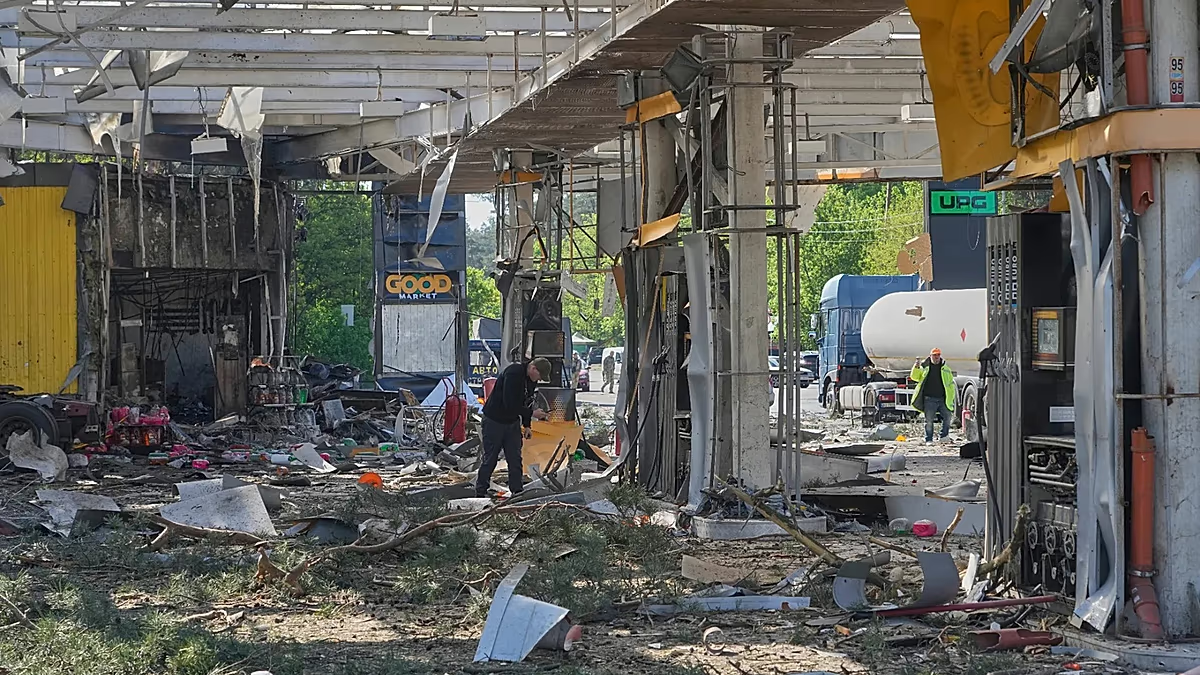
The human cost of war has once again been seared into the consciousness of the world following one of the largest and most brutal assaults since Russia’s invasion began. In a massive, coordinated barrage, Russian forces launched a wave of over 700 drones and missiles, primarily targeting Ukraine’s capital, Kyiv. The attack, which unfolded over two days, was not confined to military objectives but was aimed squarely at the heart of civilian life: homes, residential apartment blocks, and essential infrastructure. The result is a landscape of profound grief, with the death toll rising to at least 24 souls, dozens more injured, and an untold number of families shattered. In a stark symbol of the devastation, a nine-story residential building in Kyiv’s Darnytsia neighborhood collapsed, crushing all eighteen apartments within it and leaving rescue workers to sift through concrete rubble in a desperate search for survivors, with many still believed missing. Among the dead in Kyiv was a 12-year-old girl, her life and future extinguished in an instant, prompting the city to declare a day of mourning where flags will fly at half-mast.
While Kyiv bore the brunt of the assault, the terror was not isolated. The southern regions of Odesa and Kherson, and the eastern city of Kharkiv, also endured fire, illustrating the expansive and relentless nature of the offensive. Yet, amidst the chaos, Ukraine’s defenses demonstrated remarkable resilience. The Ukrainian air force reported intercepting the vast majority of the incoming projectiles, downing 652 drones and 41 missiles. This heroic effort undoubtedly prevented an even greater catastrophe, but it could not stop all the destruction from raining down on city streets and apartment courtyards. The attack laid bare a grim reality: a conflict where civilian centers have become the battlefield, and where the concept of safety has been utterly erased for millions of Ukrainians who now live under a constant, terrifying threat.
The international response was swift and forceful, framing the assault not as a military success for Russia, but as an act of profound weakness and moral bankruptcy. European Commission President Ursula von der Leyen condemned the “indiscriminate targeting of civilians,” pledging continued support for Ukraine. French President Emmanuel Macron pointed to the hypocrisy of Russia engaging in diplomatic talks while simultaneously launching such a vicious attack, arguing that bombing civilians “demonstrates less its strength than its weakness.” German Chancellor Olaf Scholz echoed this sentiment, stating that the scale of the attack sends a clear message that Moscow is “choosing escalation over negotiation.” These condemnations underscore a growing consensus that this attack represents a deliberate strategy to terrorize the Ukrainian population and break their spirit, a tactic that has instead solidified Western resolve to bolster Ukraine’s defensive capabilities.
In a significant and escalatory development, the war’s violence echoed back onto Russian soil overnight. Ukrainian forces launched a large-scale drone attack targeting military and energy infrastructure in several Russian regions, including Ryazan. Reports indicate that at least three people were killed and a dozen wounded in these strikes. Social media footage showed clouds of smoke billowing over Ryazan, with fires reportedly breaking out at a major oil refinery, a key piece of industrial infrastructure. This reciprocal strike marks a further erosion of the war’s boundaries, demonstrating Ukraine’s capacity and willingness to carry the conflict deeper into Russia in response to attacks on its own cities, potentially opening a new and more volatile chapter in the confrontation.
The aftermath in Kyiv is one of somber reckoning. As rescue operations continue, the scale of the loss is only beginning to be fully understood. Each number in the casualty report translates to a life abruptly ended, a family plunged into mourning, and a community scarred. The collapsed apartment block stands as a grotesque monument to the war’s cruelty—a place where ordinary people lived, slept, and dreamed, now reduced to a tomb of shattered concrete and personal belongings. The declaration of a day of mourning is a formal recognition of this collective trauma, a pause in public life to honor those who were simply in their homes when the war came for them yet again.
This tragic episode crystallizes the current, harrowing state of the war: a grueling cycle of escalation where diplomatic overtures are drowned out by the sound of explosions. Russia’s massive attack, followed by Ukraine’s retaliation inside Russia, suggests a conflict that is intensifying rather than winding down. The targeting of civilian areas and energy infrastructure on both sides points to a brutal war of attrition designed to wear down not just armies, but the very will of the nations involved. As the world watches, the people of Ukraine are left to bury their dead, care for their wounded, and rebuild their shattered homes, all while steeling themselves for the ominous possibility of what may come next. The message from this week’s violence is tragically clear: the front lines are everywhere, and no one is safe.