


A New Chapter in Brotherhood: Kazakhstan and Turkey Forge an Eternal Bond
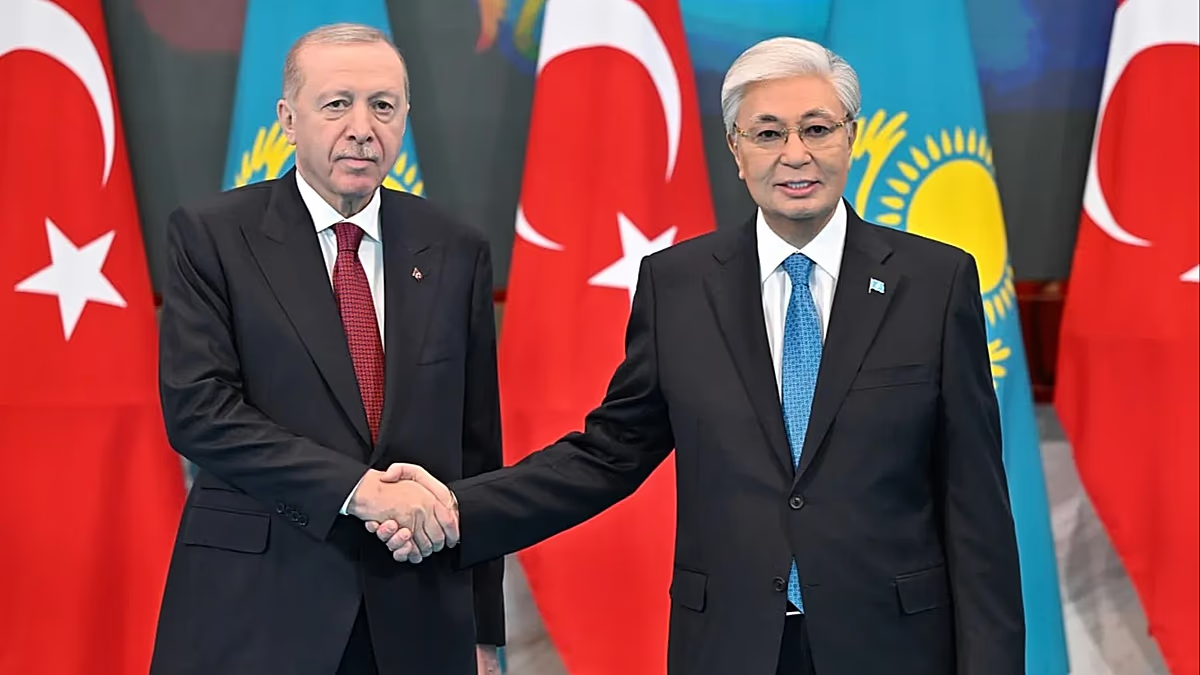
In a landmark ceremony in Astana, the leaders of Kazakhstan and Turkey transformed a deep historical and cultural kinship into a formal, forward-looking alliance. President Kassym-Jomart Tokayev of Kazakhstan and President Recep Tayyip Erdoğan of Turkey signed a historic “Declaration on Eternal Friendship and Expanded Strategic Partnership.” This powerful document elevates their relationship beyond conventional diplomacy, embedding it within a narrative of shared heritage and perpetual brotherhood. The signing coincided with President Erdoğan’s state visit, which was rich in symbolism, including his receipt of the newly established Order of Qoja Ahmet Yasawi, named for a revered 12th-century Turkic poet. Tokayev described this honour as one of “deep symbolic significance,” a sentiment Erdoğan accepted as a tribute to the Turkish people and a testament to the unbreakable bond between the two nations. This visit underscored that the partnership is not merely a transactional arrangement but is rooted in a profound sense of common identity and destiny.
The “Golden Bridge”: A Strategic Vision for Shared Prosperity
Central to the new declaration is an ambitious economic vision designed to translate fraternal ties into tangible prosperity. The two nations have set a bold bilateral trade target of €13 billion, a figure that would nearly triple the current annual trade volume of approximately €4.5 billion. President Tokayev eloquently framed Turkey’s role as a “golden bridge” connecting Europe and Asia, a crucial node in global trade and diplomacy that Kazakhstan is keen to leverage. To achieve this ambitious goal, the leaders emphasized implementing a detailed 67-point Action Plan, focusing on removing trade barriers and enhancing cooperation. The existing economic foundation is robust, with around 4,000 Turkish companies operating in Kazakhstan and mutual investments totaling over €7 billion. The co-chaired High-Level Strategic Cooperation Council meeting and an accompanying business forum served as catalysts, with both presidents expressing unwavering confidence that their complementary economies—Kazakhstan’s vast resources and Turkey’s industrial and logistical prowess—are perfectly aligned for exponential growth.
Building the Pathways: Transport, Energy, and Digital Frontiers
The partnership’s blueprint extends across critical infrastructure sectors, with a particular focus on creating new Eurasian corridors. A key priority is the expansion of the Trans-Caspian International Transport Route (TITR), or the “Middle Corridor,” which links China to Europe via Kazakhstan, the Caspian Sea, and Turkey. With rail cargo between the two countries already up by 35% this year, Tokayev called on Turkish investors to increase their participation in Kazakhstani ports like Aktau and Kuryk to unlock the route’s full potential. In energy, Kazakhstan welcomed the planned entry of the Turkish state oil company, TPAO, into its market and invited Turkish expertise in mining and lithium processing. The digital sphere saw equally promising collaborations, with Kazakh fintech giant Kaspi.kz set to support the Turkish e-commerce platform Hepsiburada. These multifaceted projects illustrate a partnership actively building the physical and digital highways of the future, ensuring both nations are at the heart of 21st-century trade and innovation.
A Foundation of Agreements: From Culture to Defence
Beyond grand visions, the visit produced a concrete portfolio of agreements that solidify cooperation across the breadth of the relationship. A series of bilateral documents were signed, covering areas as diverse as legal assistance, cultural centre establishments, and mutual investment protection. Notably, the accords included plans for cooperation in oil and gas exploration and a significant partnership for the joint production of Unmanned Aerial Vehicles (UAVs), highlighting a deepening of ties in the sensitive defence industry. Additional agreements on education, broadcasting, and financial centre collaboration point to a holistic integration of societies. These pacts provide the essential legal and institutional framework that will support the larger strategic goals, ensuring that the partnership has both depth and durability across government, industry, and civic life.
The Turkic Context and a Shifting Geopolitical Landscape
This strengthened bilateral alliance is amplified within the broader framework of the Organisation of Turkic States (OTS), an increasingly important platform for regional cooperation. The visit preceded an informal OTS summit in Turkistan, Kazakhstan, focused on “Artificial Intelligence and Digital Development.” While Turkey is the informal leader of this group, Kazakhstan contributes its status as the largest economy in Central Asia. This burgeoning Turkic unity occurs against a pivotal geopolitical backdrop: Russia’s war in Ukraine has disrupted traditional overland trade routes and accelerated the desire of Central Asian nations, including Kazakhstan, to diversify their economic and political partnerships. While maintaining its declared “multi-vector” foreign policy, Kazakhstan’s vigorous enhancement of ties with Turkey reflects a strategic drive to build resilience, secure alternative transport corridors like the TITR, and reduce historical dependencies, all within a cultural framework that feels natural and authentic.
An Eternal Partnership for a New Era
In conclusion, the Declaration on Eternal Friendship between Kazakhstan and Turkey marks a pivotal moment, formalizing a bond that transcends ordinary diplomacy. It is a partnership built on a rare triad of assets: a deep-rooted cultural and historical affinity, a clear and ambitious economic roadmap for shared prosperity, and a strategic alignment in a changing world. By targeting massive trade growth, collaborating on critical infrastructure from transport to digital networks, and signing a wide array of implementing agreements, the two nations are constructing a comprehensive partnership. As both countries navigate a complex geopolitical environment, their fortified alliance, celebrated in the spirit of the ancient poet Yasawi, stands as a testament to the power of shared heritage harnessed for future-facing success. It is truly the construction of a “golden bridge” meant to endure for generations.