

Paragraph 1: Incident Overview
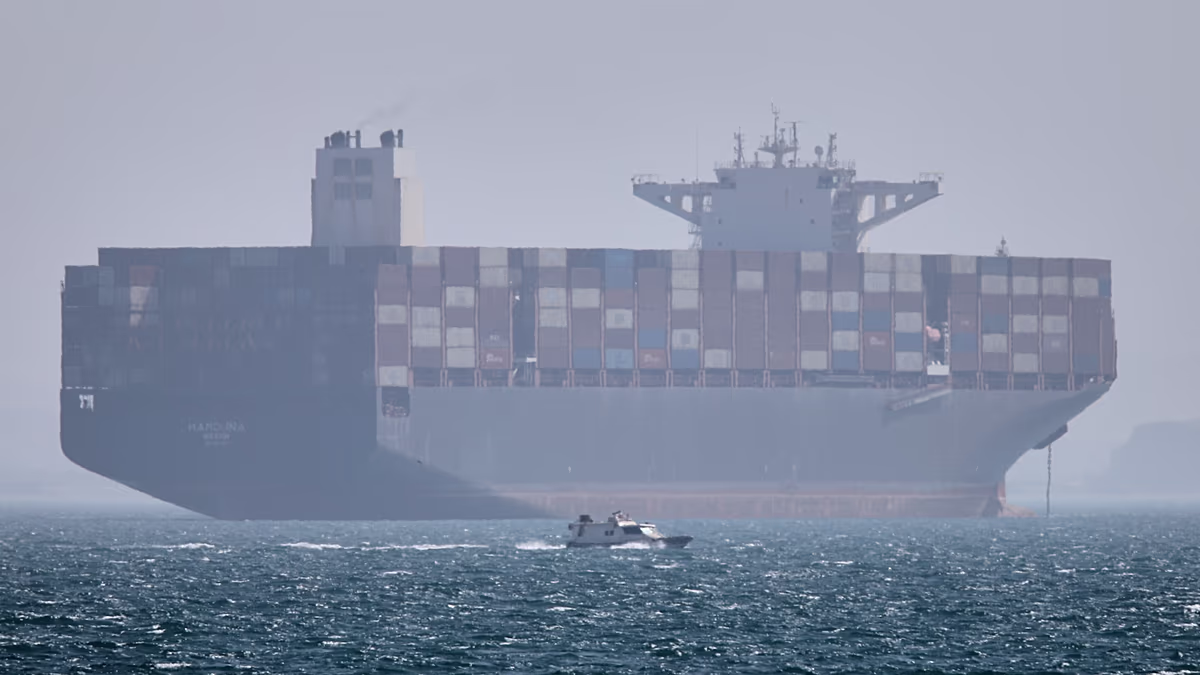
In a concerning development within one of the world’s most critical maritime corridors, a commercial ship anchored off the coast of the United Arab Emirates has been forcibly taken by unidentified individuals. The United Kingdom Maritime Trade Operations (UKMTO) agency reported on Thursday that the vessel, located approximately 70 kilometers northeast of Fujairah, was seized by “unauthorised personnel.” Following the capture, the ship altered its course and is now heading towards Iranian territorial waters. The UKMTO has not disclosed the name of the vessel or speculated on the identity of the captors, emphasizing that an investigation is ongoing. In light of the incident, the agency has issued a warning to all ships navigating the area, urging them to exercise extreme caution and report any suspicious activity immediately.
Paragraph 2: Context of Regional Tensions
This seizure is not an isolated event but part of a dangerous and escalating pattern of maritime confrontations in the Strait of Hormuz, a narrow channel essential for global energy supplies. The region has become a flashpoint amid ongoing geopolitical strife, primarily between Iran and the United States. Both nations are enforcing rival blockades, leading to a tense and volatile environment for international shipping. In recent months, several vessels have been attacked or seized, transforming this vital economic artery into a zone of heightened risk. The incident underscores the tangible human and economic costs of these geopolitical standoffs, where commercial crews and global trade flows become entangled in international disputes.
Paragraph 3: Iran’s Recent Actions and Justifications
Iran has been actively involved in these maritime incidents. Just last week, Iranian authorities seized a tanker identified as the Ocean Koi in the Gulf of Oman. According to Iran’s official IRNA news agency, the seizure was a targeted action against attempts to disrupt Iranian oil exports and interests. The agency stated the tanker was carrying Iranian oil when it was boarded and diverted to Iran’s southern coast. This action aligns with a broader pattern; the United States had previously sanctioned the Ocean Koi in February, labeling it part of a “shadow fleet” used to transport Iranian oil. Iran’s judicial officials, such as spokesperson Asghar Jahangir, defend these actions as legal and orderly. He stated that seizures of “violating” vessels are conducted under Iranian court orders and in compliance with both domestic law and international frameworks, specifically citing the 1982 UN Convention on the Law of the Sea.
Paragraph 4: Official Iranian Rhetoric vs. On-Ground Reality
Despite these assertive actions on the water, Iran’s public diplomatic rhetoric presents a contrasting picture. At a recent meeting of the BRICS bloc in New Delhi, Iranian Foreign Minister Abbas Araghchi made no direct mention of the latest seizures. Instead, he asserted that the Strait of Hormuz “is open for all” commercial vessels, provided they “cooperate” with Iran’s navy. This statement highlights a paradoxical stance: officially inviting free passage while simultaneously enforcing a selective and aggressive interception policy based on its own legal interpretations. The gap between the promise of open waterways and the reality of enforced blockades creates confusion and danger for shipping operators, who must navigate not just the physical strait but also a complex and unpredictable political landscape.
Paragraph 5: The Broader Conflict and Regional Impact
The maritime skirmishes are symptomatic of a larger, unresolved conflict. Since the outbreak of hostilities between Iran and the United States and Israel on February 28th, Iran has significantly restricted shipping through the Strait of Hormuz. In response, the United States has imposed its own naval blockade on Iranian ports, despite a fragile ceasefire that took effect on April 8th. This mutual blockade strategy has effectively turned the region into a naval chessboard, with commercial vessels suffering the consequences. The risks are not limited to seizures; the waters have become a theatre for aerial attacks. For instance, on Sunday, South Korea reported that a cargo ship was struck by unidentified aircraft in the Hormuz area, while Qatar stated a freighter entering its waters from Abu Dhabi was hit by a drone. These incidents illustrate that the threat profile is multidimensional, involving surface, legal, and now aerial dimensions.
Paragraph 6: Conclusion and Implications
The seizure of the vessel near Fujairah is a stark reminder that the fragile ceasefire in the region is under constant strain. Each incident amplifies the risks for global trade, energy security, and the safety of international crews. The competing blockades and legal justifications create a climate of instability where the rules of passage are ambiguous and enforced through coercion. For the international community, these events necessitate vigilant monitoring and coordinated diplomatic efforts to de-escalate tensions. For shipping companies and crews, they represent a direct and perilous operational hazard. As the captured ship steers towards Iranian waters, it carries with it not just its cargo, but the weight of escalating regional tensions that threaten the stability of a corridor crucial to the world’s economy.