



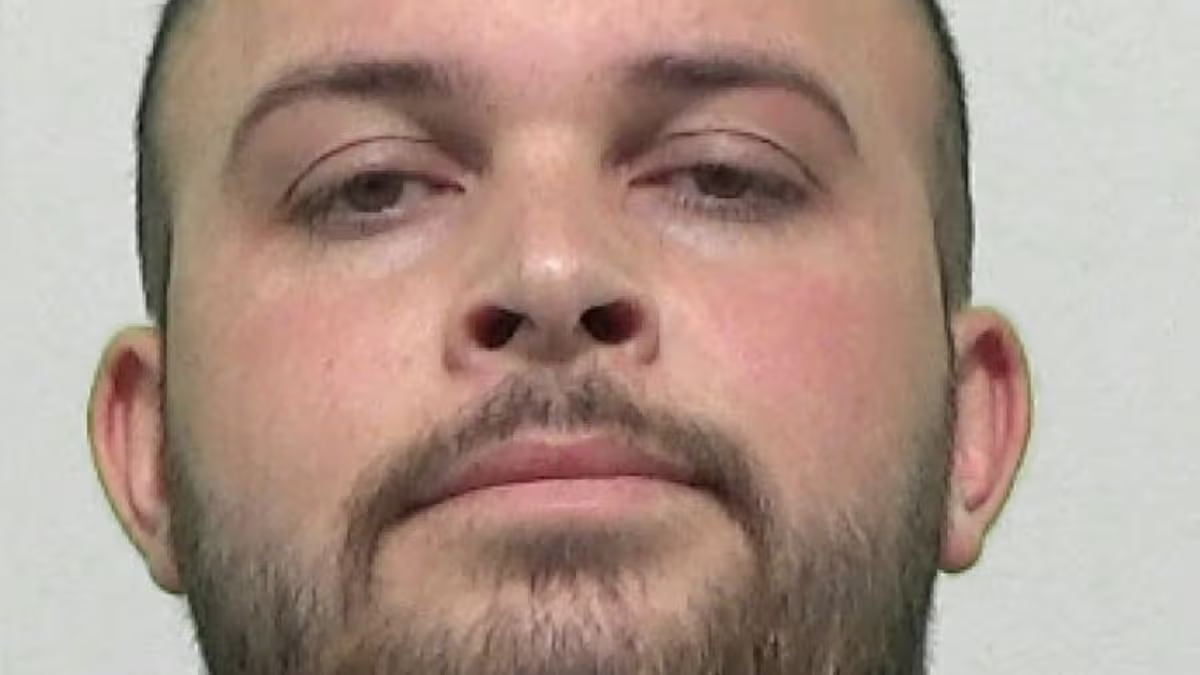
In a case that lays bare the devastating and entirely preventable consequences of reckless arrogance, a Sunderland family has been sentenced to a lifetime of grief. Reece Roberts, a 27-year-old man already banned from driving, chose to get behind the wheel on the evening of February 14th, 2026. His stated reason was trivial: to buy some milk. The outcome was catastrophic. Driving a black Volvo XC90 at more than twice the 30mph speed limit, he struck 59-year-old Diane Jones as she crossed the A690 Durham Road after a Valentine’s Night drink. The force of the impact was horrifying; Diane was dragged 190 feet along the road, suffering catastrophic injuries. In a final, cowardly act, Roberts did not brake or stop to help, instead fleeing the scene and leaving Diane to die in the road as passers-by rushed to her aid. This was not a tragic accident, but a lethal collision waiting to happen, borne from a conscious and repeated disregard for the law and for human life.
The woman whose life was so brutally taken was, in the words of her heartbroken daughter Hannah, the “diamond at the centre of the ring” of her family. Diane Jones was described as a small, funny, and fiercely caring woman, a beloved mother with the “heart and fight of a lion.” She was the kind of person who filled rooms with warmth and whose absence now leaves a void that can never be filled. In a display of immense courage, her daughter stood in Newcastle Crown Court and directly addressed the man responsible, giving a voice to the profound and searing pain he inflicted. She spoke of a mother who was “utterly beloved,” a “real force to be reckoned with,” and wondered how Roberts could ever sleep at night or look at his own mother, knowing he had left hers “lying in the road like a worthless piece of meat.” Her statement transcended the legalese of the courtroom, laying bare the raw, human cost of a single, selfish decision.
For Reece Roberts, this was not a first, tragic mistake, but a repeated pattern of dangerous behavior that finally culminated in murderous results. The court heard that he was already serving a driving ban—one imposed after a previous conviction for causing serious injury by dangerous driving in a 2019 hit-and-run. In that earlier incident, he had also been speeding, uninsured, and disqualified, fleeing at high speed and leaving another victim with life-changing injuries. His criminal history further included a conviction for blackmail. This context painted a picture of a man who consistently placed his own desires above the safety and well-being of others, viewing driving bans as mere suggestions rather than legal imperatives. Judge Tim Gittins captured this perfectly, telling Roberts he had “deliberately, arrogantly and selfishly ignored the disqualification,” and was “a fatal accident waiting to happen.”
The technical details of the collision only underscored its sheer brutality. Prosecutors detailed how Roberts was seen undertaking a taxi on a roundabout moments before the crash, driving erratically. Investigators calculated his speed at a grossly excessive 77mph in the 30mph zone seconds before impact. Diane Jones, the court was told, “stood no chance.” After abandoning her in the street, Roberts hid the badly damaged car and turned himself in the next day. While drugs were found in his system, prosecutors could not definitively link them to his driving at that specific moment. Yet, the core facts remained undeniable: a banned driver, driving at a lethal speed, killed an innocent woman and then ran. Judge Gittins condemned this as a “cowardly and callous” attempt to save himself, a stark contrast to the “caring, selfless and courageous” life of the woman he killed.
In a legal resolution that can never equate to justice for a lost life, Reece Roberts was sentenced to 10 years and 8 months in prison. He must also serve an extended licence period of five years upon his release and has been banned from driving for 20 years and one month. For Diane’s family, no sentence could ever be enough. Her daughter Hannah gave voice to a anguish familiar to too many victims of road violence, questioning how it could be fair that Roberts would one day, still relatively young, be free to live a normal life and spend time with his own family, while he had permanently stolen that future from her mother. Her hope that her mother’s memory would haunt him was a poignant expression of a grief that has no endpoint. Inspector Steven Clare of Northumbria Police acknowledged the family’s “incredible strength,” noting that their pain was the direct result of “one person’s reckless choices.”
The story of Diane Jones and Reece Roberts is a harrowing parable of consequence and contrast. It contrasts a life of love and connection with a pattern of selfishness and evasion. It contrasts a family’s enduring strength with a perpetrator’s cowardly flight. It underscores that a vehicle driven with such arrogant disregard is not just a car, but a weapon. While the legal process has concluded, the real sentence—a lifetime of absence and mourning—is borne solely by Diane’s family and friends. Their tribute paints a picture of a wonderful woman, a “true diamond,” whose light was extinguished on a dark road by a man who, despite every warning and previous second chance, decided that buying milk was worth more than every life he endangered.