

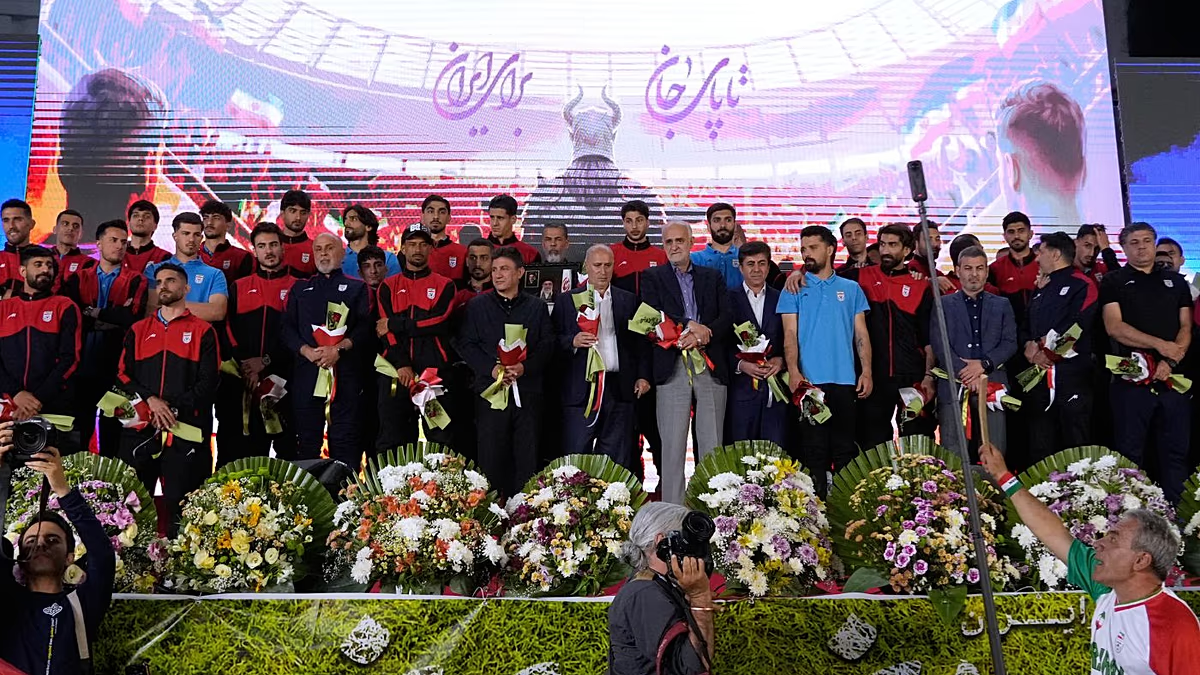
In a display of national pageantry that blurred the lines between sport and state, Iran’s national football team was given a formal send-off in Tehran this week ahead of the 2026 FIFA World Cup. The ceremony, however, was overshadowed by political tensions and stark uncertainties about the team’s very ability to compete. As large crowds gathered—so dense that players were initially unable to disembark from their buses—the event took on a distinctly ideological tone. Chants of “Death to America” echoed, and Hezbollah flags were waved among regime supporters, imagery so overt that a state-affiliated news agency later censored it from its broadcast. Against this backdrop, officials unveiled the new World Cup kit and spoke of patriotism and national dignity, even as the most pressing question hung unanswered: would the United States grant visas for the team to enter the country and play its matches?
The core issue is a logistical and diplomatic minefield. All three of Iran’s group-stage matches are scheduled to be played in the United States, a nation with which Iran is technically at war following the outbreak of a broader regional conflict in late February. To date, no visas have been issued for players or staff. This fear was compounded when Mehdi Taj, head of the Iranian Football Federation, was recently denied entry to Canada to attend a FIFA congress, a precedent rooted in the designation of Iran’s Revolutionary Guards (IRGC) as a terrorist organization by both Canada and the U.S. American officials have stated that individuals linked to the IRGC would not be permitted entry, casting a long shadow over the entire delegation. Federation officials publicly placed their hopes in FIFA, insisting the global governing body has a duty to intervene and separate sports from politics.
The political drama extended beyond visas into the realm of public narrative. During the ceremony, Mehdi Taj announced that Iranian-American singer Nasrollah Moein had agreed to record an anthem for the team. This attempt to project a unifying cultural message backfired spectacularly when Moein, based in Los Angeles, promptly denied the claim on social media, calling it a rumor. This episode highlighted the gap between the state’s desired narrative and reality, a theme also reflected in the mixed feelings many Iranians hold toward their national team. The team’s preparations have been severely disrupted by the ongoing war, with canceled fixtures, abandoned training plans, and the resignation of a foreign assistant coach, leaving the squad to play internal practice matches instead of competitive friendlies.
Even before the current geopolitical crisis, the team’s performance was under scrutiny. Recent friendly losses had led to calls from sports media, including outlets aligned with the Revolutionary Guards, for the replacement of coach Amir Ghalenoei. This sporting uncertainty is layered atop a complex and often fraught relationship between the national team and the Iranian people. The memory of the 2022 World Cup in Qatar is still fresh, where historic defeats to England and the United States were celebrated in streets across Iran as symbolic protests against the regime. This context means the team carries not just sporting hopes, but the weight of profound national divisions, representing a state that many of its citizens actively oppose.
As the ceremony concluded, officials expressed hope that Iran’s flag would be raised and defended at the tournament. Yet, the immediate path forward is fraught. The team is scheduled to travel to Turkey for a training camp and a friendly match, a plan that underscores their current limbo—preparing for a tournament they might not be allowed to attend. Federation Secretary-General Heydat Mombini voiced the anxiety shared by many, noting they had received no visa updates and were reliant on FIFA’s assurances. This sentiment was amplified by unverified reports, later denied, that the U.S. had rejected visas for Iraq’s national team, highlighting that Iran’s concerns are part of a broader regional tension impacting the supposedly apolitical world of sport.
Ultimately, the lavish farewell in Tehran was a spectacle of confident nationalism that belied a deep-seated insecurity. It was an event where “Death to America” was chanted for a team hoping for permission to enter America, where flags of a designated terrorist group were waved alongside the national football jersey, and where claims of unity were quickly contradicted. The Iranian team finds itself caught in a global political standoff, its fate hinging on diplomatic maneuvers far beyond the pitch. Their journey to the World Cup is no longer just about athletic preparation; it is a test of whether the unifying spirit of international sport can momentarily overcome the deep and divisive realities of geopolitics. For now, the players prepare in uncertainty, representing a nation at war, awaiting a verdict that will determine if they can even compete on the world’s biggest stage.