


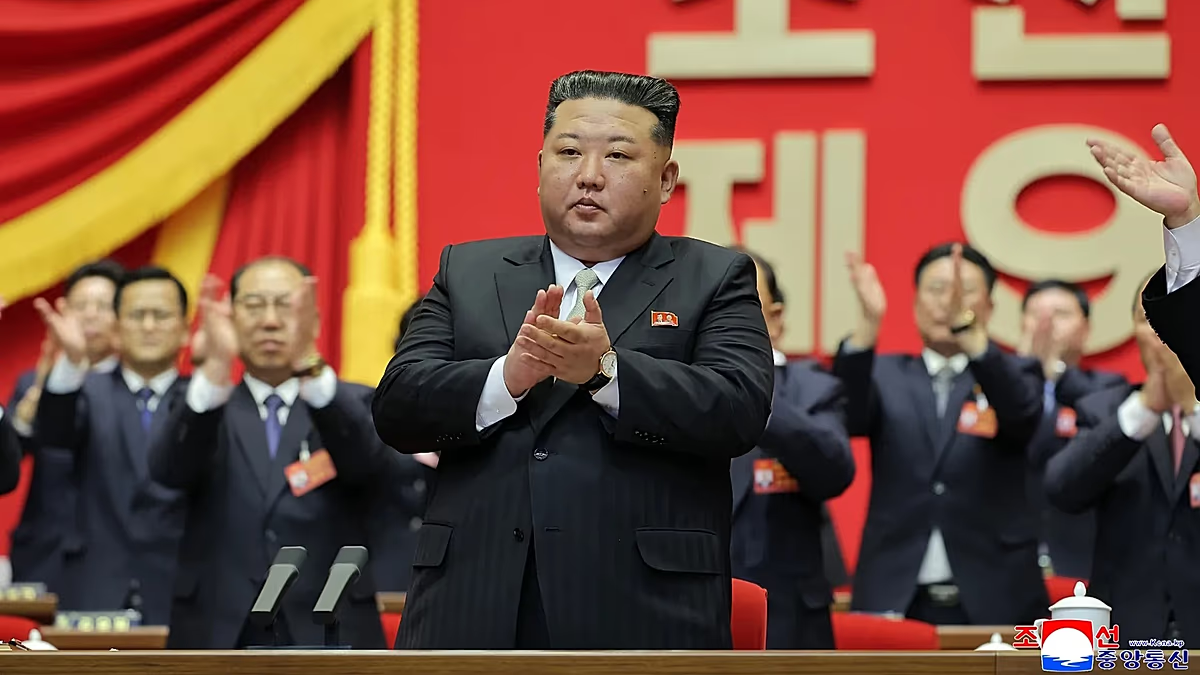
The Seoul Central District Court issued a significant ruling on Thursday, May 14th, 2026, ordering North Korean leader Kim Jong-un to pay damages totaling 105 million won (approximately €60,177) to five elderly plaintiffs. These men are not ordinary civilians; they are former South Korean soldiers who were captured during the Korean War (1950-53) and were forcibly held in North Korea for decades, never repatriated despite the armistice agreement. The court mandated a payment of 21 million won (€12,024) to each plaintiff, acknowledging the immense personal suffering they endured. This ruling marks the third such legal victory for former prisoners of war against the North Korean state, though it highlights the profound and unresolved wounds of a conflict that technically persists, as the war ended with an armistice, not a peace treaty.
The plaintiffs, including Koh Kwang-myun and Choi Ki-ho, are among only six known former South Korean POWs still alive and residing in South Korea, all now in their nineties. Their stories are harrowing testimonies of a forgotten chapter of history. Captured by Chinese communist forces during a reconnaissance mission, they were taken to North Korea. Koh endured years of forced labor, first at a prisoner-of-war camp and later at a coal mine in North Hamgyong Province, finally escaping in 2001 after nearly half a century. Choi Ki-ho similarly spent over five decades in forced labor in the region’s coal mines. Another plaintiff, Lee Sun-woo, suffered physical mutilation, losing three fingers during his capture. These individuals represent the human cost of a frozen conflict, men who lost their freedom, their homeland, and decades of their lives.
This legal action, while symbolic in its potential for actual compensation, is a powerful act of recognition. It follows a landmark 2020 case where former POW Han Jae-bok and two others won a ruling ordering North Korea to pay 42 million won. The court proceeded with the latest case via “public notification,” posting the legal documents in an official gazette after determining there was no practical way to notify Kim Jong-un or the North Korean government directly. This procedural step underscores the profound disconnect between the two nations and the inherent challenges in seeking justice from a regime that does not participate in the international legal order. The lawsuits themselves are acts of defiance, refusing to let these historical injustices fade into silence.
The practical outcome, however, remains deeply uncertain. As with the previous rulings, there is no clear mechanism for the plaintiffs to collect compensation from Pyongyang. Some have initiated legal processes to seize North Korean assets under South Korean control, such as copyright fees for state television broadcasts, but these efforts are complex and ongoing. The monetary award, therefore, serves more as a formal judicial condemnation of North Korea’s actions and a validation of the survivors’ plight than as a guarantee of financial remedy. It is a moral victory, affirming that their decades of forced labor and captivity were a grave injustice that merits accountability, even if that accountability is currently elusive.
Beyond the individual stories, this ruling casts a stark light on the enduring legacy of the Korean War. The five plaintiffs are a tiny remnant of thousands of South Korean soldiers who were never returned after the armistice, their fates ignored for decades. Their successful lawsuits challenge the narrative that the war is merely a frozen geopolitical issue; it is a continuing source of human tragedy. Each case forces the South Korean legal system and public to confront uncomfortable history, acknowledging that for these men, the war never truly ended. They lived it every day in the mines and camps of the North, and they continue to live it in their pursuit of belated justice.
Ultimately, these rulings are poignant symbols of resilience and the enduring demand for dignity. The men, in their nineties, are seeking not just financial compensation but historical rectification—a formal acknowledgement from the world that what happened to them was wrong. While Kim Jong-un and the North Korean state are unlikely to ever pay the damages, the South Korean court’s verdict stands as an official record of their suffering and a testament to their courage in speaking out. Their fight ensures that the story of the Korean War’s forgotten prisoners remains part of the living memory of the conflict, a human counterpoint to the diplomatic stalemate that still defines the Korean Peninsula.