

Here is a humanized and expanded summary of the provided content, structured into six paragraphs as requested.
Paragraph 1: A Return to Normality
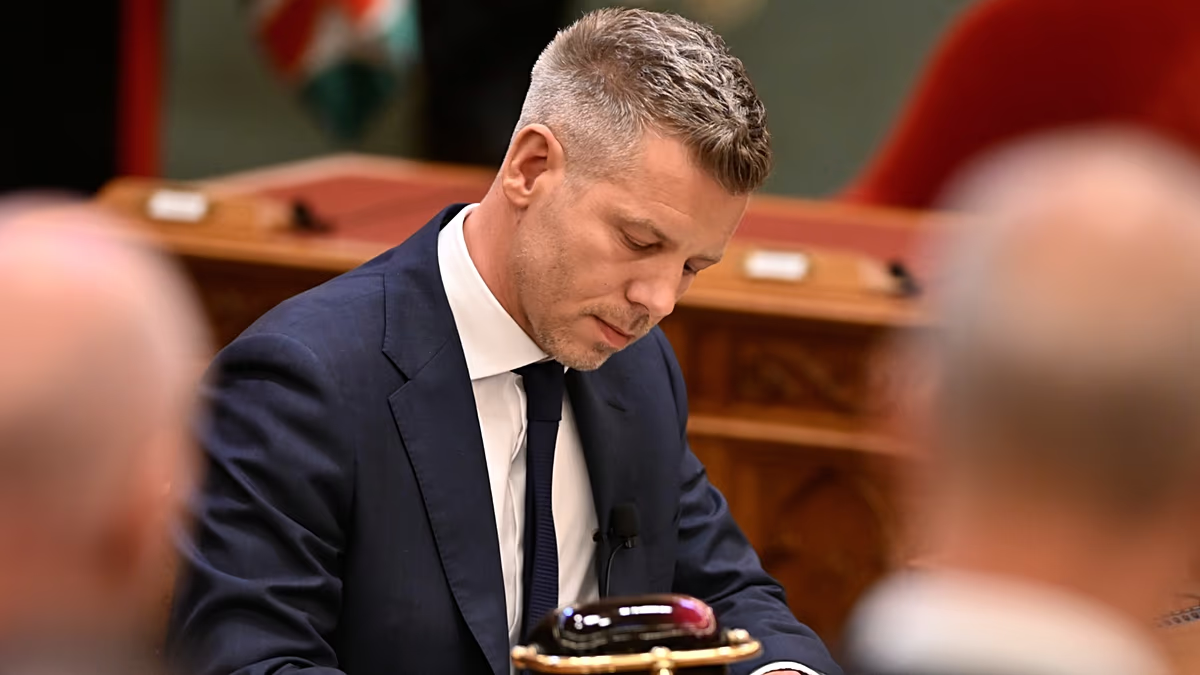
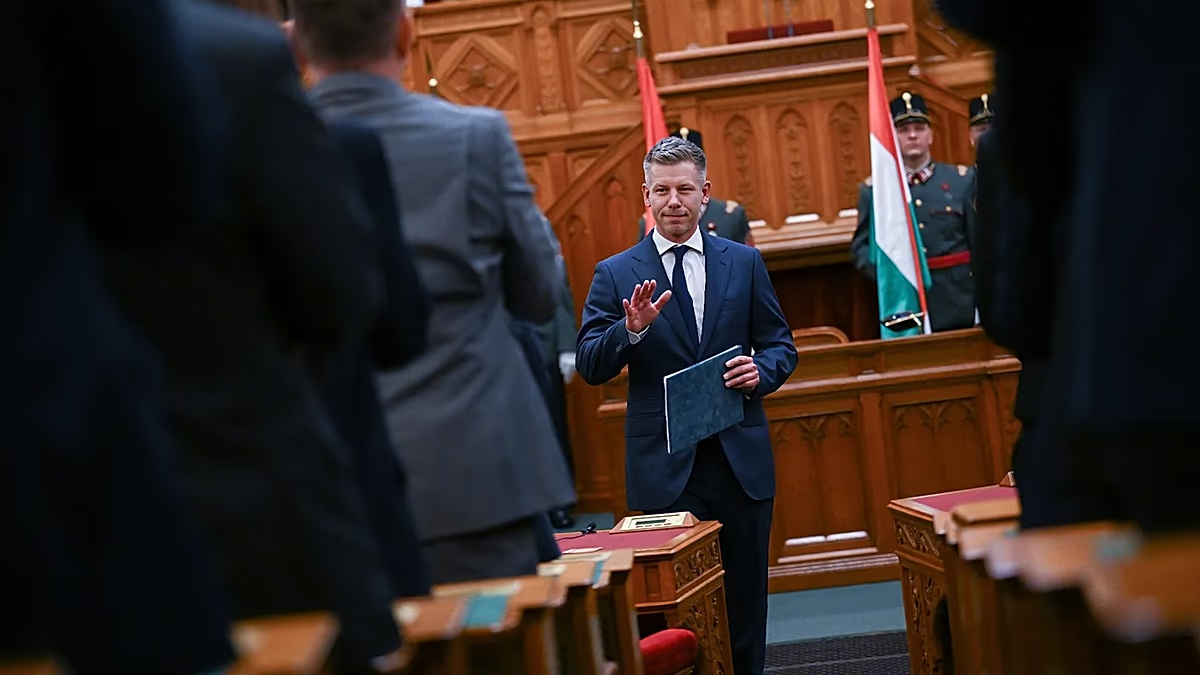
In a significant political shift, Hungary’s new government under Prime Minister Péter Magyar has formally ended the country’s state of emergency, a framework that had defined Hungarian governance for over four years. Magyar framed this move as a decisive return to “normality,” marking a clear departure from the policies of his predecessor, Viktor Orbán. The announcement, made via social media, was presented not just as a procedural change but as a symbolic restoration of regular parliamentary order. For Hungarians, this signifies the closing of a prolonged chapter where extraordinary governmental powers were the norm, potentially ushering in a period of recalibrated political life and renewed scrutiny of executive authority.
Paragraph 2: The Legacy of Emergency Rule
The state of emergency was a powerful tool first invoked by Orbán’s government in March 2020, at the onset of the COVID-19 pandemic. It granted the cabinet the authority to rule by decree, bypassing parliament to swiftly implement health and economic measures. This approach, while defended as necessary for crisis management, drew intense criticism from the European Union and human rights organizations, which argued it undermined democratic checks and balances. In 2022, following Russia’s full-scale invasion of Ukraine, the framework was extended and repurposed, with Orbán citing security and humanitarian risks emanating from the neighboring conflict. This continuous state of exception, lasting six years in various forms, became a central feature of Orbán’s tenure and a point of contention in Hungary’s relationship with European institutions.
Paragraph 3: A Dramatic Shift in Foreign Policy Tone
Concurrent with ending the domestic emergency, the Magyar government executed a stark and immediate shift in its posture toward Moscow. In a move that breaks sharply with the past decade of Hungary’s conspicuously Russia-friendly stance under Orbán, the government summoned Russian Ambassador Evgeny Stanislavov. The summons was a direct response to a massive Russian drone attack on Wednesday that struck Ukraine’s Transcarpathia region, which shares a border with Hungary and is home to a significant ethnic Hungarian minority. This action represents more than a diplomatic formality; it is a deliberate public rebuke, signaling a fundamental reassessment of Budapest’s relationship with the Kremlin under its new leadership.
Paragraph 4: Condemnation and a Direct Message to Moscow
Prime Minister Magyar left no ambiguity about the reason for the summons. At a press conference, he stated, “The Hungarian government strongly condemns the Russian attack on Transcarpathia.” He instructed Foreign Minister Anita Orbán to convey this condemnation directly to Ambassador Stanislavov and to demand answers. Specifically, Magyar stated she would ask “for information on when Russia and Vladimir Putin plan to finally end this bloody war.” This language—explicitly naming Putin and framing the conflict as a “bloody war” to be ended—contrasts profoundly with the often ambiguous, non-confrontational, and at times Putin-sympathetic rhetoric that characterized Orbán’s communications on the conflict, marking a new era of diplomatic phrasing from Budapest.
Paragraph 5: The Human Cost and European Solidarity
The attack that prompted this policy shift was one of the largest aerial assaults of the war. Russia launched a prolonged, daytime barrage involving at least 800 drones across approximately 20 Ukrainian regions. The strikes on Transcarpathia brought the war palpably closer to Hungary’s doorstep, killing at least six people and wounding dozens, including children. Ukrainian President Volodymyr Zelenskyy acknowledged Hungary’s diplomatic response as an “important message,” thanking Magyar for his stance. Zelenskyy emphasized that the attack demonstrated Moscow’s role as “a common threat not only to Ukraine, but also to neighbouring countries and Europe as a whole,” framing the conflict in terms of collective European security—a perspective the new Hungarian government now appears to share more openly.
Paragraph 6: Charting a New Course
Together, these two actions—the termination of emergency rule and the summons of the Russian ambassador—outline the initial contours of Péter Magyar’s premiership. Domestically, the government is seeking to project an image of restored democratic normalcy and legal stability after years of rule by decree. In foreign policy, it is demonstrating a willingness to recalibrate Hungary’s position within Europe and NATO, adopting a more conventionally aligned stance against Russian aggression, especially when it directly impacts Hungarian interests or ethnic kin. While the long-term trajectory of these policies remains to be seen, the first steps suggest a conscious effort to distinguish the new administration from its predecessor both at home and on the international stage, navigating a path toward what Magyar defines as “normality” after a period of sustained crisis governance.