
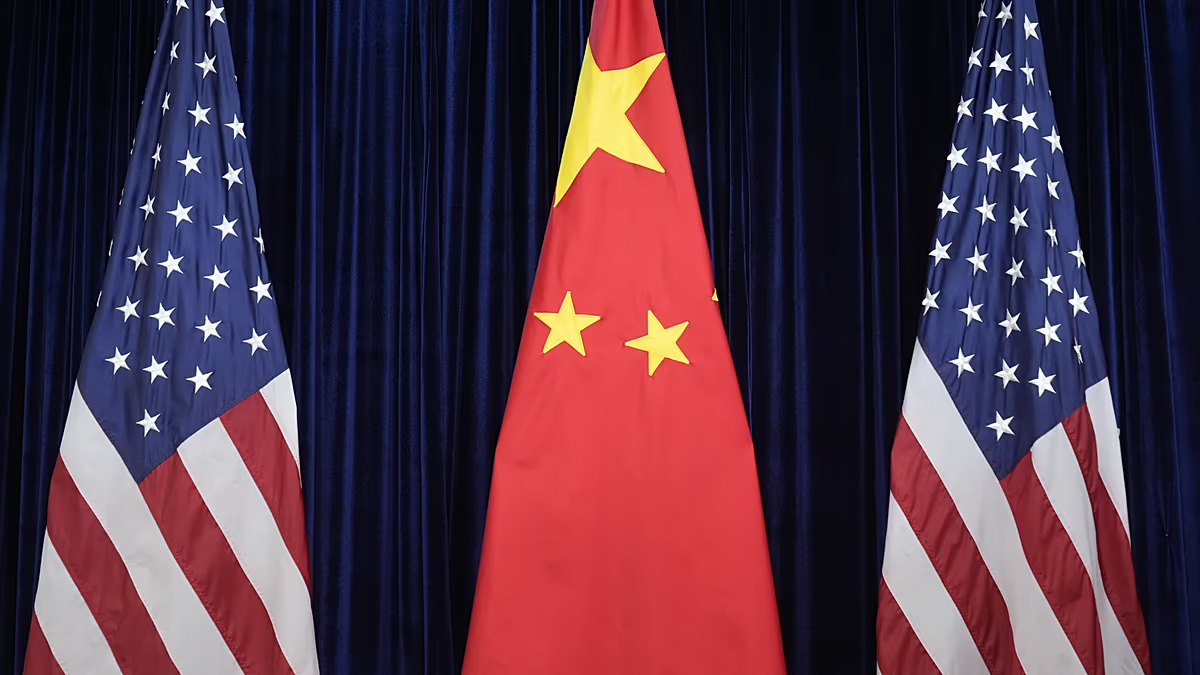


For Europe, the upcoming meeting between former U.S. President Donald Trump and China’s President Xi Jinping is far more than a bilateral tête-à-tête. It is a tense demonstration of a new global reality where the European Union, despite its economic heft, risks being muscled to the sidelines. The overarching fear in Brussels, Berlin, and other European capitals is that these two superpowers, engaged in fierce rivalry, might still strike tactical, self-serving deals over trade, technology, energy, and security. In such negotiations, European interests could be treated as an afterthought, or worse, as acceptable collateral damage. This leaves Europe in an unenviable, potentially lose-lose position: either frozen out of agreements that shape critical global markets or forced to weather the storm of escalated conflict between Washington and Beijing.
The most acute and immediate concern is one of industrial survival, centered on the supply of critical raw materials, most notably rare earths. These minerals are the invisible foundation of modern life and strategic autonomy, essential for everything from electric vehicles, semiconductors, and wind turbines to advanced defense systems. China maintains a dominant stranglehold on this supply chain. European officials are haunted by the possibility that Trump and Xi could broker a deal guaranteeing preferential access for American industries to Chinese rare earths, while Europe remains exposed. This vulnerability is not theoretical; German and Japanese industries have already felt the pinch from Chinese export controls on these strategic materials. As Ilya Epikhin of Arthur Little notes, China appears to be selectively managing exports to preserve leverage, particularly over supply chains linked to defense or advanced technology—precisely the sectors Europe is desperate to fortify.
Recognizing this peril, Europe has begun the long and arduous journey to diversify its supply chains. Nations like Germany and Japan are investing in mining and processing projects from Africa to Australia. However, consultants and analysts warn that building a viable, scaled alternative to China’s ecosystem is the work of a decade, not a year. David Merriman of Project Blue starkly warns, “The situation looks set to get worse before it gets any better.” Europe’s own ambitions, codified in the 2023 Critical Raw Materials Act with targets for local production, are hampered by a harsh reality. An EU Institute for Security Studies report is blunt: Europe is lagging. It has not adopted the aggressive, state-backed financial policies needed to make its strategic projects viable in the face of China’s subsidized dominance. The political will exists, but the practical toolkit lags far behind.
Beyond raw materials, the summit nightmare extends to Europe’s core manufacturing sectors. A potential “managed trade” agreement between the U.S. and China could involve America accepting continued flows of certain Chinese goods in exchange for concessions elsewhere. The result? A diverted tidal wave of Chinese industrial overcapacity—particularly in electric vehicles, batteries, and solar panels—could crash directly onto European shores. The price pressure is already severe; Chinese EVs can be produced 25% to 50% cheaper than European models, with cars like the MG4 undercutting a comparable Volkswagen ID.3 by thousands of euros. If the U.S. market becomes less accessible to China through new Trump tariffs, the incentive for Chinese manufacturers to aggressively target Europe intensifies exponentially, threatening entire industries and thousands of jobs.
The dynamic of the talks themselves deepens European anxiety. As Jonas Parello-Plessner of the German Marshall Fund observes, “Realistically, the Trump-Xi talks are becoming very bilateral. And one thing is certain: Trump will only speak for himself.” This transactional, unilateralist approach leaves little room for consultation with traditional allies. Chinese officials, having navigated Trump’s first term, are now reportedly more adept at wielding their economic power, warning of immediate retaliation to U.S. actions. This creates a vortex where Europe has minimal influence. A renewed and escalated U.S.-China trade war is equally perilous, damaging European industries through shattered global demand, broken supply chains, and financial market chaos. In Parello-Plessner’s grim assessment, “If the Chinese play hardball with Trump, Europe will have nothing to gain.”
Confronted with these stark scenarios, European leaders are rallying a defensive posture. EU Trade Commissioner Maroš Šefčovič has vowed the bloc will “fight tooth and nail for every European job” and is preparing to strengthen industrial policy and deploy defensive trade instruments. There is a clear resolve not to be passive victims. Yet, the underlying and unsettling message of the Trump-Xi summit is a profound one for Europe: a significant portion of its economic future is being decided in Washington and Beijing by leaders with their own, inward-looking priorities. The summit crystallizes the central challenge of Europe’s strategic era—to assert true sovereignty and build resilient leverage in a world where it is no longer the rule-maker, but a powerful player caught between two competing superpowers who are reshaping the rules around them.