

The Unraveling of a Titan: Florentino Pérez’s Press Conference and the Political Firestorm It Ignited
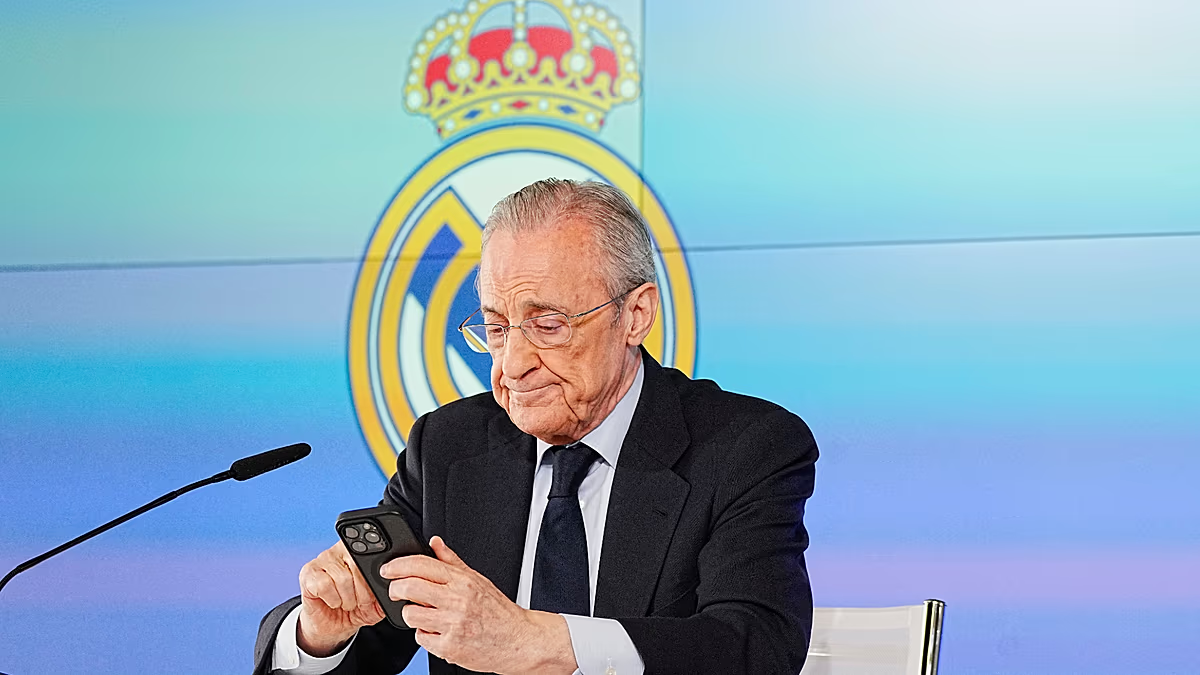
In a rare and tumultuous press conference, Real Madrid president Florentino Pérez, often described as one of the most powerful men in European football, transformed a routine post-season address into a political maelstrom. The event, intended to address a disastrous season where Real Madrid failed to reach the Champions League final and lost the La Liga title to Barcelona, quickly spiraled into a spectacle of confrontation. Pérez’s opening declaration—a firm refusal to resign—set the tone. Instead, he announced he would stand in upcoming club elections, a statement of unwavering control. Yet, what followed was not a strategic review or a blueprint for renewal, but a visceral, angry performance that would dominate Spanish media and draw comparisons to the most divisive political figures of our time.
Visibly agitated, the 79-year-old president launched a broadside against the media, particularly focusing on the newspaper ABC. He recounted a dressing-room incident involving players Aurélien Tchouaméni and Federico Valverde that ended with both in hospital, criticizing the coverage as intrusive. His confrontation escalated into a personal verbal exchange with ABC journalist David Sánchez de Castro, culminating in a dramatic announcement: he would cancel his subscription to the paper, a gesture he framed as an act done “in his father’s honour.” But his most incendiary remarks were directed at individual journalists. Referring to two articles about the club, he dismissively noted, “One of them was written by a woman. I don’t know if she knows anything about football.” Later, pointing to another journalist, he quipped, “That girl there, ask a question. The rest of you are very ugly.” These comments ignited immediate condemnation, with Spain’s leading radio station, Cadena SER, decrying the “arrogance and sexism” of his words.
The reaction from the media and political circles was swift and severe. ABC described Pérez’s statements as “outrageous attacks” intended to deflect from the club’s failures. The targeted journalist, María José Fuenteálamo, expressed her shock, clarifying she had merely written an opinion piece. Beyond the sexism, commentators dissected the performance’s underlying strategy. Some, like El Mundo, drew a direct parallel to Donald Trump, labeling it a “Trumpist exercise” in bombast and personal grievance. The theory emerged that this was a calculated, albeit risky, attempt to shift public attention away from the club’s second consecutive trophyless season—a narrative of external enemies and systemic corruption rather than internal failings.
Pérez’s diversionary tactic reached its zenith with an explosive accusation against Barcelona. He labeled their alleged corruption as “the biggest scandal in football history,” claiming “seven league titles were stolen” from Real Madrid as a result. He announced the submission of a 500-page dossier to UEFA, aiming to elevate a domestic rivalry into a continental legal battle. This move, however, risked backfiring spectacularly, prompting Barcelona to consider legal action against Pérez himself. Meanwhile, sports outlets like MARCA, traditionally close to Real Madrid, noted a glaring omission in his lengthy address: any substantive self-criticism or coherent analysis of the club’s own crisis. They described the conference as “confusing” and “chaotic,” a performance where accusation replaced accountability.
The episode lays bare the immense cultural weight of Real Madrid and its president. The club is a global brand, a symbol of Spanish identity and sporting excellence, with a history unmatched in European football. Pérez, its longest-serving president, embodies that institution’s power. His press conference, therefore, was not merely a football executive speaking to reporters; it was a powerful figure leveraging his platform in a manner that resonated far beyond sports journalism. The comparisons to Trump are not superficial; they speak to a style of leadership that uses personal insult, media vilification, and grandiose claims of victimization to rally a base and control a narrative, blurring the lines between sports management and political theater.
Ultimately, this press conference transcends a simple story of a bad season. It represents a moment where the carefully managed facade of a corporate football giant cracked, revealing a more raw, contentious, and politically charged reality. Whether a calculated gambit or a genuine loss of composure, Pérez’s actions have ensured that the conversation is no longer about missed trophies, but about power, media relations, gender dynamics, and the very language of leadership in the modern public sphere. The fallout continues, challenging not just Real Madrid’s strategy, but the model of how such institutions engage with the world that watches them.