

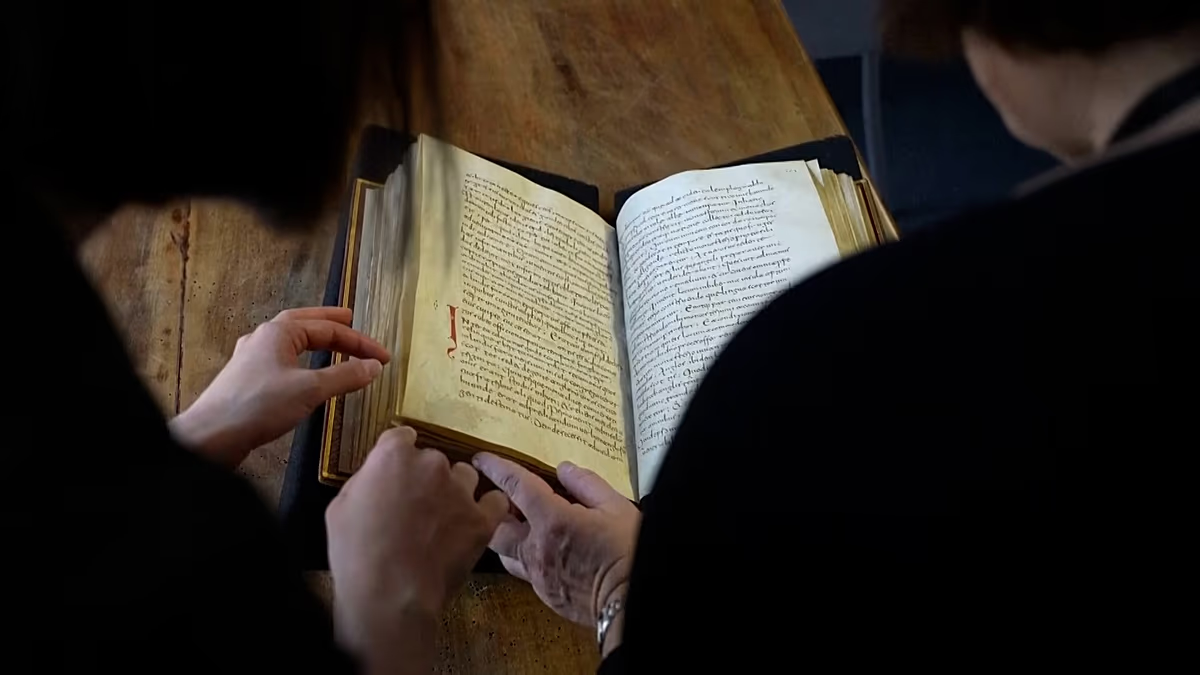


In the quiet halls of the National Central Library of Rome, a profound connection to the very dawn of the English language has been rediscovered. Scholars have identified a 9th-century manuscript as a long-lost copy of Cædmon’s Hymn, the oldest known poem in English. Composed in the 7th century, the brief, nine-line verse is attributed to Cædmon, a humble cowherd from the monastery of Whitby, who, according to legend, received the gift of poetic song in a divine dream. This hymn of praise for God’s creation was preserved for posterity by the Venerable Bede, a Northumbrian monk, who included both a Latin translation and the original Old English text in his seminal 8th-century work, the Ecclesiastical History of the English People. The rediscovery of this manuscript, hidden for centuries, is not merely the finding of a physical object; it is the recovery of a foundational piece of England’s literary soul, offering a tangible link to the moment English poetry first found its voice.
The journey of this English treasure to an Italian library is a tale as fascinating as the poem itself. It speaks to the vibrant intellectual currents of medieval Europe. The copy was meticulously transcribed in the 9th century by a monk at the Benedictine abbey of Nonantola, a renowned center of learning in northern Italy. This monk, working from an earlier version of Bede’s History, carefully integrated the Old English poem directly into the main body of his Latin text. For reasons lost to time, this particular manuscript then faded from scholarly view, presumed lost forever. Its rediscovery was made possible by the digital age: when the Rome library digitized its vast archives, two experts from Trinity College Dublin, Dr. Elisabetta Magnanti and Dr. Mark Faulkner, were able to study it online from Ireland, leading them to Rome to finally hold the ancient pages in their hands.
This Roman manuscript is of extraordinary scholarly importance because of how it presents the poem. While the two oldest surviving copies—held in Cambridge and St. Petersburg—contain the Old English text added marginally or at the end, the Rome copy is the earliest known version to weave the vernacular hymn directly into the flow of Bede’s Latin narrative. As Dr. Faulkner explains, prior to this find, the earliest such integrated copy was from the 12th century; this new discovery pushes that date back by three hundred years. This signifies that within a century or two of Bede’s death, continental scribes already recognized Cædmon’s Hymn as an integral, inseparable part of the historical record, not just a peripheral note. Its placement within the main text is a powerful testament to the cultural weight this English poem carried across the Channel and the Alps at a remarkably early date.
Furthermore, the manuscript acts as a unique window into the networks of knowledge, pilgrimage, and cultural exchange that connected Anglo-Saxon England to the continent. The presence of an Old English poem in a 9th-century Italian abbey vividly illustrates the movement of people and ideas. Monks, pilgrims, and scholars traveled between these centers of faith and learning, carrying books with them. The textual variations in this copy, including its distinctive use of punctuation with points and full stops not found in other versions, help scholars map the “family tree” of Bede’s work as it was copied and disseminated. It is physical evidence of a medieval Europe far more interconnected than we often imagine, where the product of a Northumbrian cowherd’s inspiration could be studied and reverently preserved in the heart of Italy.
The discovery, the first of an early copy of Cædmon’s Hymn in over a century, underscores the transformative power of making cultural heritage globally accessible. Dr. Andrea Cappa of the National Central Library of Rome emphasizes that this find is a direct result of their project to digitize thousands of rare books and manuscripts. By placing these treasures online, the library has democratized research, allowing experts from Dublin to make a landmark discovery without an initial costly expedition. This collaborative model, as Dr. Cappa notes, is just a starting point. The digital archive now stands as an open invitation to international scholars across countless disciplines, promising that other long-hidden stories and texts await revelation in its vast collection, fostering a new era of cooperative scholarship.
Ultimately, the rediscovery of this manuscript transcends academic intrigue. It is a poignant reminder of the enduring power of a simple song of creation. Cædmon’s Hymn, born in a moment of divine inspiration to a man who felt himself outside the poetic tradition, miraculously survived wars, the passage of centuries, and a journey across a continent. That a copy made by an Italian monk over twelve hundred years ago can now be read and pondered in our digital age is a testament to the human compulsion to preserve beauty and truth. It connects us—readers of the 21st century—in an unbroken chain of wonder back to the 7th-century Northumbrian night when, as Bede told it, a cowherd received a gift and forever changed the landscape of English literature. This single parchment in Rome is not just a historical artifact; it is a resonant echo of that first, humble voice.