



Of course. Here is a humanized and expanded summary of the content, presented in six paragraphs.
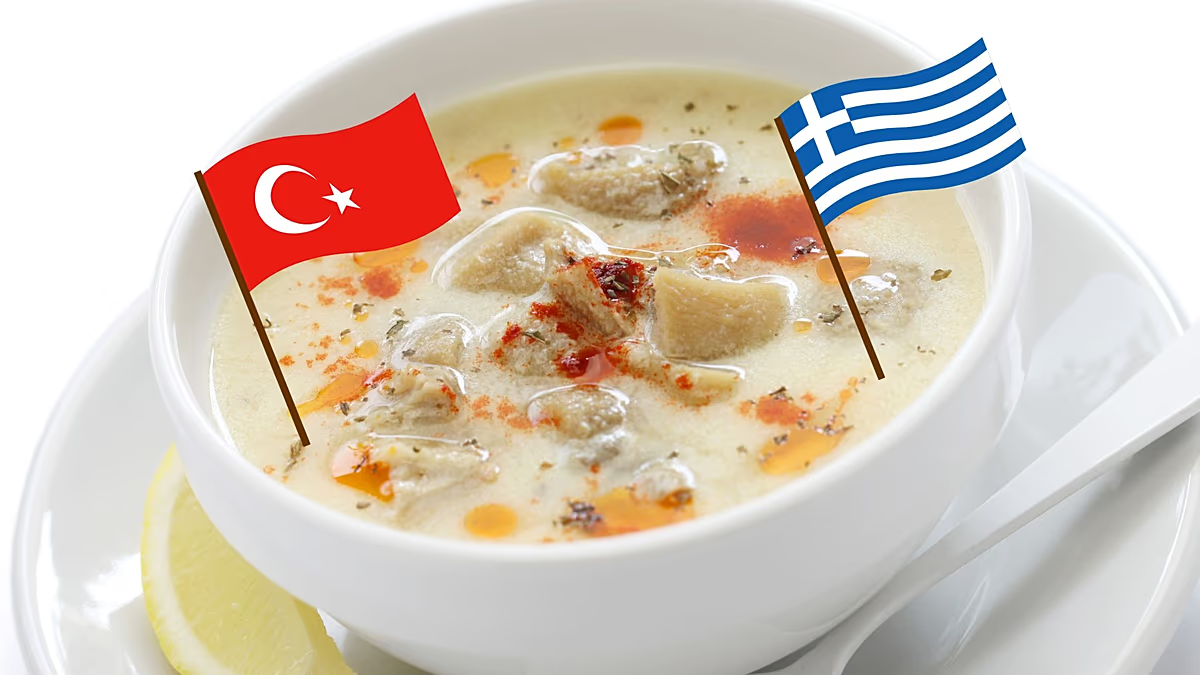
In the grand, sun-drenched kitchens of the Mediterranean, where culinary debates are as heated as the midday sun, a simmering dispute has once again reached a gentle boil. It does not concern a glittering island or a maritime boundary, but something far more humble, visceral, and universally understood: a steaming bowl of tripe soup. In Greece, it is cherished as “patsa,” a robust, garlicky remedy. Just across the Aegean Sea, in Turkey, it is celebrated as “iskembe çorbası,” a tangy, vinegared comfort. To an outsider, it might appear as a simple argument over ownership of a recipe. But to those immersed in the region’s deep history, it is a poignant, tangled tale of shared heritage, national identity, and the quiet ways food becomes a vessel for memory.
The dish at the heart of this contention is, by its very nature, a testament to ingenuity and necessity. Tripe—the edible lining of a ruminant’s stomach—is the quintessential off-cut, a food born not from luxury but from a profound respect for the animal and a need to waste nothing. For centuries, in the bustling markets of Constantinople, the port towns of Anatolia, and the mountainous villages of the Balkans, this unassuming ingredient was transformed. Simmered for hours until tender, its broth is infused with tradition. The resulting soup is more than mere sustenance; it is a culinary alchemy that turns the discarded into the divine, a practice deeply embedded in both Greek and Ottoman culinary philosophy. This common origin in resourcefulness is the first clue that the story is not one of clear creation, but of intertwined evolution.
Where the narrative—and the flavor profiles—truly diverge is in the bowl. Here, national character expresses itself through spice and garnish. The Greek patsa is often a study in bold, cleansing simplicity. The milky-white broth, achieved through a long, careful simmer, is typically laden with generous amounts of raw, crushed garlic and a splash of sharp red wine vinegar served on the side. It is bracing, direct, and purposeful. Turkish iskembe, while also starting from that same foundational broth, frequently embraces a more complex and customizable aromatic profile. It is famously served with a trio of condiments: a vibrant, garlic-infused vinegar sauce (sirkeli sarımsak), a fiery red pepper paste (acılı sos), and a dusting of dried mint. Each spoonful becomes a personal creation, balancing tang, heat, and fragrance. This divergence in presentation mirrors cultural approaches: one of definitive, communal remedy, the other of individualized, artistic assembly.
The soup’s legendary status as the ultimate hangover cure is a universal point of agreement, a rare moment of cross-cultural harmony. From the lively ouzeries of Athens to the all-night meyhanes of Istanbul, the ritual is remarkably similar. After a night of spirited indulgence, friends will gather in the early hours, often in specialized, no-frills establishments that have been serving nothing but this curative broth for generations. The science, as embraced by folk wisdom, is sound: the hot, easily digestible broth rehydrates, the protein provides sustenance, and the garlic or vinegar offers a metabolic wake-up call. It is a social sacrament of recovery, a shared, steamy confession of the night before. In this function, the soup transcends nationality, speaking a common language of human experience.
Yet, why does the question of origin provoke such gentle, persistent debate? The answer lies in the layered and often painful history of the region. For centuries, Greeks and Turks lived side-by-side under the vast umbrella of the Ottoman Empire, their culinary traditions blending and influencing one another in a constant, delicious exchange. The fall of the empire and the traumatic population exchanges of the early 20th century severed communities but could not sever taste memories. What was once a shared dish of the imperial capital, Constantinople (Istanbul), became a cherished heirloom carried by refugees in opposite directions. Each community then nurtured it, refined it, and ultimately claimed it as a symbol of their own resilience and continuity. Thus, arguing over the soup’s origin is, in a profound sense, a proxy for deeper historical conversations about legacy, loss, and belonging.
Ultimately, the story of patsa and iskembe is not a conflict to be won, but a beautiful paradox to be savored. It is a dish that proudly wears its dual citizenship, a living artifact of a time when cultures were inextricably linked. The simmering pot in a back-alley taverna in Thessaloniki and the one steaming in a corner restaurant in Beyoğlu are not rivals, but long-lost relatives. They remind us that the deepest culinary traditions are often born from the humblest ingredients and the most complex histories. Perhaps the true lesson is to be found not in declaring a victor, but in pulling up a chair in both countries, taking a spoonful of each version, and appreciating how the same foundational truth—a nourishing broth for the body and soul—can be expressed in two distinctly beautiful, and forever connected, ways.