


The Global Canvas of Venice: A Guide to the Biennale’s Most Anticipated Satellite Exhibitions
The 61st Venice Biennale is not merely an art exhibition confined to the official pavilions of the Giardini and Arsenale. It is a city-wide phenomenon, a temporary and breathtaking transformation where every corner of Venice becomes a stage for contemporary creativity. From the grandeur of historic palaces to the shimmering surfaces of its canals, the entire city pulses with artistic energy during this period. Beyond the main curated event, a constellation of independently organized “collateral” exhibitions erupts across Venice. These satellite shows are vibrant and essential, not peripheral add-ons but core components of the Biennale experience. Many are already heralded as the most significant art events of the year. To navigate this glorious profusion, a visitor must have a plan. Here is a guide to some of the most compelling artistic journeys awaiting discovery beyond the official Biennale gates.
One such journey begins at the Palazzo Barbaro in San Marco, a fifteenth-century patrician residence now hosting a delicate bridge between Indian spiritual tradition and Venetian context. The exhibition presents “Pichwai,” a centuries-old, intricate textile art form from Rajasthan. Originally, these large painted cloths hung behind temple idols, depicting rituals, seasons, and sacred geographies with devotional detail. Under the stewardship of cultural patron Pooja Singhal, this fragile heritage is being gently revived and reimagined. Ten large-scale works reinterpret the 400-year-old genre, translating its symbolic language from the havelis of Nathdwara to the architecture and atmosphere of Venice itself. This exhibition not only sustains master craftspeople but also perpetuates Venice’s historic role as a cultural confluence, placing a living textile tradition into the international spotlight with profound respect and contemporary relevance.
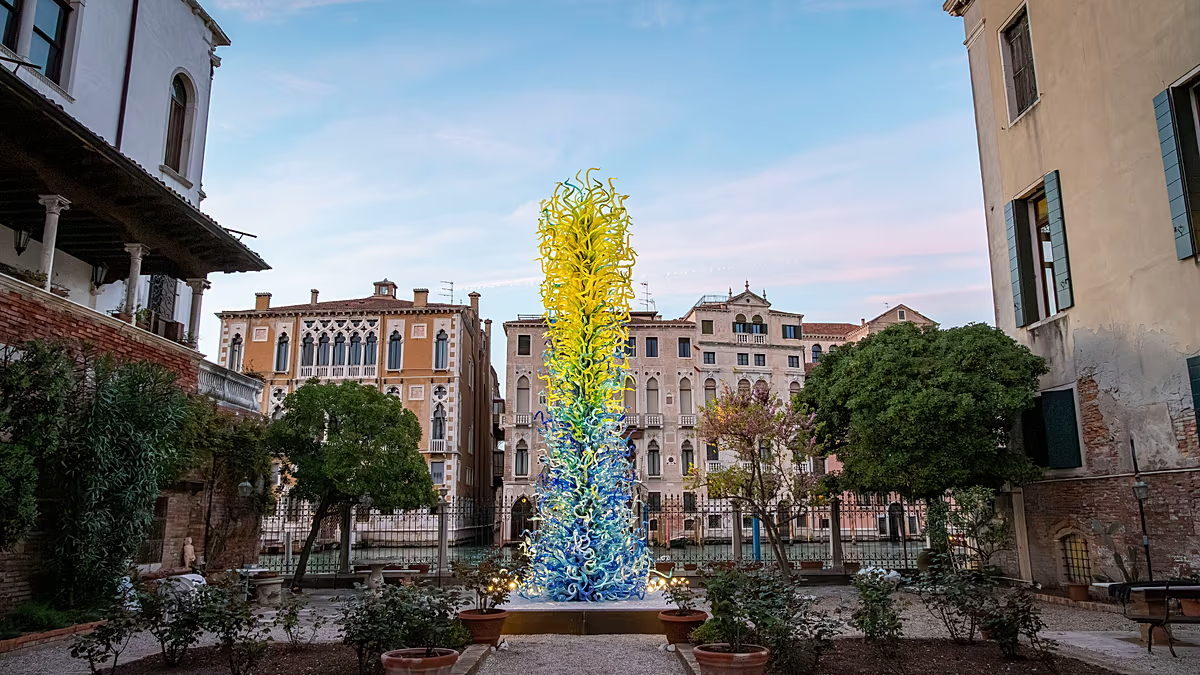
Meanwhile, the waters of Venice will once again become a gallery for American artist Dale Chihuly, thirty years after his first iconic interventions in the city’s canals. Presented by leading glass institutions, CHIHULY: Venice 2026 will feature three monumental new outdoor chandeliers installed in palazzo gardens along the Grand Canal, all visible from the Accademia Bridge. These towering works, reaching up to nine and a half meters in height, resemble giant, tendrilled aquatic plants in shimmering gold and marine blue. They promise a spectacular dialogue between organic form and Venetian architecture, transforming the city’s most famous waterway into a scene of fantastical luminosity. By night, their bioluminescent-like lighting will offer an entirely new, magical perspective, ensuring that Chihuly’s return is not just a revisit but a dramatic evolution of his conversation with this unique city.
In the Magazzini del Sale along the Dorsoduro district, a powerful and urgent meditation on gender, myth, and violence unfolds. Commissioned by the Kiran Nadar Museum of Art, Kyoto Prize laureate Nalini Malani presents Of Woman Born, a “thought chamber” inspired by the Greek myth of Orestes. Malani reflects on this ancient tale—where a son murders his mother and is spared punishment by a goddess—and its chilling resonance in contemporary conflicts where accountability is scarce and women disproportionately bear the brunt of patriarchal violence. She translates this into an immersive, continually changing environment of 67 animations, crafted from over 30,000 iPad drawings, projected onto the walls. Accompanied by a twenty-minute soundscape of women’s voices, the space becomes a layered, visceral experience where viewers navigate superimpositions of image and sound to conjure their own narratives from this profound critique of history and power.
For a deep engagement with the very painting tradition that Venice helped birth, one must visit the International Gallery of Modern Art at Ca’ Pesaro. Here, a landmark exhibition dedicates itself to British painter Jenny Saville, marking her first major show in Venice. Saville’s practice is deeply rooted in the history of Italian art, with a particular connection to the corporeal, coloristic mastery of the Venetian school. Her monumental canvases, tracing her career from the 1990s to the present, engage directly with the great masters housed within the city’s walls. The exhibition creates a dynamic, physical dialogue between contemporary figurative painting and the inherited legacy of Titian, Tintoretto, and others. In a fitting conclusion, the final room presents a previously unseen cycle of works created by Saville as a specific homage to Venice itself, sealing this profound artistic conversation between past and present, visitor and host.
These exhibitions—spanning revived craft, monumental sculpture, immersive digital installation, and contemporary painting—illustrate the true scope of the Biennale’s effect. They demonstrate that Venice during this period is not a city with an art show, but a city that is an art show. Each project, in its own way, leverages Venice’s unique fabric—its palaces, its canals, its history, its mythic atmosphere—as both backdrop and active participant. To experience the Biennale fully is to wander beyond the central venues, to allow these satellite exhibitions to guide you through a deeper, more varied understanding of what contemporary art can be when intertwined with one of the world’s most evocative settings. They ensure that the art of the Biennale is not viewed, but lived, echoing through the calli and canals long after one leaves the gallery spaces.