
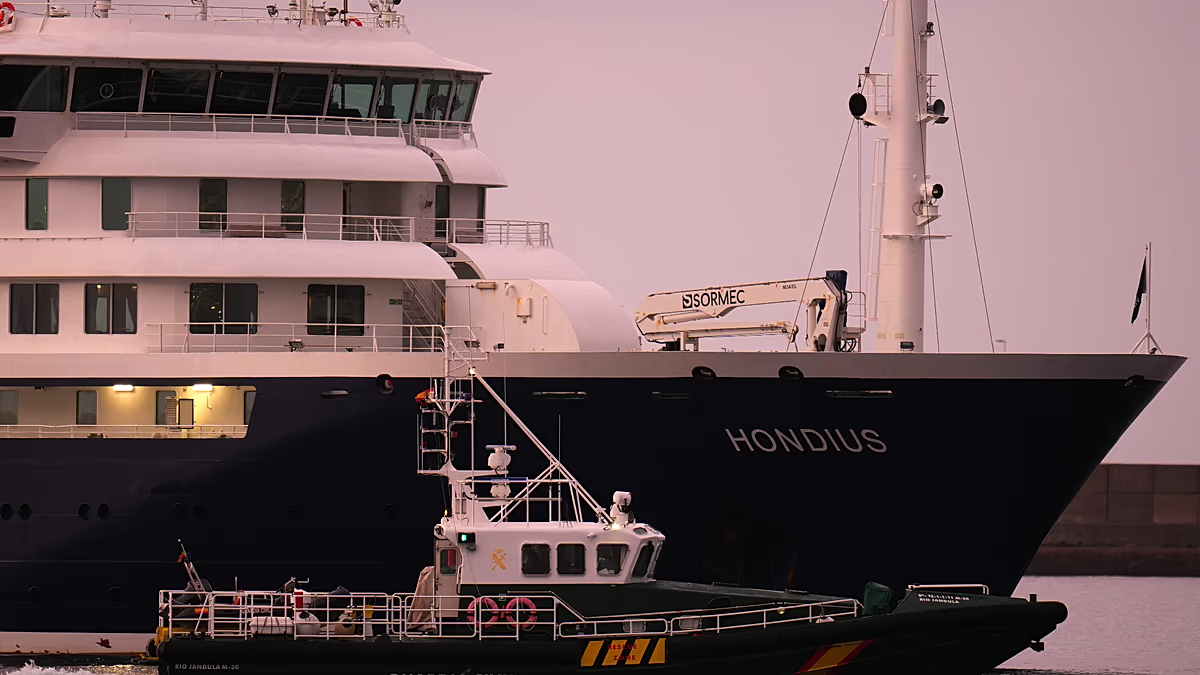


A Dutch cruise ship, the MV Hondius, arrived at the port of Granadilla on the Spanish island of Tenerife on Sunday, concluding a harrowing Atlantic voyage overshadowed by a deadly outbreak of hantavirus. The ship, which had departed from Ushuaia, Argentina, on April 1st, became the site of a rare and tragic public health event, resulting in the deaths of three passengers—a Dutch couple and a German woman. This prompted a complex international response and a carefully managed evacuation plan for the nearly 150 people on board, who would now be flown home from the Canary Islands after weeks at sea under a shadow of anxiety.
The outbreak has drawn significant global attention, primarily due to the specific strain of the virus involved. The World Health Organization confirmed that the Andes virus, the only type of hantavirus known to transmit from person to person, was present among those who tested positive. This characteristic heightened concerns about the potential for wider spread. In response, WHO officials, including Director-General Dr. Tedros Adhanom Ghebreyesus who traveled to Tenerife, worked to balance vigilance with reassurance. They classified everyone aboard as a “high-risk contact” but consistently emphasized that the risk to the general public in the Canaries and beyond remained low. Dr. Tedros directly addressed public fears in an open letter, stating plainly, “This is not another Covid,” aiming to prevent panic while underscoring the seriousness of the controlled operation.
Spanish authorities implemented stringent measures to ensure the evacuation posed no threat to local communities. Health and interior ministers outlined a plan where evacuees would be transported “by nationality groups” through completely sealed corridors to waiting flights, with no contact with the local population. A maritime exclusion zone was established around the vessel at port. This meticulous logistical effort, observed by Dr. Tedros who expressed confidence in Spain’s readiness, was designed to safely end the shipboard quarantine. The vessel itself, after disembarking its passengers and some crew, was scheduled to continue its journey to the Netherlands with a reduced crew.
The international web of contact tracing expanded far beyond the ship itself, illustrating the globalized nature of modern travel. Health agencies across multiple countries worked to track down passengers who had disembarked earlier in the voyage, as well as their contacts. One notable incident involved a KLM flight attendant who, after contact with an infected passenger, developed mild symptoms but ultimately tested negative. That passenger, the wife of the first fatality, had been on a flight from Johannesburg to the Netherlands but was removed before takeoff and later died in a South African hospital. Meanwhile, a woman on that same flight, now in eastern Spain, was hospitalized in isolation with symptoms and undergoing testing. Authorities in Singapore reported two of their residents who had been on the cruise tested negative but would remain in quarantine, and even the remote island community of Tristan da Cunha reported a suspected case.
The origins of the outbreak remain under investigation. The cruise itinerary, which spanned from South America to Cape Verde off the coast of West Africa, complicates pinpointing where the infection was introduced. A provincial health official from Argentina stated there was an “almost zero chance” the initial Dutch case was contracted in Ushuaia, based on the virus’s incubation period. This uncertainty underscores the challenges of managing disease outbreaks in the mobile, interconnected world of cruise tourism, where passengers from numerous countries converge and then disperse across the globe.
The arrival of the MV Hondius in Tenerife marked the beginning of the end of a deeply distressing chapter for all involved. While the evacuation operation focused on logistics and biosecurity, the human dimension remained profound: passengers and crew were finally leaving a vessel associated with loss and illness, returning to their homes after an ordeal no holidaymaker could have anticipated. The coordinated response by Spanish, Dutch, and international health authorities aimed to ensure this transition happened as safely and smoothly as possible, containing the outbreak while compassionately attending to those caught in its wake. The incident serves as a sobering reminder of the persistent, if rare, threat of zoonotic diseases and the critical importance of robust global health surveillance and cooperation.