



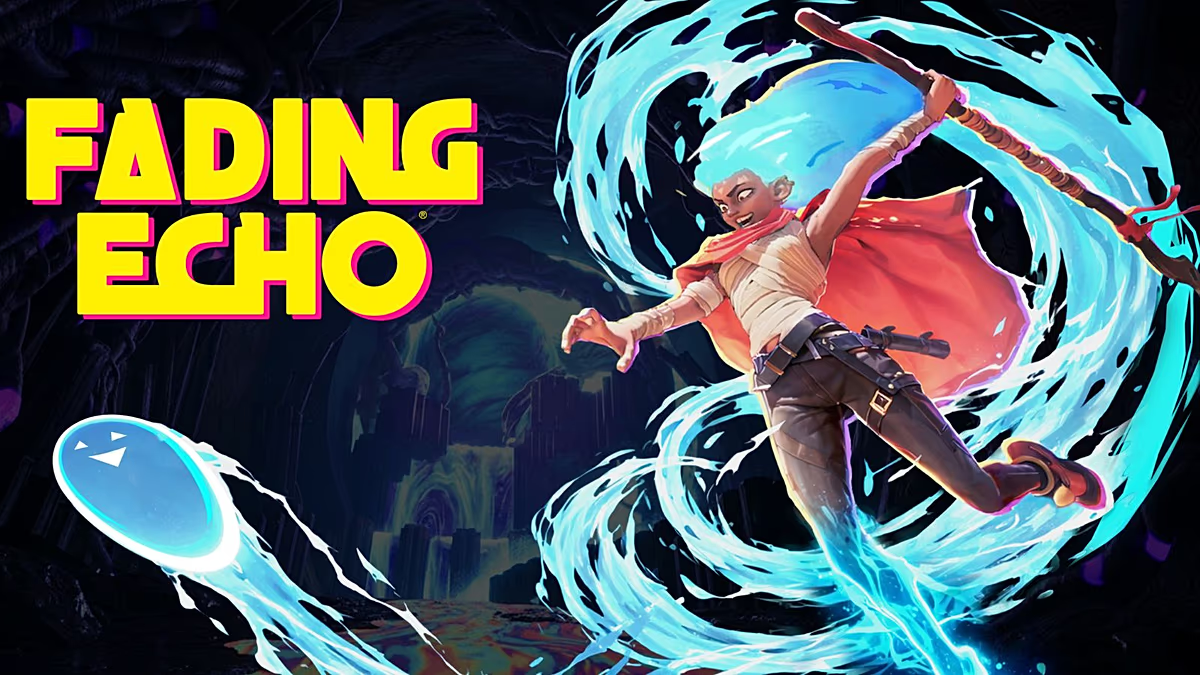
In a world saturated with alarming headlines about climate collapse, political disarray, and the relentless creep of artificial intelligence, three simple statements—“Reality is fracturing. The world is dying. We’re running out of time”—feel less like fiction and more like a daily news digest. Yet, this grim mantra serves as the foundational premise for Fading Echo, the debut title from Emeteria, an independent studio based in Lyon, France. Set for release later this year on PC and consoles, the game presents players with a decaying world where realities have shattered. You embody a shapeshifting character, navigating between human and aquatic forms, tasked with gathering water to power a bastion and escape a corrupted island. With its striking comic-inspired art, Fading Echo is more than a dystopian adventure; it’s a narrative vessel exploring profound themes of environmental decay and resilience, asking players to fight for a future that, in our own world, feels increasingly precarious.
The journey to create Fading Echo was born from upheaval and collaboration. The studio formed after the closure of Blizzard’s French office, with senior leadership forging a new path not just as developers but as a publisher partnering with global teams, including making history with the first console game from Madagascar. Initially conceived as a tabletop role-playing experience, the game evolved into an action RPG while striving to retain its narrative soul. Senior Producer Elise Marchouba describes her role as akin to building a car—figuring out the precise order of operations so the final product runs smoothly. The game’s environmental themes, once overt, have been woven more subtly into the fabric of its mechanics. A central element called “Corruption” offers power in small doses but proves fatal in excess, a deliberate metaphor for humanity’s fraught relationship with the planet. The team’s philosophy is clear: a message must enhance gameplay, not overshadow it. The goal is to craft an engaging experience where reflection arises naturally, leaving players with a lingering sense of connection to the game’s core questions.
This commitment to nuanced storytelling reflects a broader shift across the industry, where games are increasingly embracing complex, layered narratives that mirror our complicated era. Marchouba notes that current events inevitably seep into creative work, citing the team’s lead writer in the U.S., whose experiences over three years of development informed the game’s emotional texture. The studio sees its role not as delivering lectures but as posing questions, inviting players to engage more deeply with the world around them. This potential for cultural impact is significant. Marchouba points to titles like Spec Ops: The Line—a military shooter that subverts the genre to explore trauma and morality—as proof that games can fundamentally alter perspectives. In a landscape crowded with titles prioritizing scale over substance, Fading Echo stakes its claim by focusing on a single-player, narrative-driven experience without online frills, microtransactions, or trending buzzwords like crypto. Its choice of a female protagonist, while celebrated by many, also highlights lingering resistance in some corners of the gaming community, underscoring the ongoing struggle for broader representation.
The path for an indie title like Fading Echo is fraught with challenges, existing within an industry that is paradoxically both wildly profitable and deeply unstable. Video games now out-earn films annually, yet the environment is “very dire and very scary,” Marchouba admits. The pandemic created a bubble—sales soared, remote hiring exploded, and studios expanded rapidly. Now, as sales normalize, mass layoffs have followed, with even giants like Epic Games cutting thousands of jobs. For smaller studios, survival hinges on agility, transparency, and community. At Emeteria, a tight-knit team of about 16 receives regular financial updates to avoid sudden shocks, a stark contrast to the impersonal “fruit basket” warning signs of AAA studios. Additionally, the industry continues to grapple with systemic issues, from the toxic fallout of scandals like those at Ubisoft to the slow progress of women into senior roles. Marchouba, having moved countries to find a better environment, sees meaningful change happening more readily in smaller, intentional studios where culture can be carefully cultivated, not just corporately mandated.
Amidst these structural challenges looms the specter of artificial intelligence, the “villain du jour” sparking existential dread across creative fields. In gaming, the pressure to adopt AI is often driven less by innovation and more by investor demand. Marchouba observes a dangerous trend: studios hastily replacing concept artists with generative tools, risking quality and ethical breaches. However, she advocates for a middle path, guided by the motto, “People won’t be replaced by AI. People will be replaced by people using AI.” At her studio, the focus is on deploying AI for mundane tasks, enhancing efficiency without eliminating human creativity. The irreplaceable element, she argues, is human nuance—like the dark humor and layered relationships in Fading Echo’s dialogue, which AI cannot authentically replicate. The future will belong to studios that ethically integrate technology while championing the human experiences—the trauma, emotion, and personality—that form the soul of compelling storytelling.
Ultimately, Fading Echo emerges as a testament to the enduring power of human-centric creation. In an era of slop and saturation, it represents a deliberate choice: to tell a specific story, to build a genuine community, and to offer players not just an escape but a meaningful experience. Marchouba’s hope for players is refreshingly open-ended. She doesn’t seek to dictate a particular emotion but hopes that upon finishing the game, each person feels that their time was worthwhile, that the journey meant something uniquely personal to them. As the game prepares for release, with playable demos at events like Lyon’s Speedons, it stands as a quiet rebuttal to industry anxieties. It is a reminder that games, at their best, are forged by diverse teams of passionate “weirdo nerds” who have found their system—a community where they can connect, create, and perhaps, through layers of code and art, help us all make a little more sense of a fractured world.