


In a sweeping and ideologically charged document released in early May 2026, the administration of US President Donald Trump unveiled a new national counter-terrorism strategy that marks a significant departure from traditional frameworks. The strategy expands the definition of terrorism far beyond conventional jihadist threats, explicitly naming violent left-wing extremists, anarchists, and what it terms “radically pro-transgender” groups as primary targets. Furthermore, it places drug cartels operating in the Americas at the heart of its security efforts, framing them as terrorist organizations. The document, overseen by counter-terrorism coordinator Sebastian Gorka—a figure previously criticized for alleged associations with far-right movements—serves not only as a security blueprint but also as a potent instrument for advancing the administration’s conservative political agenda, framing domestic ideological opponents as national security risks.
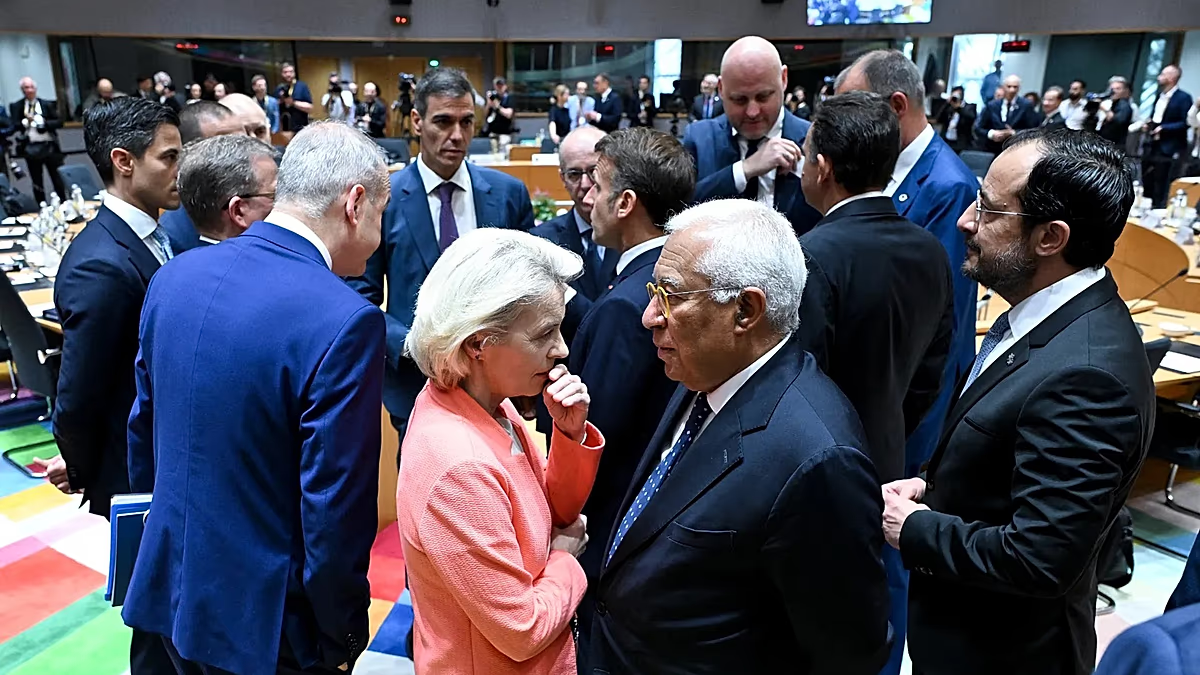
The strategy reserves some of its most pointed and controversial language for Europe, accusing the continent of being a “incubator” for terrorism fueled by mass migration. It argues that “well-organised hostile groups exploit open borders and related globalist ideals,” and starkly warns that “the more these alien cultures grow, and the longer current European policies persist, the more terrorism is guaranteed.” This critique represents a dramatic escalation in rhetoric, directly challenging the social policies of numerous US allies. The document implores Europe, described as “the birthplace of Western culture and values,” to “act now and halt its wilful decline.” This echoes sentiments from Trump’s earlier national security strategy, which claimed Europe faced “civilisational erasure,” and aligns with his recurring criticisms of European NATO members for their perceived lack of support in global conflicts, such as his war on Iran.
A central and novel pillar of the strategy is its focus on combating left-wing and anarchist movements within the United States. It declares that efforts will “prioritise the rapid identification and neutralisation of violent secular political groups whose ideology is anti-American, radically pro-transgender, and anarchist.” This framing politically weaponizes national security by categorizing broad activist movements—including anti-fascist (Antifa) groups—as terrorist threats. The administration substantiates this focus by citing specific incidents, such as the alleged killing of conservative influencer Charlie Kirk by an individual espousing “extreme transgender ideologies.” This approach institutionalizes the administration’s longstanding rhetorical attacks on its political opponents into official policy, blurring the lines between law enforcement, counter-terrorism, and political discourse.
The strategy’s emphasis on “radically pro-transgender” ideologies is a direct extension of President Trump’s domestic social policy agenda. Since his return to office, Trump has consistently demonized gender diversity, regularly boasting about banning transgender women from women’s sports and signing an executive order proclaiming there are only two genders. The counter-terrorism document effectively elevates this cultural battle to a national security level, suggesting that certain expressions of transgender advocacy are not just social debates but potential sources of violent extremism. This move seeks to legitimize and provide a security justification for the administration’s broader crusade against LGBTQ+ rights, particularly transgender rights, by placing them under the ominous umbrella of counter-terrorism.
The expansion of the strategy to include drug cartels in the Americas represents another significant shift, merging the wars on drugs and terror into a single, overarching campaign. This approach likely aims to justify more aggressive military, intelligence, and law enforcement actions across Latin America, framing complex issues of organized crime, narcotics trafficking, and governance under the simplified and urgent label of “terrorism.” It reflects an administration preference for hard-power solutions and a disdain for nuanced, socio-economic approaches to regional security, potentially straining diplomatic relations with neighboring countries.
Ultimately, the 2026 counter-terrorism strategy is far more than a tactical security plan; it is a profound statement of the Trump administration’s worldview. It externalizes perceived cultural and political decay by casting European migration policies as a direct security threat to the West. Simultaneously, it internalizes the threat by defining domestic political and social movements that oppose the administration’s values as terrorist entities. The document serves to consolidate a narrative where traditional Western civilization is under assault from both external migration and internal “radical” ideologies, requiring an aggressive, unified response. This strategy alarms allies, redefines longstanding security concepts, and deeply politicizes the apparatus of national security, setting a contentious course for US policy that prioritizes ideological conflict alongside traditional counter-terrorism.