


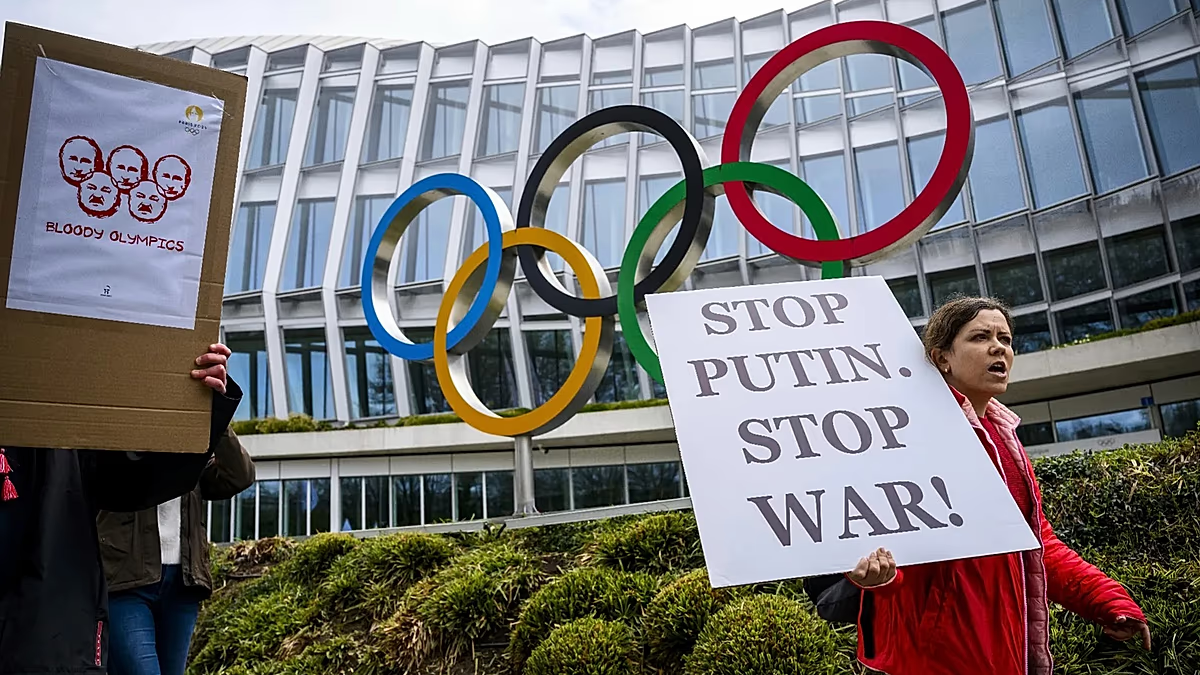
In a significant shift for international sports, the International Olympic Committee (IOC) announced on Thursday that it has lifted all remaining restrictions on athletes from Belarus, allowing them to return to global competition under their national flag and as part of official national teams. This decision marks the end of a period of exile that began following Russia’s full-scale invasion of Ukraine in 2022, where Belarus, as a key ally, permitted its territory to be used as a staging ground for the military offensive. The move effectively normalizes the status of Belarusian athletes, who, alongside their Russian counterparts, had been banned or forced to compete only as neutrals in recent years. The IOC’s executive board stated it “no longer recommends any restrictions on the participation of Belarusian athletes, including teams,” signaling a clear diplomatic and procedural separation between Belarus and Russia in the eyes of the Olympic body.
This restoration of rights is rooted in a core principle repeatedly invoked by the IOC: that individual athletes should not be held accountable for the geopolitical actions of their governments. As the statement elaborated, “The IOC reaffirms that athletes’ participation in international competition should not be limited by the actions of their governments, including involvement in a war or conflict.” By extending this logic to Belarus now, the Committee draws a distinct line, suggesting that the ongoing suspension of the Russian Olympic Committee (ROC) relates to separate and more severe institutional violations. For Belarusian athletes, this means the immediate opportunity to qualify for and compete in upcoming Games without the stigmatizing “neutral athlete” label, and the prospective honour of marching under their own flag at the Los Angeles 2028 Summer Olympics.
The practical impact of this policy shift is profound. While the lifting of IOC recommendations opens the door, it is now up to each international sports federation to formally implement the change, potentially allowing Belarusians to return to world championships and qualifying events in their respective sports. The timing, as noted by the IOC, is strategically aligned with the commencement of the qualification cycle for the LA 2028 Games this summer. This provides a clear runway for a full Belarusian delegation to prepare, qualify, and participate in the traditional sense—present at the opening ceremony, celebrated in the medal table, and adorned in national colours—a stark contrast to their diminished presence at the recent Paris 2024 Summer Games and Milan-Cortina 2026 Winter Games, where they competed in small numbers as “Individual Neutral Athletes.”
Crucially, the IOC was careful to delineate why Belarus’s path diverges from Russia’s. The Russian Olympic Committee remains suspended, a penalty initially levied in autumn 2023 for the politically charged annexation of the sports organizations from four Ukrainian regions illegally occupied by Russia. This suspension was a direct punishment of the national Olympic body for violating the territorial integrity of the Ukrainian Olympic committee. Furthermore, the IOC cited fresh and ongoing concerns regarding the reliability of Russia’s national anti-doping system, an issue with a long and contentious history. Thus, Russian athletes, for the foreseeable future, will continue to face a far more restrictive framework, competing only as strictly vetted individuals without national symbols, contingent on not having actively supported the war in Ukraine.
For the athletes themselves, these geopolitical decisions translate to deeply personal realities. Belarusian competitors can now reclaim a sense of national identity in their sporting pursuits, a powerful psychological and symbolic restoration. They no longer must grapple with the ambiguous and often lonely status of neutrality, which, while allowing participation, severed the formal connection to their homeland and fellow citizens. The decision promises to reinvigorate the sports ecosystem within Belarus, providing clear goals and national representation for upcoming generations. However, this normalization is likely to be met with mixed emotions globally, particularly from Ukrainian athletes and supporters who view Belarus as a co-aggressor in a war that continues to devastate their nation.
Ultimately, the IOC’s decision reflects the complex, often fraught, intersection of global sport with international politics and ethical responsibility. By reinstating Belarus while maintaining sanctions on Russia, the Committee attempts to navigate a middle path, balancing its stated principle of athlete neutrality with a response to state actions. It creates a tiered system of consequences, suggesting that direct institutional breaches of Olympic charter and doping integrity (as with Russia) warrant harsher, ongoing sanctions than broader geopolitical alignment (as with Belarus). As the sporting world moves toward Los Angeles 2028, the presence of a full Belarusian team will stand as a testament to this nuanced—and undoubtedly debated—diplomatic calculus, highlighting the enduring challenge of separating the games from the turbulent world stage upon which they are played.