



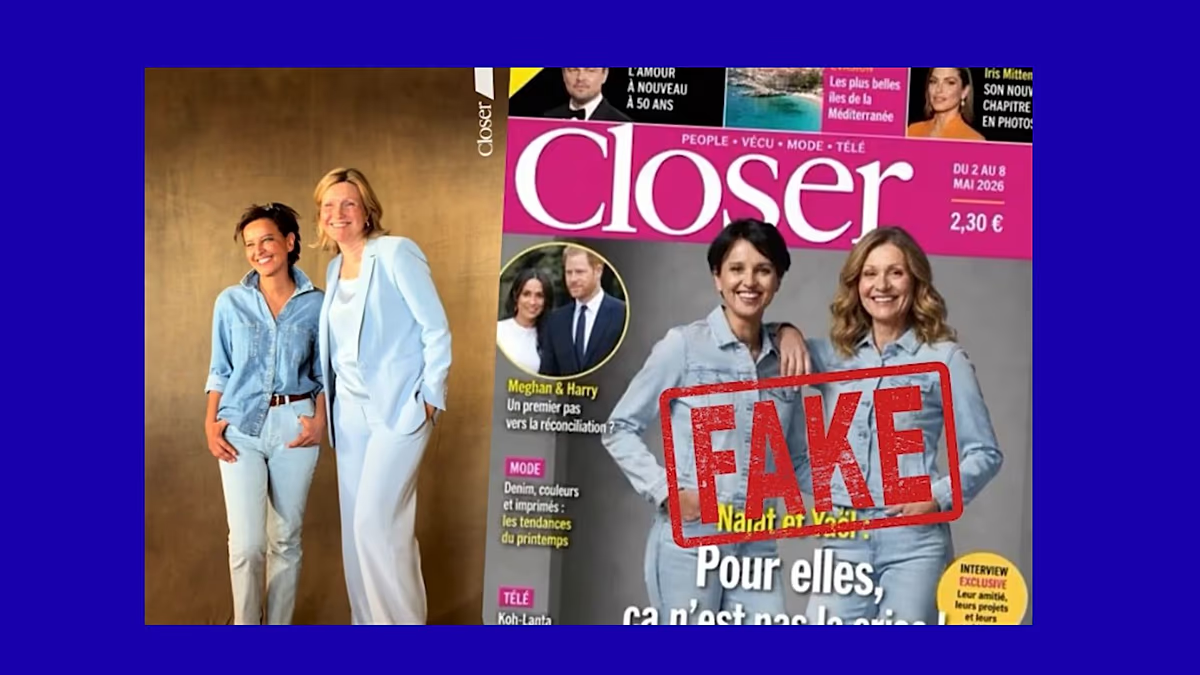
In a stark demonstration of how rapidly artificial intelligence can corrode public discourse, France’s right-leaning television channel CNews recently became the unwitting vehicle for a political embarrassment. During a live broadcast, political commentators seized on what they believed to be a cover of the tabloid magazine Closer from May 4th. The image featured Yaël Braun-Pivet, the President of France’s National Assembly and a member of President Macron’s party, alongside Najat Vallaud-Belkacem, a former Education Minister from the Socialist Party. The commentators, interpreting the image as a genuine political maneuver, proceeded to ridicule Braun-Pivet. They suggested the cover was a calculated effort to soften her centrist-right image and appeal to left-leaning voters, with one analyst asserting, “It’s a way for her to say, ‘Look, I’m a bit left-leaning…’ You know she wants to play a role in the presidential election.” The segment was built entirely on a critical assumption: that the magazine cover was real.
The foundation for their critique, however, was pure fabrication. The Closer magazine cover was not authentic; it had been generated by artificial intelligence. While the program eventually corrected its error live on air, the damage was done. The incident highlighted a dangerous new normal where AI-generated content, indistinguishable at a glance from reality, can be injected directly into the bloodstream of political debate. Yaël Braun-Pivet did not let the moment pass unchallenged. In a pointed video posted to her social media platforms, she underscored the profound implications of the error, noting that the fake cover did not even accurately resemble her. “Today, the line between what’s real and what’s fake has never been as fragile,” she stated. “So, in this context, media outlets have a huge responsibility.” Her rebuke went beyond personal offense, framing the mistake as a fundamental journalistic failure: “Reporting isn’t just about passing on information; it’s about verifying it.”
In response to the broadcast, Braun-Pivet took formal action, announcing she would refer the matter to Arcom, France’s audiovisual regulatory authority. This move places the incident within a broader pattern of contentious interactions between CNews and the regulator. The channel, known for its conservative commentary, has faced repeated fines from Arcom for violations ranging from broadcasting hateful content to airing climate disinformation. This context turns a single on-air blunder into a symptom of a deeper issue concerning the channel’s editorial standards and its role in a media landscape increasingly polluted by falsehoods. Pascal Praud, the prominent conservative commentator who hosted the segment, responded to the controversy on social media platform X. While he admitted Braun-Pivet was “right” to call out the error, he emphasized that the correction was made “live a few minutes later.” This defense, however, underscores a problematic logic in modern fast-paced news: the idea that speed in correction mitigates the damage of the initial, unchecked spread of falsehood.
The irony of the situation is deepened by a twist of genuine coincidence. While the specific magazine cover was fabricated, Braun-Pivet and Vallaud-Belkacem were, in fact, photographed together in late April on the sidelines of a film screening in Paris. The real Closer magazine even shared behind-the-scenes footage from that shoot on its social media, showing the two politicians in entirely different attire—Braun-Pivet in a suit and Vallaud-Belkacem in denim—than depicted in the AI-generated image. This reality highlights a key mechanism of effective disinformation: it often grafts a plausible falsehood onto a kernel of truth. The commentators’ narrative of a political alliance was imaginative, but the existence of a real meeting lent a superficial credibility to the fabricated visual, making the forgery seem more believable to the hurried eye.
This episode serves as a critical case study for the challenges facing media, politics, and society in the age of AI. It illustrates how synthetic media can be weaponized, intentionally or not, to frame narratives, attack opponents, and mislead the public. The commentators’ swift and assured analysis based on a fake image shows a failure of basic due diligence, where the hunger for provocative content overrode the imperative of verification. For the public, it is a warning about the necessity of media literacy and healthy skepticism. When even professional broadcasters on a major network can be so easily deceived by a convincing fake, the burden on citizens to critically evaluate sources becomes exponentially heavier.
Ultimately, the CNews incident is more than a fleeting political scandal; it is a alarm bell. Yaël Braun-Pivet’s invocation of media responsibility strikes at the heart of the dilemma. As the tools for creating hyper-realistic falsifications become universally accessible, the ethical and professional obligations of news organizations must be reinforced, not relaxed. Regulatory bodies like Arcom will increasingly be tasked with navigating this new frontier, where breaches of standards may involve not just bias or hate speech, but the very manipulation of reality itself. The integrity of public debate depends on media outlets remembering that their primary role is to illuminate truth, not amplify convincing fictions, regardless of how compelling those fictions may seem in the heat of a live broadcast.