


In a statement on Thursday, the European Commission sought to project confidence about ongoing negotiations surrounding last year’s EU-U.S. trade agreement, emphasizing that “progress” had been achieved during recent late-night discussions. Officials maintained that the intricate process of translating the political deal into enforceable law remained “fully in line with standard legislative practice,” portraying the talks as a normal, if painstaking, part of the EU’s democratic machinery. This public-facing optimism, however, served as a thin veneer over a reality of significant discord and mounting pressure, revealing the complex challenges of legislating in an era of geopolitical volatility.
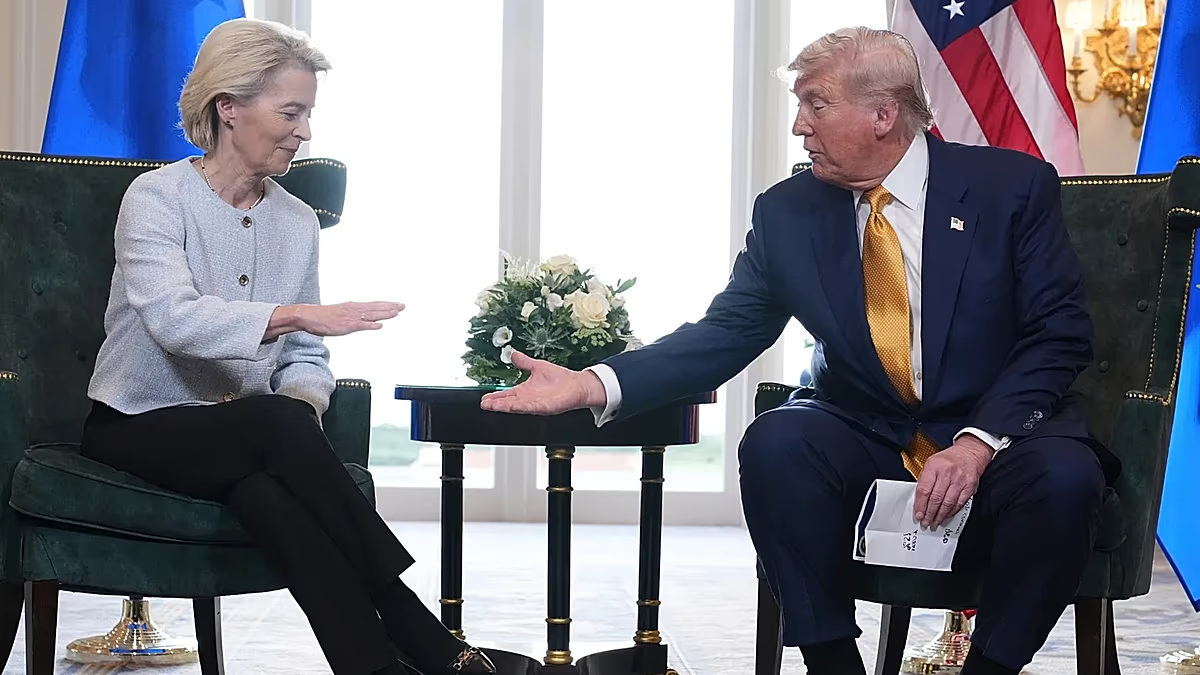
Behind closed doors, the gulf between negotiators was stark. Nearly nine months after the controversial pact was first announced at Scotland’s Turnberry golf course, the agreement remains ensnared in fraught negotiations among the European Parliament, the Commission, and EU member states. These divisions are hardening at a particularly sensitive moment, as former U.S. President Donald Trump ramps up pressure on Europe with renewed threats of aggressive tariffs. The core of the deal—which would eliminate EU tariffs on American industrial goods and cap U.S. tariffs at 15%—is now overshadowed by Trump’s weekend warning that he would slap a 25% charge on European cars and trucks if the EU fails to implement the accord promptly.
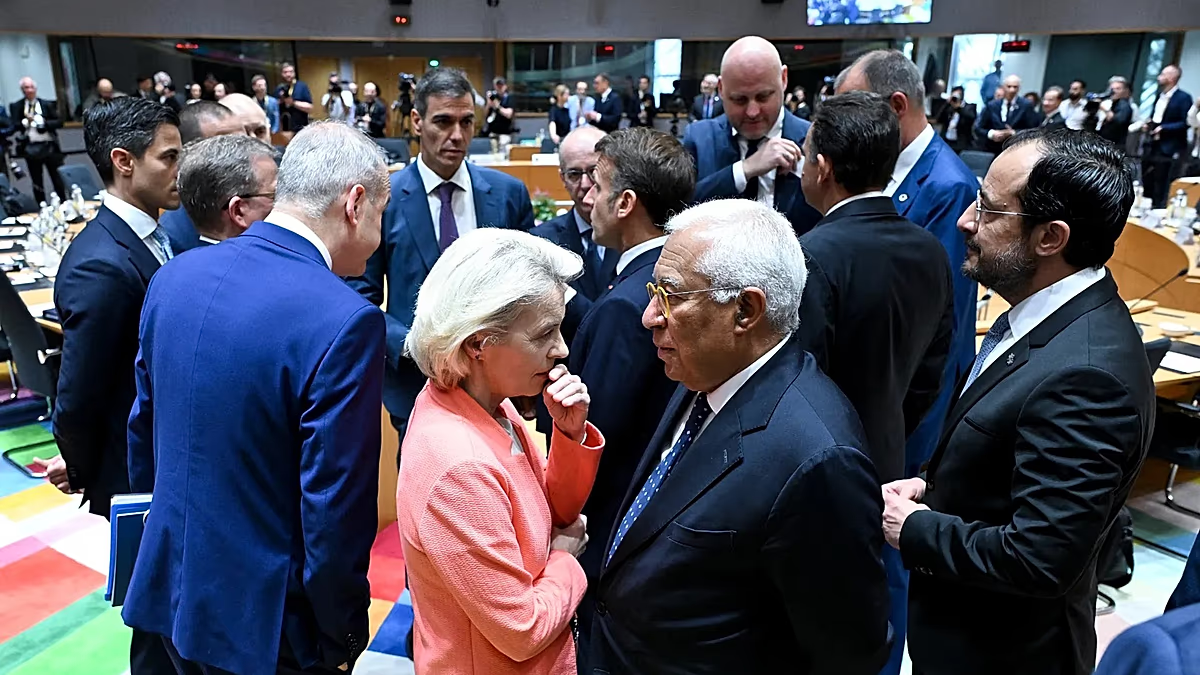
The depth of the stalemate became clear when Wednesday night’s crucial “trilogue” negotiations—involving EU Trade Commissioner Maroš Šefčovič, representatives of the European Parliament, and officials from EU national governments—broke down after six grueling hours. Despite Šefčovič’s praise for a “constructive mood,” fierce resistance from several political groups within the Parliament brought proceedings to a halt, necessitating a postponement. A new meeting was scheduled for May 19th, but the delay underscored a fundamental clash of priorities: while the Commission and most EU capitals are pushing for swift approval to secure economic stability, MEPs are digging in their heels, refusing to be rushed into what they see as a potentially risky commitment.
At the heart of the Parliament’s resistance is a demand for robust safeguard mechanisms to protect European interests. Lawmakers are insisting on clauses that would allow the EU to suspend the agreement immediately if the U.S. violates its terms by imposing new tariffs or, more dramatically, if it threatens the EU’s territorial integrity—a direct reference to Trump’s past suggestion that the U.S. could annex Greenland. Furthermore, MEPs are seeking protections against a potential flood of U.S. imports that could distort competition within the EU’s Single Market. Another key point of contention is a proposed “sunset clause,” championed by the Parliament’s chief negotiator, German MEP Bernd Lange, which would see the tariff relief automatically expire in March 2028 unless explicitly renewed, thereby forcing a conscious reconsideration of the partnership down the line.
MEPs are explicitly pushing back against external pressure to rubber-stamp the deal, arguing that Trump’s own combative tactics and unpredictable behavior make these safeguards not merely prudent but essential. In their view, the very threats designed to speed up approval instead justify a more cautious, deliberate approach. “We are not here to be bullied. It takes some time, but this is the regular legislative EU process, and we are working constructively,” a source from the Socialists and Democrats group explained. Echoing this sentiment, Greens/EFA MEP Anna Cavazzini stressed, “The Parliament is not blocking the agreement, we are working on implementing it.” Their stance reflects a broader determination to assert the Parliament’s role as a co-legislator and guardian of European strategic autonomy, rather than a passive endorser of executive-brokered deals.
Despite the current impasse, there remains a cautious hope that a resolution is within reach. Some Parliament officials express confidence that the deal could be approved within the next two weeks, with discussions underway about holding an extraordinary meeting to accelerate the final stages. As European People’s Party negotiator Jörgen Warborn noted, “The earlier we can close the trial of negotiations, the earlier we give clarity for businesses and indeed more predictability in a turbulent situation.” This final push highlights the enduring tension at play: the urgent need to provide economic certainty for industries and citizens, weighed against the democratic imperative to secure a deal that is resilient, balanced, and firmly protective of European values and interests in an uncertain world.