


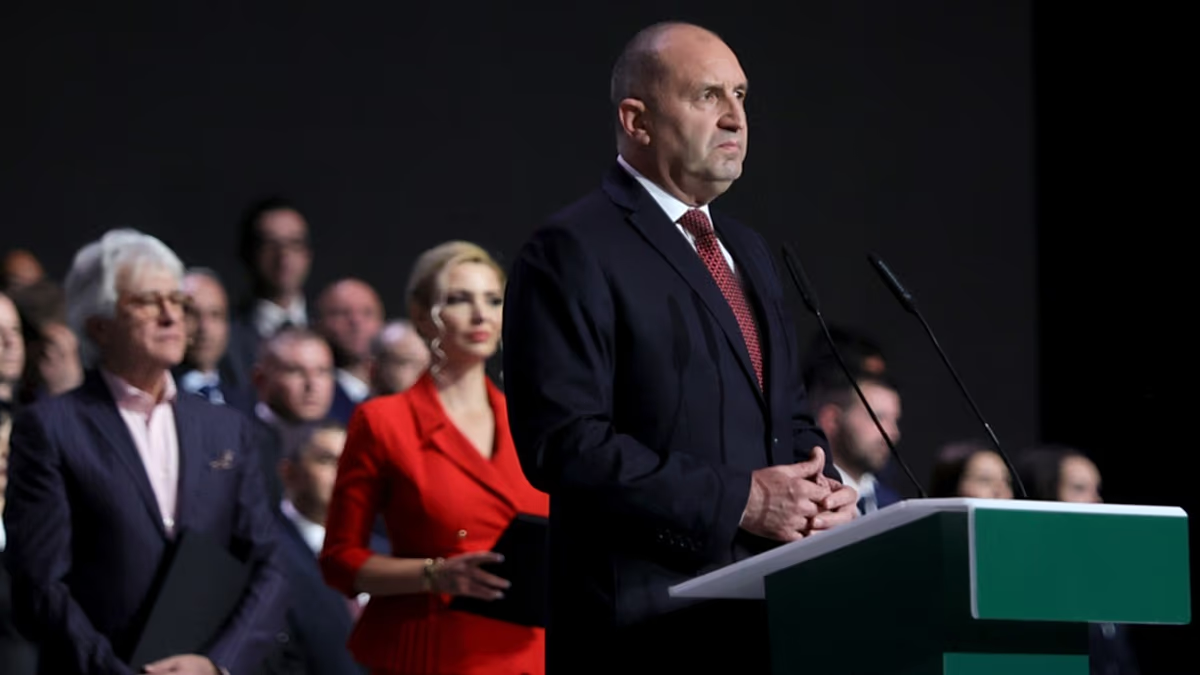
A New Era for Bulgaria: Rumen Radev’s Mandate for Change
After years of relentless political turbulence, Bulgaria has reached a decisive turning point. On Thursday, Rumen Radev, a former president and fighter pilot, was formally named the nation’s new prime minister following his party’s resounding victory in last month’s parliamentary elections. This victory is historic, marking the first time since 1997 that a single political formation has secured an outright majority. For a Balkan nation weary from eight elections in just five years, Radev’s landslide win ignites a profound hope for the stability and coherent governance that have been so desperately missing. The mandate handed to him by Bulgarian voters represents not just a political shift, but a collective yearning for a functional state after a prolonged period of crisis and paralysis.
A Platform of Purification and Sovereignty
Radev ascends to power on a bold and clear platform centered on radical domestic reform and a recalibration of foreign policy. He campaigned vehemently on a promise to dismantle what he termed Bulgaria’s “oligarchic model,” vowing to fight deep-seated corruption and “clean up” the state. This message resonated powerfully in a country that, alongside Hungary, is perceived as the European Union’s most corrupt according to Transparency International. Simultaneously, Radev brings a distinctly skeptical voice toward the EU, advocating for a more assertive Bulgarian sovereignty within the bloc. Furthermore, he has pledged to resume dialogue with Russia, signaling a potential shift in Bulgaria’s diplomatic stance and underscoring his reputation as a staunch critic of the EU’s prevailing consensus.
Inheriting a Nation of Challenges
The celebratory moment of receiving the mandate from President Iliana Iotova is quickly tempered by the sheer scale of the challenges awaiting the new administration. Radev inherits a nation grappling with urgent and intertwined crises. He must immediately tackle the practical task of drafting a 2026 budget amid global economic headwinds and address the pinch of rising inflation affecting Bulgarian households. More systemically, he faces the monumental duty of reforming a judicial system widely seen as paralyzed and ineffective—a key pillar in any serious anti-corruption effort. Perhaps most pressingly, his government’s success is directly tied to unlocking nearly €400 million in frozen EU recovery funds, which are contingent on implementing specific reforms, particularly in the rule of law and anti-graft measures.
The Roots of the Crisis
To understand the significance of this moment, one must look back at the turbulent path that led here. Bulgaria’s recent political chaos can be traced to widespread public disillusionment that erupted in major anti-corruption protests in 2021. These demonstrations successfully brought down the long-standing, pro-European government of Boyko Borissov. The political instability that followed proved intractable, with a succession of fragile cabinets unable to secure a governing majority. Notably, Radev, then serving as president, positioned himself as a supporter of these anti-establishment protests, building the public credibility that now underpins his mandate. His resignation from the presidency earlier this year to run in the parliamentary race underscored his commitment to transitioning from a symbolic head of state to an executive leader with a direct democratic mandate to enact change.
The Immediate Path Forward
The procedural path for Radev’s government is now set. Following the presentation of his cabinet lineup, a vote in parliament scheduled for Friday will confirm him and his ministers, officially commencing his term. This confirmation is virtually assured given his party’s majority, allowing the government to begin its work without the coalition bargaining that has crippled its predecessors. In his first remarks as prime minister-designate, Radev framed the victory as a national affirmation, stating that Bulgarians had “confirmed their desire for stable institutions and for the defence of freedom, democracy and justice.” These words now set the benchmark against which his administration will be measured by its citizens and international partners alike.
A Test of Promises and Perception
As Rumen Radev prepares to lead, the eyes of Bulgaria and Europe are upon him. His premiership presents a fundamental test: can a leader who harnessed popular frustration against the status quo now deliver the tangible stability and reform he has promised? The immediate tasks are daunting—from economic management to judicial overhaul and navigating complex relations with both Brussels and Moscow. For the 6.5 million people of Bulgaria, the hope is that this clear electoral result finally breaks the cycle of political crisis and opens a chapter of effective governance. For the European Union, it introduces a determined and somewhat unpredictable partner whose approach to corruption, judicial independence, and foreign policy will have significant implications for the bloc’s cohesion and its eastern frontier. The journey for Bulgaria under Radev has just begun, and its direction will shape the nation’s future for years to come.