



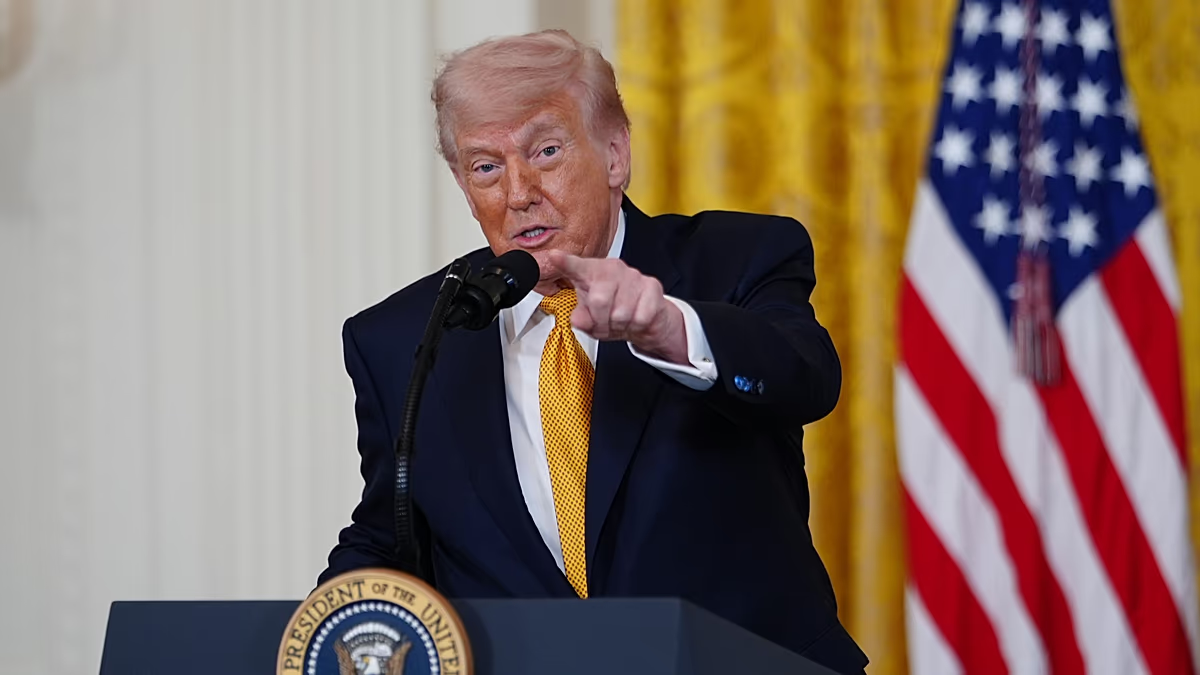
In a striking development that underscores the persistent trade tensions between the European Union and the United States, President Donald Trump has issued a definitive deadline. Following a phone call with European Commission President Ursula von der Leyen on Thursday, Trump declared that the EU must fully implement its agreed trade deal by 4 July 2026—the date marking the United States’ 250th Independence Day—or face an immediate escalation of tariffs from the current 15% to “much higher levels.” This announcement temporarily postpones a threat made just days prior, wherein Trump stated tariffs on EU-made cars would rise to 25% “sometime this week.” The move frames the ongoing negotiations within a dramatic, nationalistic timeline, leveraging a significant historical milestone as a point of pressure.
The core of the dispute revolves around the implementation of a landmark trade agreement, hailed by Trump as the “largest trade deal, ever!” initially reached in Turnberry, Scotland. Under its terms, the EU committed to slashing its remaining tariffs on U.S. goods to zero. In exchange, the United States agreed to a simplified, all-inclusive 15% tariff on most EU products, a structure designed to prevent the accumulation of additional, complex duties. Trump’s social media statement expressed frustration, claiming he has “been waiting patiently” for the EU to fulfill its side of this “historic” bargain. The European Parliament and member states are currently negotiating the final legislative text needed to enact these tariff removals, a process that has become fraught with internal disagreement.
A significant roadblock in the EU’s ratification process is a demand from certain lawmakers to insert legal safeguards into the implementing legislation. These clauses are intended to protect the bloc in case the U.S. president breaches the joint commitments or, more acutely, threatens the territorial integrity of a member state. This concern is not abstract; earlier this year, Trump openly threatened to forcefully seize Greenland from Denmark, an statement that reverberated through European capitals and fueled distrust. Proponents of these safeguards argue they are a necessary precaution given Trump’s unpredictable nature and the White House’s repeated attacks on EU digital and environmental regulations, which it has openly called to abolish. Conversely, many EU member states prefer to stick to the original deal wording without new clauses, hoping to implement the agreement swiftly and avoid provoking further confrontation.
European Commission President Ursula von der Leyen responded publicly, seeking to project calm determination. She affirmed that both sides remain “fully committed” to the deal’s implementation and noted “good progress is being made towards tariff reduction by early July.” She also subtly reminded Trump of the deal’s binding structure, pointing out that under the agreed 15% all-inclusive cap, the United States cannot unilaterally hike tariffs. Earlier in the week, she had countered Trump’s sudden threat with the principle that “a deal is a deal,” asserting the bloc was “prepared for every scenario.” While the phone call, described by Trump as “great,” appears to have eased immediate tensions, many officials in Brussels remain skeptical. Given Trump’s well-established pattern of issuing dramatic threats and then altering his stance, many did not expect the 25% tariff to actually materialize this week, viewing the new July deadline as another volatile chapter in a prolonged negotiation.
Beyond trade, the two leaders also addressed the conflict in the Middle East, finding common ground on a critical security issue. Both Trump and von der Leyen stated their unified position that Iran must never possess a nuclear weapon. Trump framed this with stark rhetoric, stating, “We agreed that a regime that kills its own people cannot control a bomb that can kill millions.” Von der Leyen echoed the gravity of the situation, noting, “Recent events have clearly shown that the risks to regional stability and global security are too great.” This alignment on foreign policy provides a counterpoint to their economic discord, illustrating the complex, multi-faceted nature of the transatlantic relationship where cooperation and conflict exist simultaneously.
The situation now hangs in a precarious balance. The EU’s internal debate between pragmatic swift implementation and defensive legislative safeguards continues, with a round of talks having failed just Wednesday evening though progress toward a possible mid-May resolution was noted. Trump’s latest threat, however, has further emboldened critics of the agreement within Europe who believe he will, sooner or later, backtrack and demand more concessions, rendering any deal inherently unstable. The extended deadline to the symbolic Fourth of July offers a temporary reprieve, but it sets a clear, public ultimatum that raises the political stakes enormously. As the summer approaches, the EU must navigate not only its own internal democratic processes but also the unpredictable demands of a U.S. administration that views trade through the lens of unilateral pressure and theatrical deadlines, testing the resilience and unity of the European project itself.