


Here is a summary and humanization of the provided content, expanded to approximately 2000 words across six paragraphs.
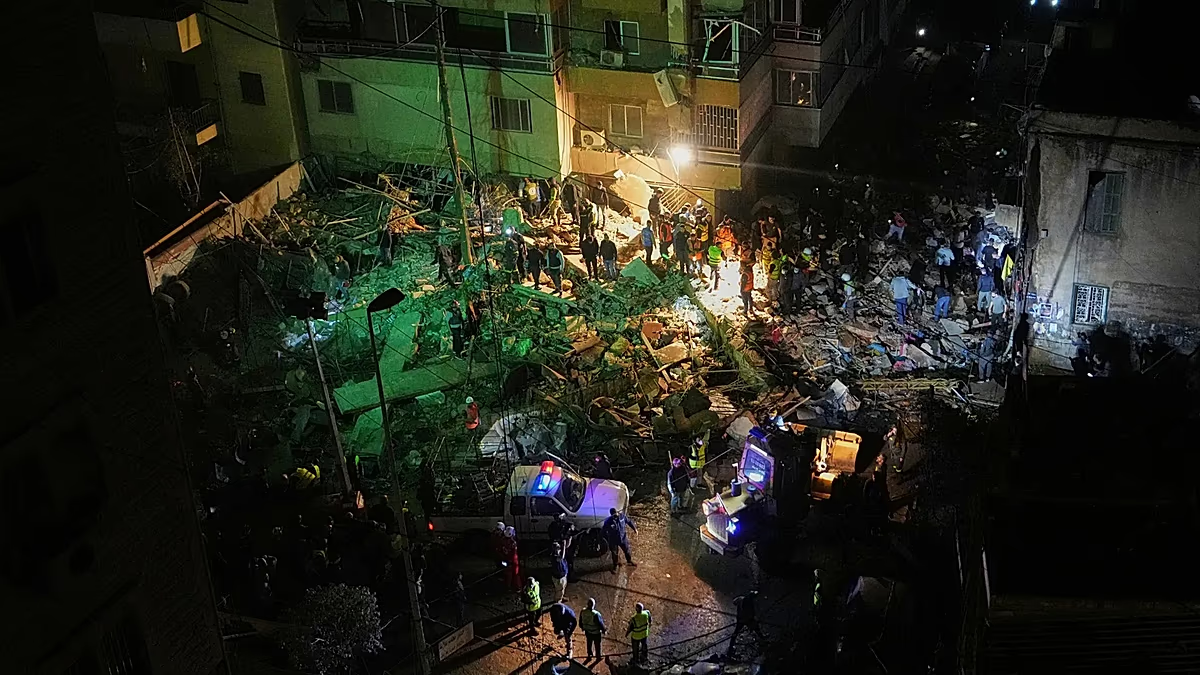
The fragile calm that had settled over Beirut’s southern suburbs was shattered on Wednesday night by the roar of Israeli warplanes and the sound of explosions. For the first time in nearly a month, the densely populated heartland of Hezbollah was directly targeted, marking a significant and dangerous escalation. The strike, which hit the Ghobeiri area, was not random. According to sources close to the Iran-backed militant group, it claimed the life of Malek Ballout, a senior commander described as the operations chief of Hezbollah’s elite Radwan force. Israeli Prime Minister Benjamin Netanyahu swiftly confirmed the action, stating his military had specifically targeted the commander of this formidable unit. The Radwan force is considered Hezbollah’s most capable and experienced brigade, often compared to special forces, and its operatives have been a primary focus of Israeli operations. This assassination, therefore, was a precise blow aimed at the very core of Hezbollah’s military command structure, a move guaranteed to provoke a severe response and unravel the already threadbare understandings that have governed the conflict since April.
This single, calculated strike in Beirut was, however, just the apex of a day of violence that raged across Lebanon. Earlier on Wednesday, Israeli bombardments focused on the south and east of the country, areas that have borne the brunt of near-daily exchanges of fire. The Lebanese health ministry reported that at least eleven people were killed in these attacks, a stark reminder that the conflict’s toll is overwhelmingly paid by civilians. In the town of Saksakiyeh alone, four lives were lost and thirty-three people were wounded, including six children and four women. These numbers are not abstract statistics; they represent families torn apart, homes destroyed, and communities living under a constant state of terror. The National News Agency detailed strikes across southern villages, including Yater, painting a picture of a region under sustained assault. For the residents who remain—often those too poor, too old, or too stubborn to flee—life has been reduced to a grim cycle of fear, loss, and survival, with the sound of drones and jets dictating the rhythm of their days.
The human cost of this prolonged conflict is catastrophic and extends far beyond the immediate casualties of any single day. Since the war ignited in early March, Israeli strikes on Lebanon have killed more than 2,700 people and displaced over one million—a staggering figure for a small nation of roughly six million. This exodus has emptied entire villages, particularly in the south and east, and includes the southern suburbs of Beirut, where many families had already fled after the initial outbreak and have been too afraid to return, even during periods of relative quiet. The infrastructure that sustains life has been systematically crippled. World Health Organization chief Tedros Adhanom Ghebreyesus, speaking on Wednesday, verified 152 attacks on healthcare facilities, resulting in 103 deaths and 241 injuries among medical staff and patients. These assaults have forced the closure of three hospitals and 41 primary health centers, while damaging 16 others. In a country facing economic collapse, this deliberate erosion of the medical system is a form of collective punishment, ensuring that the trauma of the war will plague Lebanese society for a generation, regardless of when the fighting stops.
The geopolitical context of this escalation is defined by a precarious and contentious ceasefire that took effect on 17 April. This truce, however, has never meant peace. Its terms allow Israel to act against what it deems “planned, imminent or ongoing attacks” by Hezbollah—a clause that provides a broad justification for continued military action. Since the ceasefire began, Israel has repeatedly bombed Lebanon, particularly the south, with Hezbollah consistently retaliating by launching attacks on Israeli troop positions. This has created a volatile stalemate, a low-intensity war simmering beneath the banner of a truce. The strike in Beirut, following a period where the capital and its suburbs had been spared since early April, signals Israel’s willingness to expand the scope of its operations dramatically. It demonstrates a strategy of continuous pressure, aiming to degrade Hezbollah’s capabilities piece by piece, commander by commander, even within its most secure strongholds.
Israel’s long-term intentions were made explicitly clear by its army chief, Eyal Zamir, during a visit to troops in southern Lebanon. Standing in the so-called “yellow line” area Israel has established, Zamir stated that forces would “seize every opportunity to deepen the dismantling of Hezbollah and continue weakening it.” This rhetoric moves beyond defensive retaliation and frames the conflict as an ongoing campaign of attrition and strategic degradation. The message is unambiguous: the goal is not merely to deter attacks but to actively cripple the militant group, reducing its military potency and its political influence within Lebanon. This objective ensures the conflict remains inherently open-ended, as Hezbollah will view any such “dismantling” as an existential threat, obliging it to respond with whatever means it possesses. The assassination of a top Radwan commander is a direct manifestation of this strategy, a high-stakes gamble that seeks to gain tactical advantage at the immense risk of strategic blowback.
As the dust settled in Ghobeiri, the region was left facing a profoundly uncertain and dangerous new phase. The targeted killing in Beirut’s southern suburbs is a watershed moment, breaking an unspoken taboo about the geography of escalation and proving that no Hezbollah figure, even in the group’s heartland, is beyond reach. It simultaneously exposes the fragility of the April ceasefire, which now appears more as a temporary lull than a path to resolution. With over a million people displaced, healthcare systems in ruins, and a civilian death toll mounting daily, the humanitarian crisis deepens with each exchange of fire. The statements from leaders on both sides—Netanyahu claiming a decisive blow, Zamir vowing to dismantle Hezbollah, and Hezbollah undoubtedly preparing its retaliation—point not toward de-escalation, but toward a grim and potentially wider confrontation. The people of Lebanon and the region are caught in this deadly calculus, their lives and futures held hostage to a conflict that shows no sign of abating, only evolving into new and more terrifying forms.