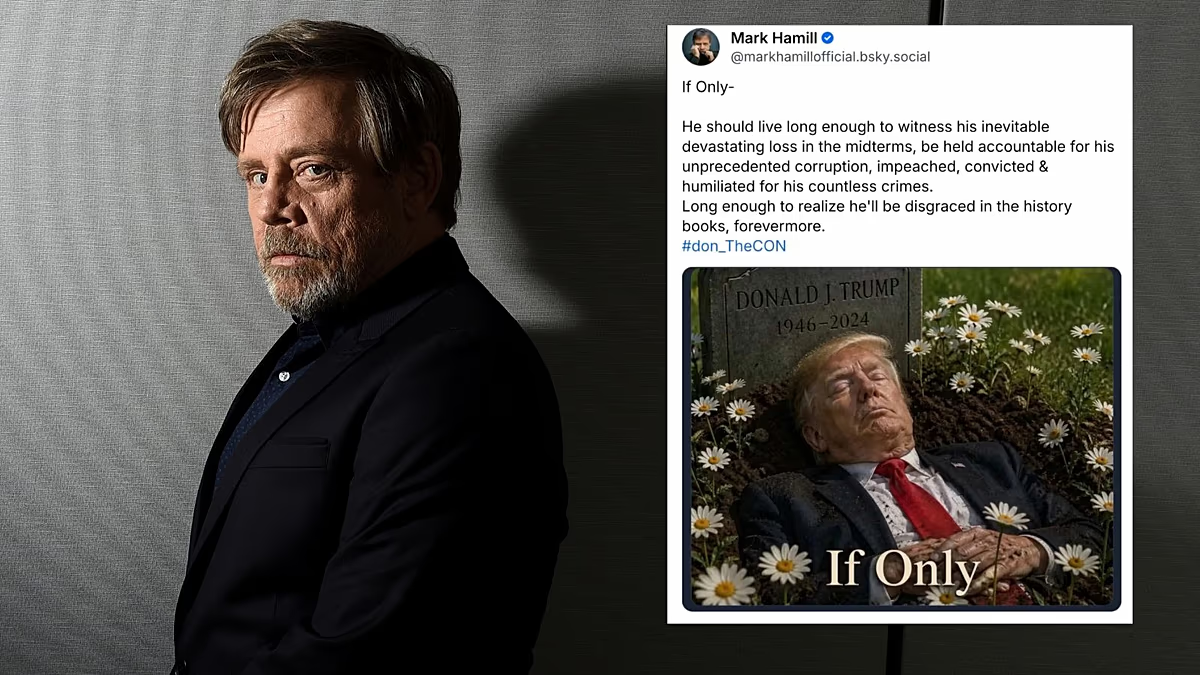
In a striking collision of pop culture and politics, the Trump administration has publicly condemned actor Mark Hamill—iconically known as Luke Skywalker from the Star Wars franchise—for sharing a digitally altered image on social media depicting former President Donald Trump deceased in a grave. The White House responded swiftly and sharply on the platform X, labeling Hamill “one sick individual” and accusing “Radical Left lunatics” of employing rhetoric that “is exactly what has inspired three assassination attempts in two years against our President.” This fiery rebuke frames the actor’s post not merely as offensive political commentary, but as a potential incitement to real-world violence, tying it to a charged atmosphere where political speech is scrutinized for its physical consequences. The administration’s reaction underscores a broader narrative it frequently promotes: that critics on the left dangerously escalate verbal and visual attacks, thereby jeopardizing the safety of public figures.
Hamill’s original post on Bluesky featured an AI-generated image of Trump in an open grave, captioned “If Only,” with a headstone marking a hypothetical 2024 date of death. In an accompanying message, the actor elaborated, writing that he wished Trump would “live long enough to witness his inevitable devastating loss… be held accountable for his unprecedented corruption, impeached, convicted & humiliated for his countless crimes.” However, following the White House’s outcry, Hamill deleted the image and offered a clarification, stating that he was actually “wishing him the opposite of dead” and apologizing if the visual was found inappropriate. This sequence highlights the volatile nature of political discourse in the digital age, where provocative, often satirical imagery can be instantly disseminated and misinterpreted, forcing public figures to navigate the fine line between pointed criticism and perceived threats. The incident gains added gravity as it follows the recent charging of a man for an attempted assassination of Trump at a White House Correspondents’ Association dinner, a context that makes any imagery involving violence or death particularly sensitive.
This controversy did not emerge in a vacuum but sits within a recurring pattern of accusations regarding violent rhetoric—a pattern in which the Trump camp itself has often participated. Shortly after the shooting incident, former First Lady Melania Trump demanded the firing of talk show host Jimmy Kimmel for a joke he made days prior, suggesting she had a “glow like an expectant widow.” Kimmel defended the comment as a lighthearted reference to the couple’s age difference, but Melania’s call for repercussions sparked widespread accusations of hypocrisy online. Critics were quick to note that Donald Trump himself has repeatedly employed violent imagery and threatening language against opponents, from posting a video depicting the bombing of protestors to sharing an image of himself holding a machine gun during tensions with Iran, warning that a “whole civilization will die” unless demands were met. This apparent double standard fuels public perception that the administration condemns offensive speech only when it originates from the opposing side, while regularly deploying similar or more extreme rhetoric itself.
The intersection of Trump and Star Wars imagery, however, extends beyond this Hamill incident, revealing a consistent and often clumsy attempt by the administration to harness pop culture for political messaging. On May 4th—celebrated globally as Star Wars Day—the White House shared an image of Trump portrayed as the Mandalorian, complete with the character Grogu, captioned “This is the way. May the 4th be with you.” The post was quickly mocked by fans who noted multiple inaccuracies: the American flag Trump held displayed only 11 stripes instead of 13, and he was shown without the Mandalorian’s helmet, a violation of the core tenet of the Mandalorian creed. This lack of attention to detail suggested a superficial engagement with the cultural reference, aiming for viral appeal without genuine understanding or respect for the source material, leading to backlash from a dedicated fan community protective of the saga’s lore.
In a similarly tone-deaf post the previous year, the administration shared an image of a heavily muscular Trump wielding a red lightsaber, accompanied by a caption that accused the “Radical Left Lunatics” of being akin to the Empire. This effort spectacularly backfired, as any casual Star Wars fan knows that red lightsabers are exclusively used by the villainous Sith Lords, while heroes wield blue or green blades. As one social media user astutely noted, the post demonstrated a “lack of self awareness and hypocrisy” by calling the left “the empire” while visually aligning Trump with the Sith. These missteps reveal a recurring failure to grasp the nuanced symbolism of the cultural artifacts they appropriate, turning intended propaganda into self-satire. Rather than resonating as strong, culturally savvy messaging, such posts often highlight a disconnect between the administration’s narrative and the very audiences it hopes to inspire or persuade.
Ultimately, the clash between Mark Hamill’s deleted grave image and the White House’s own history of violent or incongruous postings illustrates the deeply polarized and performative nature of modern political communication. Both sides leverage potent symbols—death, heroism, villainy—to energize supporters and demonize opponents, often in the rapid-fire, context-flattening arena of social media. However, the administration’s selective outrage and its own rhetorical excesses undermine its claims to moral high ground, while its bungled pop culture homages expose a struggle to authentically connect with broader audiences. In an era where imagery travels faster than explanation, and where every post can become a flashpoint, these episodes collectively underscore a troubling erosion of dialogue, replaced by competing spectacles of condemnation and theatricality that deepen divisions rather than bridge them.