



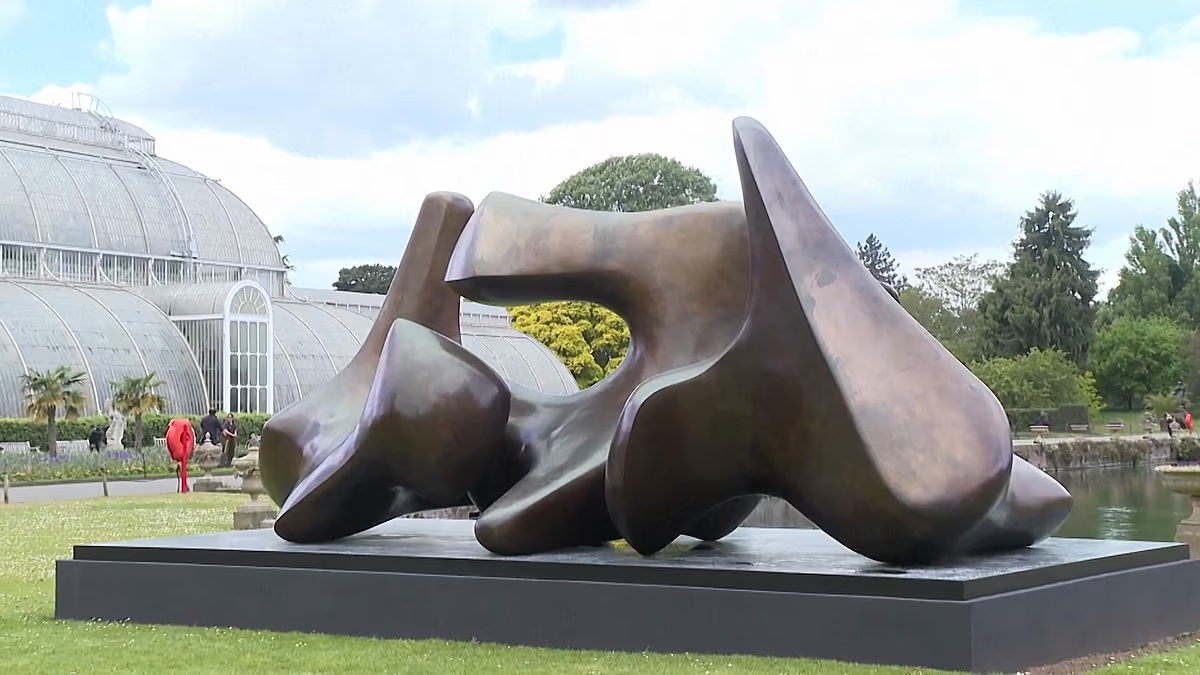
The serene landscape of London’s Royal Botanic Gardens, Kew, has been profoundly transformed. Scattered across its 300 acres, from the shadow of the Temperate House to the quiet glades beside the lake, thirty monumental sculptures by Henry Moore now reside. This is not a crowded exhibition but a carefully curated conversation, where organic bronze and elm wood forms engage in a silent, powerful dialogue with the living tapestry of the garden. The placement is deliberate and thoughtful; a reclining figure mirrors the slope of a hill, a large bronze arch frames a canopy of ancient trees, and smooth, biomorphic shapes emerge from beds of ferns as if they themselves have grown from the earth. This harmonious integration makes the exhibition, “Henry Moore at Kew,” a unique and immersive experience, dissolving the boundary between the gallery and the natural world.
To understand the profound resonance of this pairing, one must consider Moore’s lifelong inspiration. He was not a sculptor who imposed rigid geometry upon his materials, but one who sought to reveal the forms already latent within them. He famously collected bones, flint stones, and weathered pieces of wood, seeing in their curves and hollows the principles of natural sculpture—erosion, growth, and structural strength. His works, whether the internal-external play of his stringed figures or the protective grandeur of his family groups, are abstractions of nature, not abstractions from it. Placing them in a manicured landscape like Kew, which is itself a celebration of botanical form and diversity, feels less like an installation and more like a homecoming. The sculptures are not merely visitors; they are kin to the gnarled roots, the bulbous seed pods, and the sweeping branches that surround them.
The experience of encountering these works at Kew is intentionally slow and personal. Unlike a white-walled gallery where art is presented in sequence, here the sculptures are discovered. A visitor wandering a path might round a corner to find the immense, weathered bronze of “The Arch” (1963/69) standing sentinel, its opening offering a dynamic frame for the shifting landscape beyond. Elsewhere, the tender, enclosing shapes of “Mother and Child” (1983) might be glimpsed through a screen of birch trees, creating a moment of intimate discovery. This interactive, exploratory aspect humanizes the often-daunting scale of Moore’s work. The artworks become waypoints in a personal journey, their meaning changing with the weather, the light, and the season—glistening in the rain, dappled in summer sun, or cloaked in autumn mist.
This dialogue also highlights a compelling tension between the enduring and the ephemeral. Moore’s sculptures are solid, weighty testaments intended to last for centuries, cast in bronze or carved from resilient stone and wood. They speak of permanence and timeless human themes. Yet, they are situated in an environment of constant, graceful flux. The gardens are a living entity where blossoms fade, leaves turn, and plants cycle through life and dormancy. This juxtaposition is quietly moving. It reminds us that while art seeks to capture and hold a moment of vision, nature is a continuous process of change. The static, reclining figure beside the lake is reflected in water stirred by the wind, just as our own solid human forms exist within the relentless flow of time.
For many, Moore’s large-scale abstract forms can seem imposing or obscure in an urban square or museum plaza. Kew Gardens provides a vital, accessible context that softens and explains them. When one sees the smooth, hollowed-out shapes of “Reclining Figure: Hand” (1979) nestled amongst rolling hills, it immediately evokes the landscape of the human body as part of the wider geological landscape—a concept central to Moore’s work. The garden setting acts as a universal translator, allowing the viewer to intuitively grasp the sculptor’s inspirations. It democratizes the art, making it available not just for academic contemplation but for sensory enjoyment. A child may instinctively understand a large, rounded form as a friendly presence among the trees, proving that the communication between these sculptures and their viewers is direct and emotional.
Ultimately, “Henry Moore at Kew” is more than an exhibition; it is a profound meditation on creativity itself. It presents a powerful argument that art and nature are not separate realms, but intertwined sources of wonder and form. As we walk between towering trees and equally monumental sculptures, we are invited to see the world through Moore’s eyes—to recognize the sculpture in a shell and the anatomy in a hill. This seamless integration offers a rare moment of harmony, where human imagination and natural beauty are shown to be part of the same continuum. In the dappled light of the gardens, Moore’s monumental works finally complete their dialogue, reminding us that we, too, are part of this ancient, beautiful, and ever-unfolding conversation between form and life.