


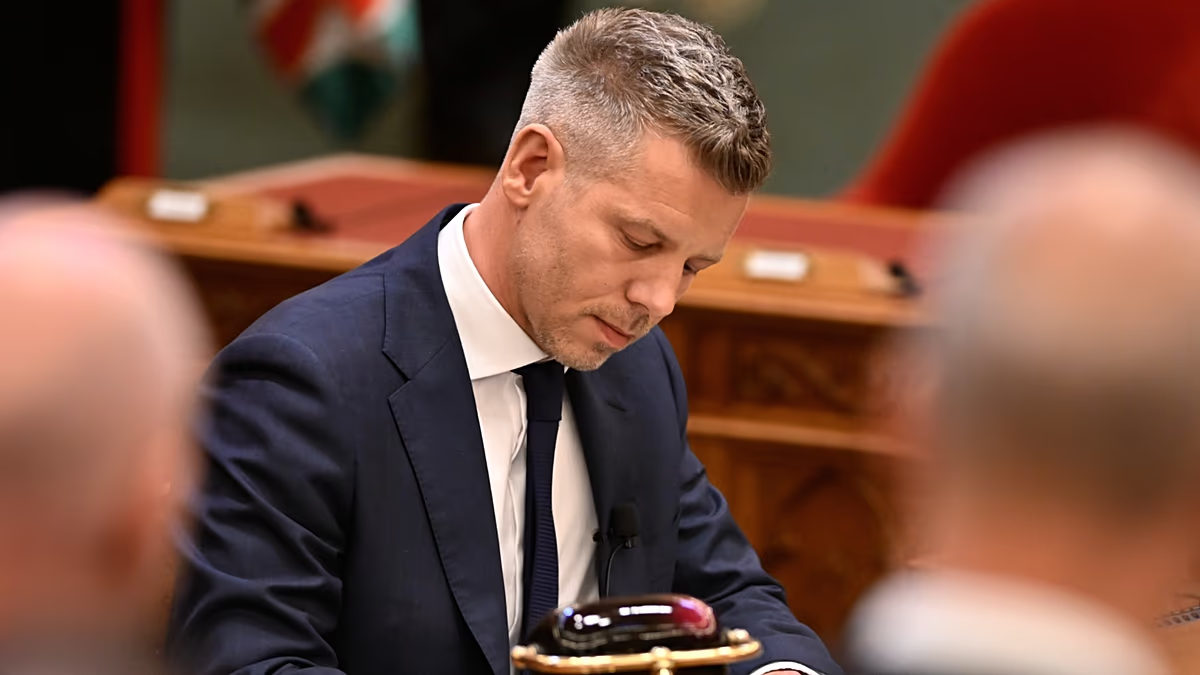
In a significant shift for European politics, Hungary’s new government, led by Péter Magyar, is racing against the clock to unlock billions of euros in frozen European Union funds. With a critical deadline looming at the end of August, the European Commission is actively seeking ways to assist Budapest in accessing this vital financial support. A high-level delegation from Brussels is set to travel to Hungary next week, signaling a cooperative spirit and a shared urgency. At stake is approximately €10.4 billion from the EU’s post-pandemic Recovery and Resilience Facility, a sum comprising both grants and loans that Hungary risks forfeiting entirely if it fails to meet strict reform conditions in time.
The timeline is exceptionally tight, and the path forward is complex. While Commission officials privately express hope that Hungary could still secure the full amount, they emphasize that the grant portion of €6.5 billion is the primary focus, as it does not require repayment. The additional €3.9 billion in loans is seen as far more difficult to obtain within the narrow window. The core challenge lies in Budapest’s need to swiftly implement a series of rule-of-law and anti-corruption reforms—central pledges of Magyar’s campaign—while simultaneously demonstrating tangible progress on concrete investment projects. Although the new government commands a strong parliamentary majority to pass laws quickly, proving physical project implementation by August is a formidable hurdle.
To navigate this, creative solutions are being explored. One prominent option involves using Hungary’s state-owned Exim Bank as a channel for the funds. This model, used successfully in other member states like Poland and Spain, would allow Brussels to transfer money to the bank before all conditions are formally met. The bank would then disburse funds to projects as reforms are implemented. While this could accelerate the process, Commission officials caution that it would reduce their direct oversight, a sensitive point given that concerns over corruption and democratic backsliding led to the funds being blocked under the previous Orbán administration. The delegation’s visit will aim to clarify these mechanisms and push for a simplified, revised spending plan from Hungary, due by the end of May.
Beyond the recovery funds, the new government faces additional financial and political challenges. Another €6.3 billion in regular EU cohesion funds is also partially blocked, with over €1 billion tied to contentious Hungarian laws on asylum and LGBTQ+ rights. Unlocking this segment would require politically difficult steps, such as repealing the so-called “child protection law” and reforming the asylum system—actions that could alienate conservative segments of Magyar’s base. Furthermore, while an extension of the August recovery fund deadline is theoretically possible, it is considered unlikely due to legal complexities and political resistance from other EU member states, who are wary of reopening the fund’s regulations.
Amid these pressing negotiations, Péter Magyar himself is preparing for a crucial visit to Brussels around May 25th for high-level talks, aiming to secure a political agreement on the funds’ release. His economic team, led by Finance Minister András Kármán, is expected to move rapidly on the necessary legislation, including steps toward joining the European Public Prosecutor’s Office—a move viewed as a major anti-corruption commitment. The Commission has assigned additional staff to assist Hungary’s efforts, indicating a constructive, though demanding, dialogue is underway.
This moment represents a critical test for both Hungary and the European Union. For Magyar’s government, successfully reclaiming these funds is essential to fulfilling a key electoral promise and stabilizing the national economy. For Brussels, it is an opportunity to reaffirm the EU’s foundational values by rewarding demonstrable reform, while also supporting a member state in political transition. The outcome will depend on difficult compromises, technical precision, and unwavering political will in the coming weeks, as the clock continues its inexorable countdown.