

A Strained Partnership: Malaysia Condemns Norway’s Sudden Arms Export Halt
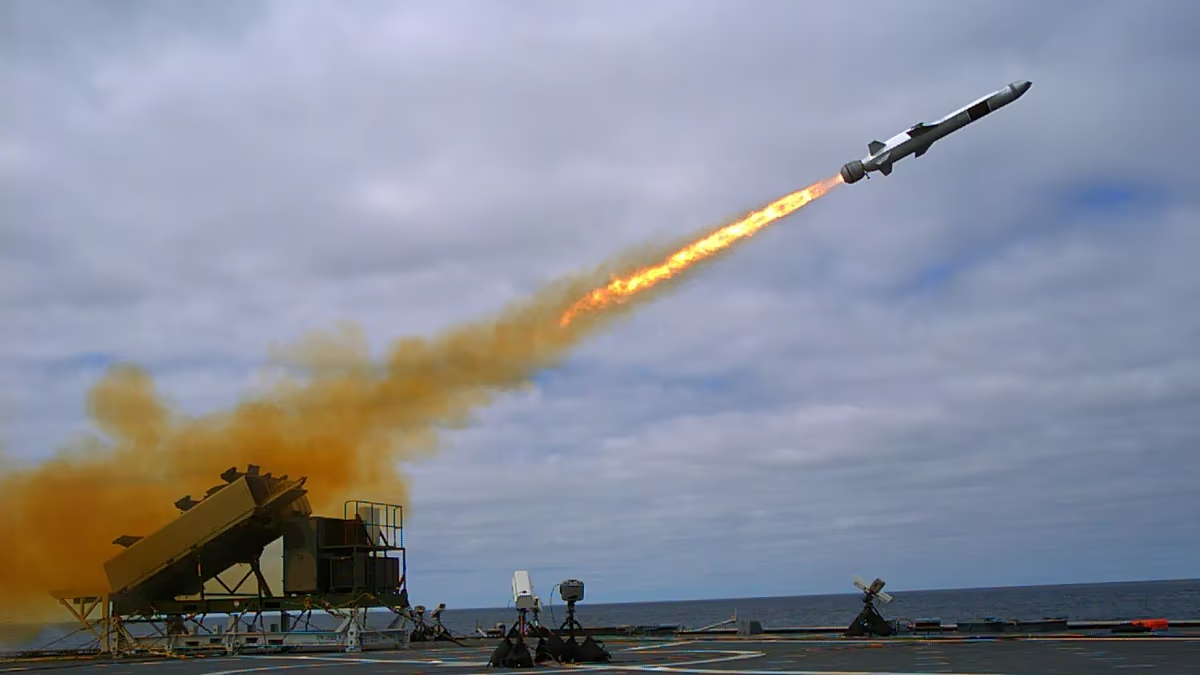
In a move that has sent ripples through international defence circles and bilateral relations, Malaysia’s Prime Minister Anwar Ibrahim has issued a stern condemnation of Norway’s decision to revoke the export license for a critical naval missile system. The abrupt cancellation, communicated in March and now made public, blocks the delivery of the sophisticated Naval Strike Missile (NSM) system and its launcher components, which were destined for Malaysia’s new class of littoral combat ships. This action by Oslo represents more than a simple contract dispute; for Malaysia, it is a profound breach of trust that strikes at the heart of its national security planning and modernisation efforts. Prime Minister Anwar framed the issue not merely as a commercial grievance but as a matter of strategic principle, warning that such unilateral decisions could severely damage confidence in European defence suppliers across the globe.
The background of this agreement underscores why Malaysia’s reaction is so vehement. The contract with Norway’s Kongsberg Defence & Aerospace AS dates back to 2018, and according to Malaysian officials, their government has meticulously fulfilled every financial and procedural obligation since then. Defence Minister Mohamed Khaled Nordin revealed a startling detail that adds significant weight to Malaysia’s sense of grievance: nearly 95% of the contract’s total value had already been paid to Norway when the export license was revoked. This fact transforms the cancellation from a mere policy shift into what Malaysia perceives as a bad-faith act, leaving a major ally financially committed yet operationally vulnerable. The NSM system is a cornerstone of Malaysia’s naval upgrade strategy, designed to equip its new ships with a potent, long-range anti-ship capability essential for patrolling and securing the nation’s extensive coastline and vital sea lanes.
Prime Minister Anwar’s response has been both forceful and eloquently pointed, reflecting a deep sense of betrayal. In a statement following a phone call with Norwegian Prime Minister Jonas Gahr Støre, Anwar declared Malaysia’s “vehement objection,” starkly contrasting the two nations’ adherence to the deal. “Malaysia has honoured every obligation under this contract since 2018: scrupulously, faithfully and without equivocation,” Anwar stated. “Norway, it appears, has not felt compelled to extend us the same courtesy and demonstration of good faith.” His language elevated the dispute beyond diplomacy, framing signed contracts as “solemn instruments” rather than “confetti to be scattered in so capricious a manner.” This rhetoric underscores a fundamental anxiety for smaller nations reliant on foreign arms: the fear that hard-won agreements can be overturned by a supplier’s changing political winds.
The practical consequences for Malaysia’s defence posture are immediate and severe. Anwar warned that Oslo’s move directly hurts Malaysia’s “operational readiness” and would “undoubtedly carry broader ramifications for the regional balance.” Without these advanced missiles, the combat capability and strategic value of its new littoral combat ships are fundamentally compromised, delaying a key element of its military modernisation. This setback forces Malaysia to scramble for alternatives in a complex global arms market, a process that is time-consuming, costly, and uncertain. Beyond the tactical gap, the incident prompts a harsh reevaluation of procurement partnerships. Anwar posed a damning question to European suppliers: “If European defence suppliers reserve the right to renege with impunity, their value as strategic partners flies out the window.” This sentiment resonates far beyond Kuala Lumpur, potentially giving pause to other nations considering major European defence acquisitions.
Notably, the Norwegian government has maintained a near-total silence on the specifics of the cancellation and Anwar’s accusations, offering no public explanation for its decision. This lack of transparency only fuels speculation and frustration in Malaysia. The missile manufacturer, Kongsberg, has deferred to government authorities, stating that export licensing decisions are handled entirely by the Norwegian state. This silence points to potential geopolitical or policy motivations behind the revocation—whether related to broader regional tensions, human rights considerations, or internal Norwegian politics—none of which have been clarified. For Malaysia, this opacity is insult added to injury; they are left with a broken deal, a significant financial loss, and a security void, all without a clear, public rationale from their partner.
Confronted with this reality, the Malaysian government is now exploring its recourse. Defence Minister Khaled confirmed that officials are examining legal options and potential avenues for compensation claims over the cancelled delivery. While legal battles in international arms contracts are notoriously difficult and protracted, pursuing them is a necessary step to recoup losses and assert contractual rights. More broadly, this episode will likely accelerate Malaysia’s ongoing efforts to diversify its defence suppliers and perhaps intensify regional cooperation with other partners. The rift with Norway serves as a stark lesson in the vulnerabilities of dependency. It highlights how the strategic calculations of a distant European nation can directly, and perhaps unexpectedly, undermine the security planning of a Southeast Asian state, forcing a reassessment of what it truly means to be a “reliable” partner in the high-stakes realm of global defence.