


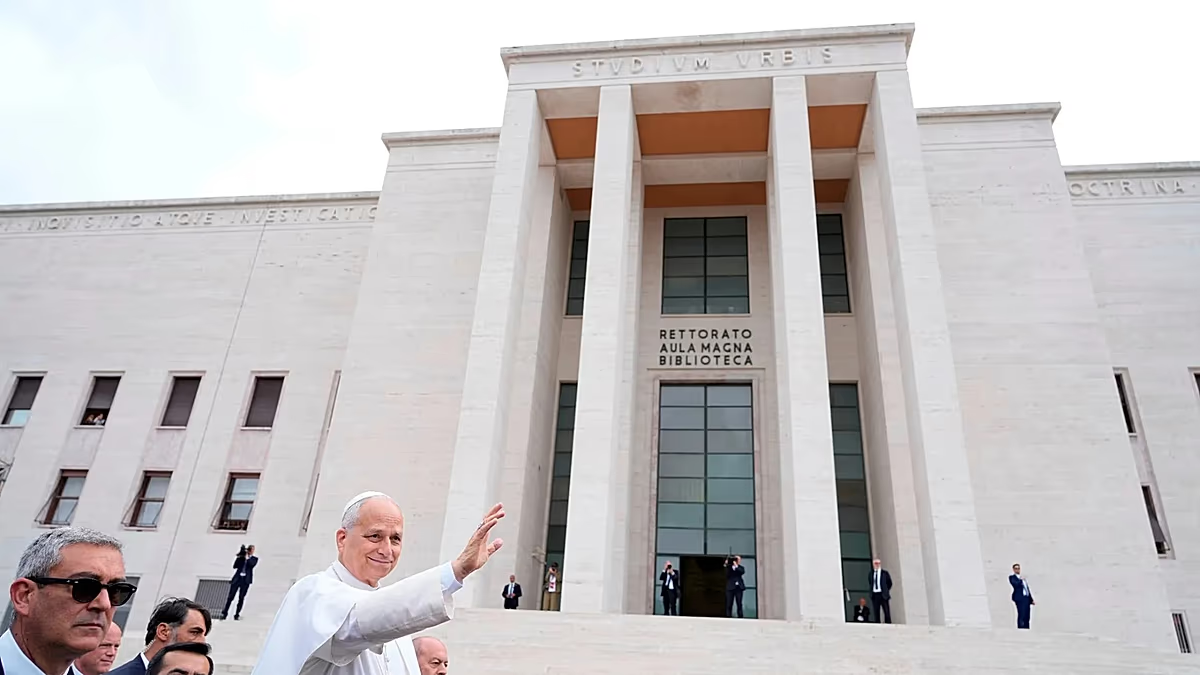
In a profound and urgent address at Rome’s historic La Sapienza University, Pope Leo XIV delivered a stark warning to the international community, framing the relentless pursuit of advanced artificial intelligence and high-tech weaponry as a perilous descent into a “spiral of annihilation.” His visit, the first by a pontiff to Europe’s largest university since 2008, carried a symbolic weight, emphasizing the critical role of academic and moral institutions in navigating global crises. The setting was poignant, as the university, founded by a pope in the 14th century, provided a backdrop for a modern-day plea that fused ancient ethical principles with the most pressing technological dilemmas of our age. Beyond the formal speech, the day was humanized by the Pope’s heartfelt encounters with a group of young Palestinian students from Gaza, recently arrived via a humanitarian corridor, reminding all present that abstract discussions of war and technology have devastating human consequences.
The core of the Pope’s message was a forceful condemnation of global priorities that favor militarization over human welfare. He lamented the dramatic surge in military spending, particularly across Europe, arguing that this allocation of resources enriches a powerful few while directly stripping funding from essential pillars of society like public education and healthcare. This critique painted a picture of a world where short-term strategic advantage is pursued at the long-term expense of societal health and stability. The pontiff framed this not merely as poor budgeting, but as a profound moral failure, where “elites who care nothing for the common good” are empowered, and the basic needs of the vulnerable are systematically neglected. His words challenged nations to examine their consciences and reconsider what truly constitutes security and prosperity.
Central to this critique was Pope Leo’s focused apprehension regarding the unchecked development of artificial intelligence, especially its integration into warfare and surveillance. He called for robust, ethical frameworks and vigilant monitoring to ensure that these technologies do not become tools of unprecedented destruction or mechanisms that erode human accountability. The Pope’s fear is that AI could create a dangerous detachment, where the gravity of life-and-death decisions is obscured by algorithms, absolving humans of moral responsibility for the consequences. This, he argued, represents a new and horrifying chapter in conflict, where the speed, scale, and impersonality of technology could escalate violence beyond traditional limits of containment and reason.
To illustrate this terrifying convergence, the Pope pointed explicitly to the ongoing suffering in Ukraine, Gaza, the Palestinian territories, Lebanon, and Iran. He described these conflicts as vivid, tragic examples of his theoretical warning—regions where advanced weaponry and digital tools are actively contributing to humanitarian catastrophe. By naming these places, he grounded his philosophical argument in immediate, tangible human suffering. The presence of the Gazan students in the audience served as a living testament to this connection, their very presence in Rome a result of the horrors the Pope described. This linkage made his warning impossible to dismiss as mere speculation; it was presented as a chilling reality already unfolding.
In contrast to this “spiral of annihilation,” Pope Leo XIV presented a compelling alternative path, one directed by the mission of universities like La Sapienza. He called for education and scientific research to be consciously steered toward a direction that “values life,” emphasizing the pursuit of knowledge that fosters peace, justice, and human dignity. This vision positions academia not as a neutral observer, but as an active participant in shaping a better future, developing technologies that heal and unite rather than destroy. The Pope’s planned first encyclical, expected to delve deeper into these themes of AI and ethics, signals that this speech was not an isolated remark but a cornerstone of his papacy, aiming to establish a moral framework for the technological age.
Ultimately, the Pope’s address was a holistic appeal for a fundamental reorientation of human ambition. It wove together a condemnation of immoral spending, a caution against dehumanizing technology, a prayer for victims of war, and a hopeful mandate for educators. He argued that the pursuit of technological supremacy without a parallel commitment to ethical wisdom and human solidarity is a recipe for global disaster. By speaking from a great university, to an audience that included both future leaders and young survivors of war, Pope Leo XIV underscored that the choice before us is not merely technical, but deeply human: will our ingenuity be used to build a more just world, or will it accelerate our descent into a spiral from which we may not return? The answer, he implied, lies in our collective courage to choose life.