

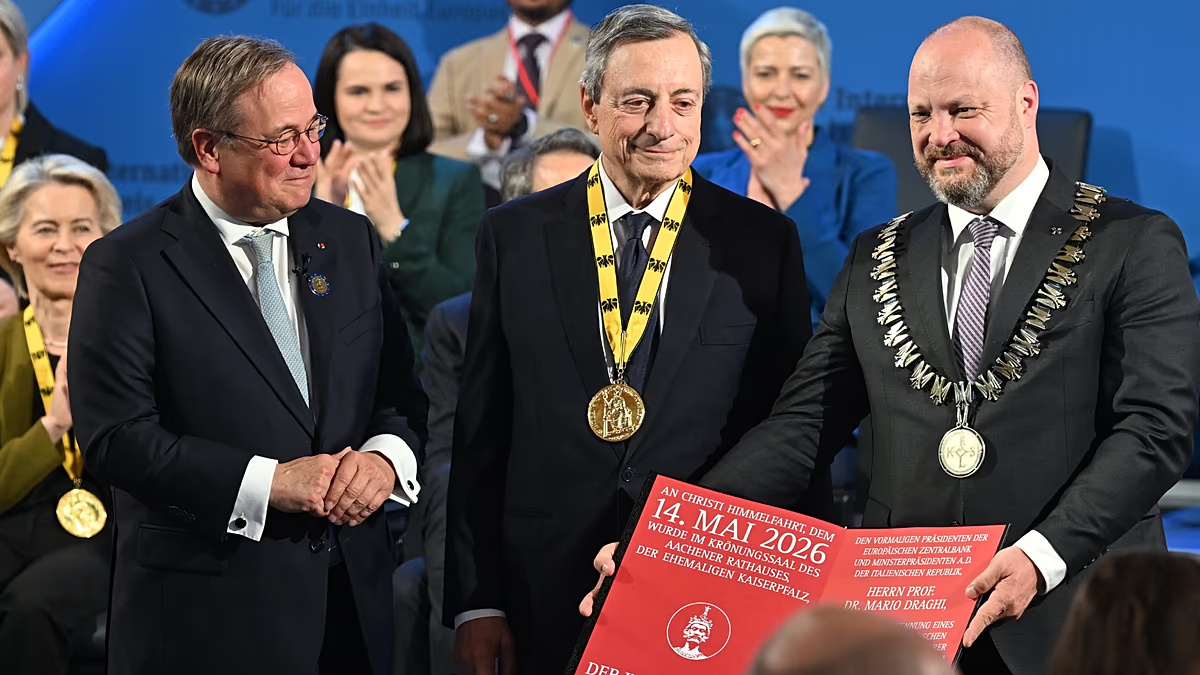
Mario Draghi, the distinguished Italian economist and former President of the European Central Bank, has been honoured with the 2026 International Charlemagne Prize, a testament to his indispensable role in safeguarding the European project during its most precarious economic hour. Steering the ECB from 2011 to 2019, Draghi confronted the existential eurozone debt crisis with a now-legendary resolve, famously pledging to do “whatever it takes” to preserve the single currency. This decisive action, which calmed panicked financial markets and staved off a potential collapse, earned him the moniker “Super Mario.” The prize, awarded in the historic city of Aachen, recognizes not just this technical mastery but also his enduring commitment to European unity, framing him as a pivotal figure who held the continent together through sheer force of intellect and will.
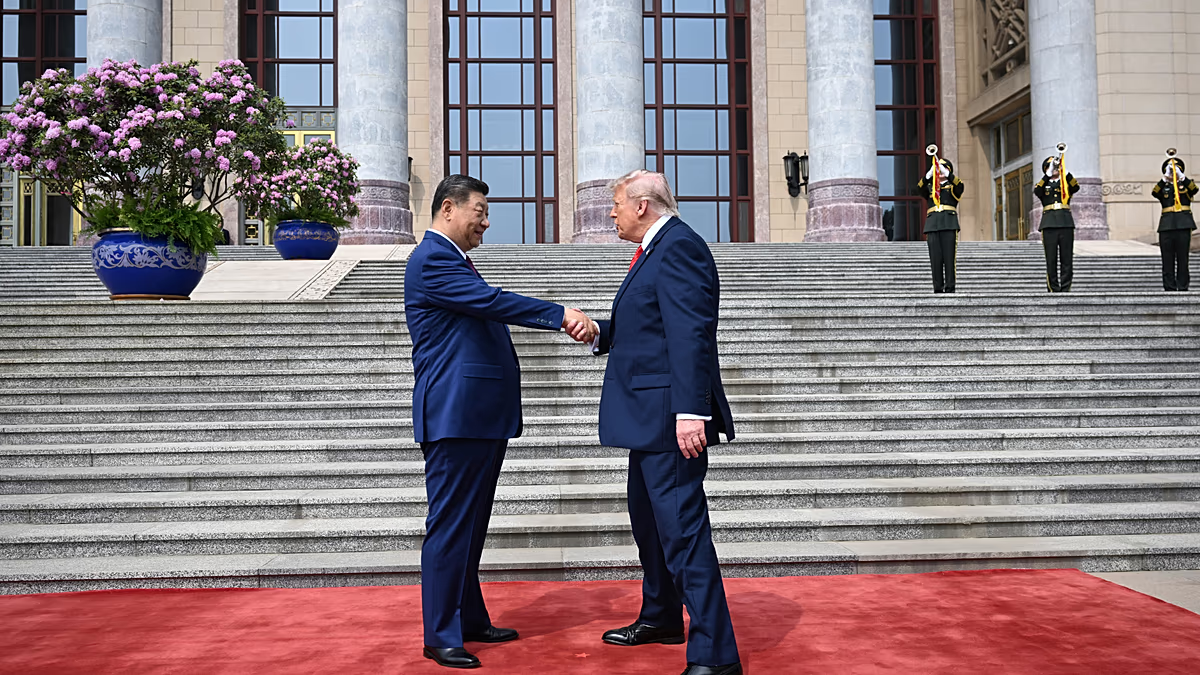
The award ceremony served as both a recognition of past triumphs and a platform for urgent contemporary debate. In their tributes, German politician Friedrich Merz and Greek Prime Minister Kyriakos Mitsotakis lauded Draghi as a protector of Europe. Merz, however, swiftly pivoted to a pressing call for action, advocating for a stronger, more integrated European Union capable of navigating a new era of global threats. He pointed explicitly to external pressures, including the unpredictable transatlantic relationship under a potential second Trump administration and the systemic challenge posed by China’s rise. His message was clear: the cohesion Draghi helped engineer in the last decade is now the prerequisite for survival in a world demanding greater European sovereignty in defence and industrial policy.
In his acceptance speech, Draghi issued a stark and intellectually formidable warning, arguing that Europe stands at a critical juncture where it risks irreversible decline. He asserted that without profound economic integration and massive, coordinated investment in key future sectors—such as green energy, digital infrastructure, and a genuinely unified single market—the bloc will fall behind the United States and China. He critiqued the persistent fragmentation of European capital and markets, noting that mere trade agreements are insufficient bandaids for these deep structural weaknesses. Most notably, he renewed his advocacy for joint European borrowing, a mechanism successfully deployed during the pandemic but still facing fierce resistance from fiscally conservative nations like Germany, which fear creating a permanent system of shared debt.
These remarks are not theoretical; they directly fuel the fires of current EU negotiations. Draghi’s vision clashes with the gritty reality of member states debating the bloc’s budgetary framework for 2028-2034, where every euro for defence or competitiveness is weighed against national burdens and debt constraints. His speech effectively serves as a public manifesto for the ideas contained within his influential 2024 report on European competitiveness, a document that sent shockwaves through policy circles by calling for up to €800 billion in annual public and private investment. By accepting the Charlemagne Prize, Draghi leveraged its symbolic weight to inject these ambitious prescriptions into the heart of political discussions, challenging leaders to think beyond short-term national budgets toward a shared European future.
The prize itself, born in Aachen in the aftermath of the Second World War, carries profound historical resonance. Named for Charlemagne, the medieval emperor who unified much of Western Europe from that very city, it was conceived to honour those who advance peace and integration on the continent. Its past recipients form a pantheon of European architects: from founding visionaries like Jean Monnet and Robert Schuman to modern stalwarts like Angela Merkel, and even the European Union as an institution. In bestowing the award upon Draghi, the committee positioned him within this lineage, not merely as a crisis manager but as a builder. He is recognized as a figure who translated the foundational dream of unity into the hard, technical work of preservation during a time when economic forces threatened to tear it all apart.
Ultimately, the awarding of the Charlemagne Prize to Mario Draghi symbolizes a moment of reflection and transition for Europe. It celebrates the overcoming of one existential crisis—the near-fragmentation of the euro—while highlighting the daunting nature of the next set of challenges: geopolitical irrelevance, industrial stagnation, and internal disunion. Draghi, now a revered elder statesman, uses the honour not to rest on his laurels but to issue a compelling, if contentious, blueprint for the future. His argument is that the unity he fought to maintain must now be the foundation for a great leap forward. The prize thus becomes more than an accolade; it is a passing of the baton and a raised standard, challenging a new generation of leaders to answer whether Europe can muster the collective will and sacrifice to ensure its own prosperity and security in an increasingly contested world.