

Paragraph 1: A Morning Commute Thrown into Chaos
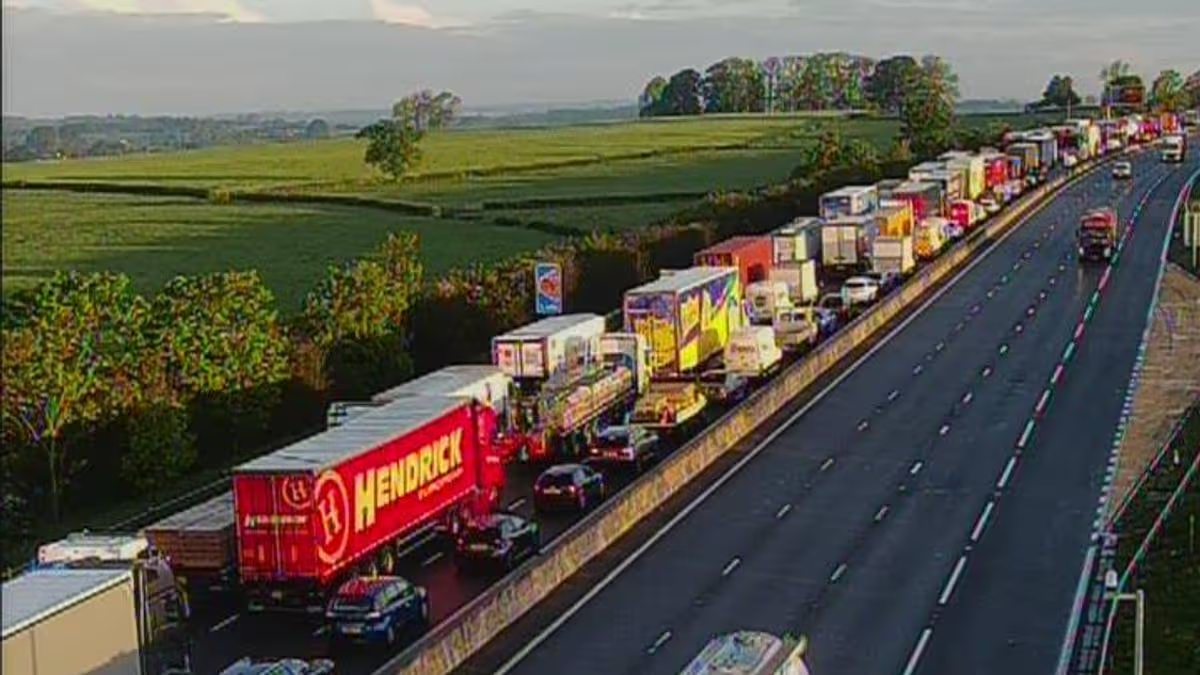
The familiar rhythm of a Thursday morning was shattered today as one of England’s busiest motorways ground to a halt. On the M6, a vital artery for countless commuters and freight, an early-morning collision has triggered a cascade of disruption just as the rush hour was poised to begin. According to live traffic updates, emergency services are on the scene, their flashing blue lights a stark contrast to the otherwise static sea of vehicles. The incident has effectively created a car park stretching between junctions 14 and 15, with traffic cameras capturing the grim reality of elongated queues snaking back along the carriageway. For thousands of people, what should have been a routine journey to work, school, or appointments has transformed into an exercise in frustration and waiting, their plans held hostage by the unfolding situation on the tarmac ahead.
Paragraph 2: The Human Impact Beyond the Traffic Cameras
Behind every stalled vehicle captured by the impersonal lens of a traffic camera is a human story. In one car, a parent anxiously glances at the clock, realizing they will be late to drop their child at daycare, setting off a chain of complications for their own workday. In another, a delivery driver feels a knot of stress, knowing a tight schedule of drop-offs is unraveling minute by minute. A healthcare worker, perhaps a nurse ending a night shift or a doctor rushing to a morning clinic, sits helplessly, their essential role delayed by the gridlock. The stationary traffic isn’t just an inconvenience; it represents lost time with family, missed business meetings, delayed medical deliveries, and the quiet, mounting anxiety of modern life where time is a precious and often unforgiving currency. The sound of idling engines mixes with sighs and the chatter of radio traffic reports, painting an auditory picture of a community temporarily stranded.
Paragraph 3: The Unseen Efforts at the Scene
While the queue of traffic grows longer in one direction, a very different scene unfolds at the point of the collision. Here, the focus is narrow, intense, and guided by procedure and compassion. Police officers work diligently to secure the scene, their priority the safety of everyone involved and the swift investigation of what transpired. Firefighters, if required, employ specialized tools to carefully extract any trapped individuals, their actions a blend of brute force and delicate precision. Paramedics provide urgent medical care, offering calm reassurance amid the chaos, their ambulance a sanctuary on the hard shoulder. These emergency responders operate in a coordinated ballet of flashing lights and focused action, their goal not only to manage the immediate incident but to eventually clear a path, both literal and metaphorical, for the stranded river of traffic to flow once more.
Paragraph 4: The Ripple Effect of a Single Incident
The impact of this motorway disruption refuses to be contained by the crash barriers. As news filters through traffic apps and radio bulletins, drivers miles away begin to alter their routes, seeking alternative paths through a network of A-roads and local streets ill-equipped for such a sudden influx. This creates a secondary wave of congestion, spreading the disruption like a stain across the regional map. Public transport networks feel the strain as more people consider trains and buses, while local businesses near the alternative routes see an unexpected, if frustrating, surge in passersby. The economic toll is silent but significant: wasted fuel, lost productivity, and delayed logistics. A single incident on a single stretch of tarmac demonstrates with brutal clarity how interconnected and fragile our transport infrastructure truly is, where a localized problem rapidly becomes a shared regional experience.
Paragraph 5: The Shared Experience of Waiting
In the absence of movement, a peculiar form of community emerges on the motorway. Drivers, normally isolated in their metal cocoons, make eye contact with those in neighbouring cars, sharing a look of resigned understanding. Some roll down windows to exchange fragmentary information gleaned from different radio stations or traffic apps. The simple act of seeing another person equally stalled can be a small comfort. In this suspended animation, people turn to their phones—to inform workplaces, to reschedule calls, to post updates on social media, or to simply pass the time. This digital communion becomes a lifeline, connecting those in the same physical predicament. The wait becomes a collective, if unwilling, pause in the day, a story that will later be told at dinner tables and office kitchens: “You’ll never believe the traffic I was stuck in this morning.”
Paragraph 6: The Slow Return to Normalcy
Eventually, after what feels like an eternity to those waiting, the traffic will begin to creep forward. The clearance of the incident scene is a gradual process, followed by the cautious acceleration of thousands of vehicles, as if the massive metal snake is waking from a deep sleep. The return to speed is tentative, with drivers navigating past the now-empty emergency service vehicles and the subtle scars on the road surface. For most, the remainder of the journey will be tinged with relief mixed with the lingering irritation of a morning derailed. Yet, the disruption leaves a lasting imprint. It serves as a stark reminder of our shared vulnerability on the road and of the skill and dedication of the emergency services who manage these crises. As the last of the congestion clears and the motorway resumes its normal relentless flow, the hope for everyone, from the first responder to the last delayed commuter, is for a safer, smoother journey ahead, and a profound appreciation for the uneventful trips we so often take for granted.