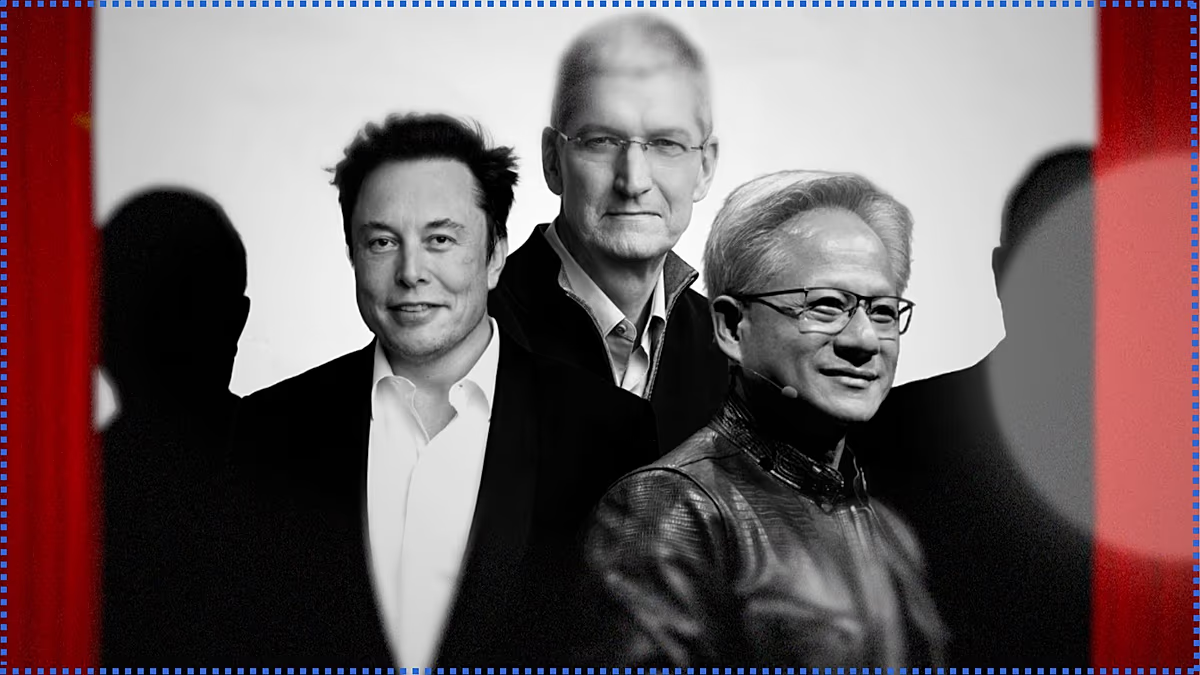


In mid-May 2026, a high-stakes gathering of the world’s most influential tech CEOs unfolded, serving as a stark snapshot of our current geopolitical and technological era. The central figures were Elon Musk, Tim Cook, and Jensen Huang, each representing a colossal corporate empire with deep, yet precarious, ties to China. Musk’s presence was twofold: to safeguard Tesla’s extensive manufacturing and market footprint in China, and to advance the interests of his artificial intelligence venture, xAI. For Tim Cook, this meeting marked a delicate chapter in his final lap as Apple’s CEO. His task was to balance the billions in revenue still flowing from the Chinese market against the complex, long-term strategic shift of moving Apple’s production lines out of China, a painstaking effort to diversify supply chain risk. Meanwhile, Nvidia’s Jensen Huang, often hailed as the “king of chips,” arrived with a urgent lobbying mission: to push for the sale of his company’s most powerful AI chips, like the H200, whose export is currently entangled in a web of U.S. and Chinese regulatory restrictions.
This summit was not merely a meeting of standalone titans; it was a convocation of the entire global tech supply chain. CEOs from Micron and Qualcomm were also in attendance, fighting battles on the front lines of the semiconductor war. Micron sought to overturn Beijing’s ban on its American memory chips, a significant blow in the fiercely competitive memory market. Qualcomm’s mission was to protect its entrenched role as the primary chip supplier for China’s dominant smartphone brands, a position threatened by rising domestic competitors and geopolitical friction. Their collective presence underscored a critical reality: the Silicon Valley-led tech ecosystem remains profoundly interdependent with China, a relationship now fraught with tension. The discussions transcended simple trade disputes, delving into the “new age” of AI-supported warfare and the palpable risk of Chinese firms replicating America’s frontier AI models. This gathering provided, in essence, a living portrait of the AI industry in practice—a field driven not just by code and algorithms, but by raw geopolitics, hardware access, and national security concerns.
Against this backdrop of U.S.-China tech rivalry, the position of Europe appears distinctly different, prompting a moment of sober reflection. If one searches for a European equivalent to OpenAI or Google—a hyperscale giant dominating the consumer-facing AI model space—the news is indeed grim. The continent lacks the concentrated capital, data scale, and risk-tolerant culture that have propelled American and Chinese firms to lead the generative AI revolution. However, this surface-level assessment misses a deeper, more strategic European narrative. The news is not all bad because Europe has been diligently securing a different, yet utterly vital, segment of the AI supply chain: the foundational hardware.
While the superpowers battle for supremacy in software models, European firms like STMicroelectronics, Soitec, and the Dutch crown jewel ASML are providing the essential tools to build those models. ASML manufactures the extreme ultraviolet lithography machines, without which the world’s most advanced chips cannot be etched. STMicroelectronics produces critical semiconductors, and Soitec engineers the sophisticated materials that enable them. This is a calculated bet on what European policymakers term “strategic autonomy”—the idea that you do not need to outspend the giants in flashy, end-user applications if you control the indispensable, specialized tools that drive the entire race. Europe is positioning itself as the indispensable enabler, the keeper of the technological keys.
This strategy of controlling the upstream supply chain raises a fundamental question: will it be enough for Europe to maintain relevance and power in the AI era? The answer is complex and hinges on perspective. One could, as the original text wryly notes, pose the question to a favorite AI agent. Yet the response would inherently be colored by the agent’s origin—whether it’s Elon Musk’s Grok, steeped in a Silicon Valley worldview, or France’s Mistral, reflecting European priorities and constraints. This divergence itself highlights the fragmentation of the AI landscape. Europe’s hardware-centric approach provides resilience and a crucial negotiating lever, but it may not yield the same cultural and economic influence as owning the dominant platforms that interact directly with billions of users.
Ultimately, the 2026 meeting encapsulates a world splitting into distinct technological blocs. The U.S. and China are locked in a direct duel over model supremacy and market access, a conflict encompassing commerce, security, and innovation. Europe, meanwhile, is carving out a third path as the strategic supplier, aiming for autonomy through indispensability. This triad of approaches will define the coming decade. The CEOs in that room were not just discussing tariffs or chip sales; they were negotiating the future architecture of global power, where AI is both the prize and the weapon. Their conversations underscored that the race is multidimensional—it is equally about who designs the most captivating AI, who manufactures the chips that run it, and who owns the machines that make those chips possible.
In conclusion, the full story, as detailed in the accompanying Euronews report, reveals a nuanced and high-stakes technological ecosystem. The era of simple globalized tech flow is over, replaced by a fragmented landscape of strategic competition, guarded supply chains, and divergent national strategies. Europe’s bet on hardware sovereignty offers a viable, though different, route to influence. The ultimate test will be whether controlling the foundational tools can secure not just economic stability, but also the capacity to shape the ethical, security, and societal directions of the AI age itself. As the world asks its AI agents for answers, the very design of those agents will increasingly depend on which geopolitical bloc built the physical components inside them.