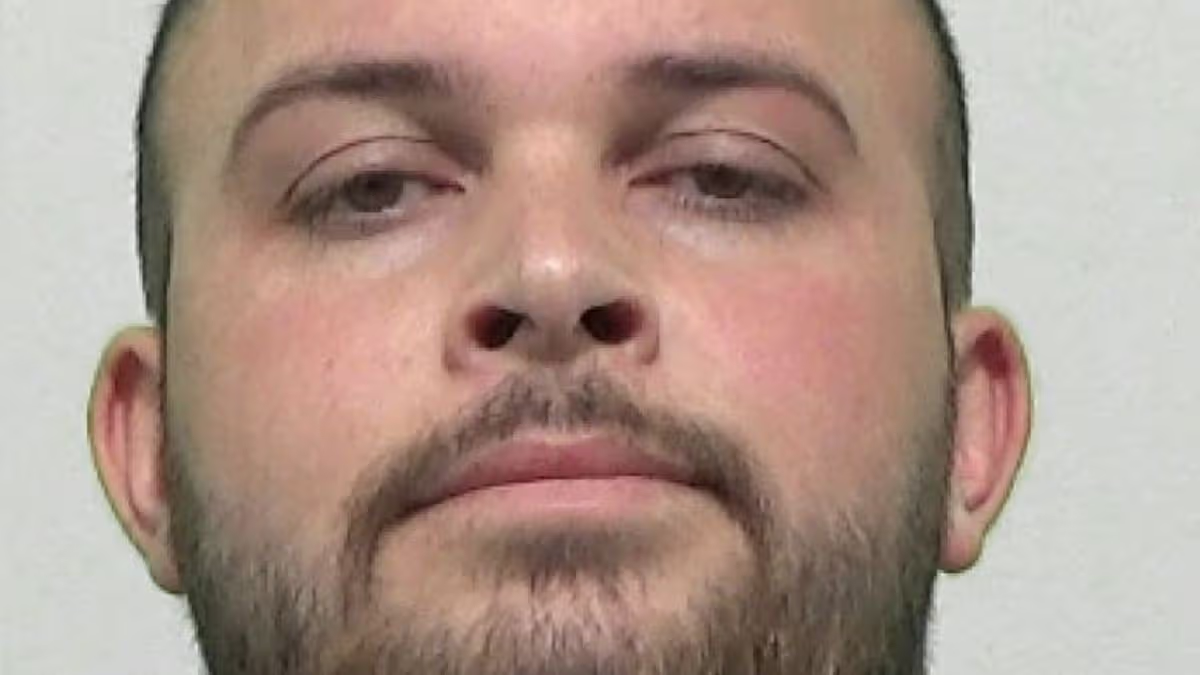




In a swift and dramatic turn of events, the long arm of the law has once again demonstrated its reach, capturing one of Britain’s most sought-after fugitives mere hours after his name was publicly spotlighted. Simon Dutton, a 49-year-old convicted drug smuggler from Bolton, found his time on the run cut short near the bustling Spanish coastal resort of Benidorm. His arrest in the quiet town of La Nucia underscores the relentless, coordinated efforts of international law enforcement. The National Crime Agency (NCA) had just unveiled its latest “Operation Captura” list—featuring twelve of the UK’s most wanted men believed to be hiding in Spain—when Spanish police moved in. Dutton, no stranger to arrest having been apprehended in a Greek bar in 2015 for a prison recall, was now back in custody, this time for far more serious crimes. The speed of his capture sends a powerful message to fugitives worldwide: publicity can quickly turn into peril.
The operation that netted Dutton was as cinematic as it was calculated. In the early morning hours, heavily-armed officers from Spain’s Civil Guard descended on a whitewashed villa. Bodycam footage released to the media shows the tense moments as police, shouting “Police, police!” in English, surrounded the property before forcing entry. This arrest was not an isolated incident but part of a broader crackdown on a network linked to drug trafficking and forgery in the Benidorm area, which also resulted in the detention of three other individuals. The investigation had begun months earlier, in November 2025, triggered by an alert from a conscientious courier firm manager in Benidorm who discovered a suitcase destined for the UK containing 16 kilograms of cannabis resin. This tip ignited an inquiry that would slowly unravel a criminal operation and, ultimately, lead to a man whose face was freshly plastered across wanted bulletins.
Dutton’s criminal profile paints a picture of a significant player in the underworld. In September 2016, he was sentenced to 14 years in prison for orchestrating large-scale cocaine imports and money laundering. His physical description—including the name ‘Rachel’ tattooed on his left arm and scars on his chin, left hand, and right leg—had been circulated by authorities, marking him as a man with a history etched both in his skin and in his criminal record. His inclusion on the NCA’s most wanted list was part of a campaign marking the 20th anniversary of Operation Captura, a multi-agency initiative that has seen remarkable success, with 98 out of 111 publicized fugitives apprehended. This campaign specifically targets individuals believed to be leveraging Spain’s popular expatriate regions, such as Tenerife, Marbella, Alicante, and Malaga, as havens from justice.
The Spanish Civil Guard, in their official statement, confirmed the arrest was of a fugitive on the UK’s Most Wanted list, for whom an International Arrest Warrant had been issued at the end of the previous year. They detailed how the drug trafficking investigation allowed them to identify and confirm Dutton’s involvement and presence. It was a convergence of two separate law enforcement tracks: a local drug probe and a targeted international manhunt. This synergy highlights the critical importance of cross-border cooperation and intelligence sharing in modern policing. Criminal networks may operate globally, but so too does the collective resolve to dismantle them, proving that borders are no longer barriers to justice.
For the communities in Spain’s coastal enclaves, often perceived as sunny retreats for tourists and expatriates, this event is a stark reminder of the hidden tensions that can simmer beneath the surface. The arrest lays bare the reality that these areas can sometimes be exploited as operational bases for serious organized crime. The public involvement, starting with the courier manager’s vigilance, also emphasizes the role that ordinary citizens and businesses play in safeguarding their communities. It is a narrative that transcends a simple police bulletin, touching on themes of safety, civic duty, and the ongoing battle against the drug trade that fuels violence and corruption across continents.
Ultimately, the capture of Simon Dutton is more than just the closing of a case file; it is a testament to persistence and collaboration. As he faces the prospect of serving his substantial sentence, the success of Operation Captura offers a measure of reassurance to the public. It demonstrates that even those who believe they have vanished into the crowd, aided by forged documents and foreign shores, can be found. Each arrest chips away at the infrastructure of crime networks and reinforces a fundamental principle: justice, though sometimes delayed, remains a persistent pursuit. The remaining names on the wanted list now stand as the next challenge, with law enforcement undoubtedly hoping that the rapid fate of Simon Dutton will hasten their journeys from hiding to holding cells.