


Amid the soft, predawn light of eastern Al-Bureij, 86-year-old Jadallah Masran begins a daily pilgrimage that has become a grim ritual for survival. Every morning at 5:30, he joins the silent, weary queue outside the nearest bakery—a journey he never imagined making in his twilight years. Once, as an elder, bread was delivered to his tent; now, dignity is a casualty of hunger. He stands for hours, a testament to the profound unraveling of daily life, waiting for a single loaf that now costs triple its former price. Masran’s story is not unique but emblematic, a piercing illustration of how the most basic human rhythms—the sharing of a meal, the respect for age—have been fractured for hundreds of thousands displaced across Gaza. His frail figure in the bakery line speaks volumes of a society brought to its knees, where the simple act of acquiring bread has become a central, exhausting struggle of existence.
The landscape of sustenance has been reduced to a monotonous and meager calendar dictated by charity kitchens, known locally as takaya. These communal pots, often operating only once or twice a week in many areas, have become the primary source of food for a displaced population. The meals they offer are a repetitive cycle of lentils, pasta, and mashed beans—a stark, beige diet where meat and fresh vegetables have virtually vanished. While some, like Luay Sahmoud from eastern Gaza, call lentils “a blessing” in a context where starvation is a constant threat, the soul-crushing monotony takes its own toll. Abdullah Zagout, displaced from Al-Shati Refugee Camp, voices a widespread exhaustion: “We’re sick of lentils.” For others, like Hassan al-Azzazi, the lack of variety has become so demoralizing that it pushes people to stop eating altogether, with food sometimes being thrown away—a shocking act in an environment of severe scarcity that underscores the human need for dignity and variety, not just calories.
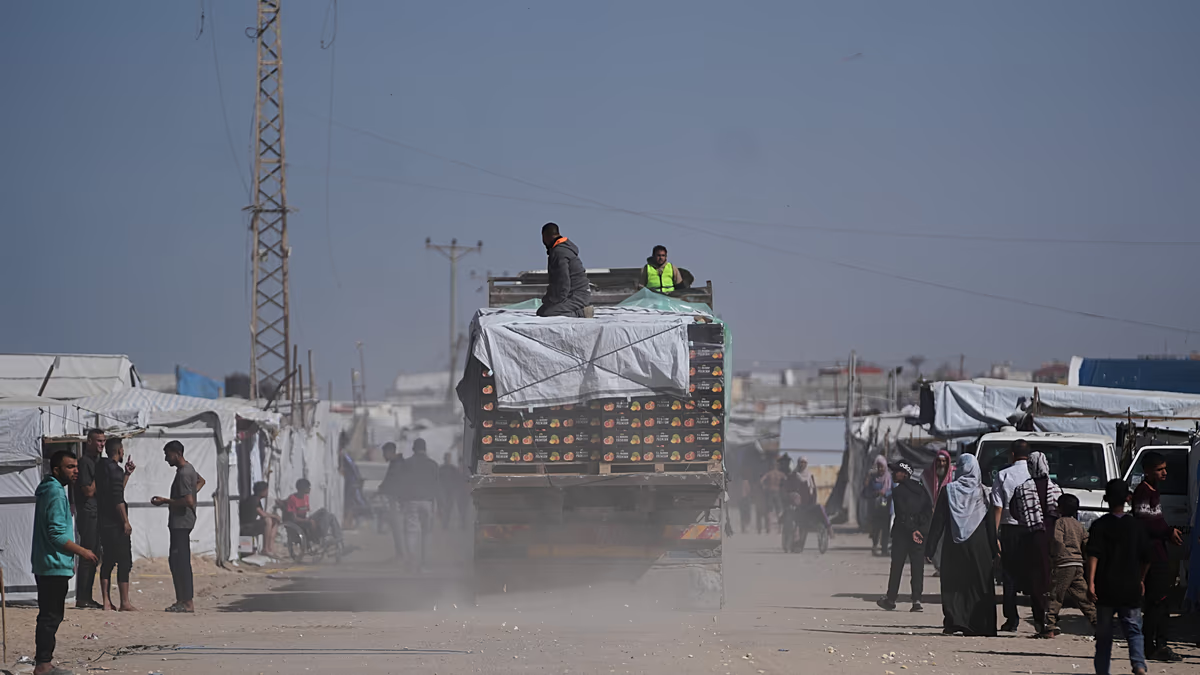
Behind this daily struggle for survival lies a staggering systemic collapse. According to the latest integrated assessments, roughly 77% of Gaza’s population—around 1.6 million people—face high levels of acute food insecurity. The humanitarian response, while heroic in its efforts, is critically overstretched and underfunded. Aid deliveries have plummeted by 37% following a period of relative calm after the October 2025 ceasefire, dropping from over 167,600 metric tonnes to fewer than 105,000. Agencies cite a confluence of logistical nightmares: reduced crossing operations, scanning malfunctions, increased cargo returns, and impediments within Gaza itself. Even as the World Food Programme distributes more than 400,000 hot meals daily and reaches over a million people monthly through all channels, it falls tragically short of the needs of 1.5 million displaced individuals. Most devastatingly, this failure is etched onto the bodies of the most vulnerable. A joint UN assessment projects over 100,000 children under five will suffer acute malnutrition, with no child between six and 23 months receiving the minimum dietary diversity required for healthy development.
Compounding the crisis is a tangled web of accountability and obstruction that diverts and diminishes the life-saving aid that does trickle in. Israel has repeatedly accused Hamas of systematically stealing aid convoys to finance its operations, imposing levies, and running a parallel distribution market. These claims find some corroboration from non-Israeli sources; the BBC reported Gazan sources describing significant aid diversions, and Palestinian Authority leader Mahmoud Abbas pointed the finger at Hamas-affiliated gangs. However, the narrative is deliberately complex and inconsistent. Senior Israeli military officials told the New York Times they found no evidence of Hamas regularly stealing from major UN operations, and USAID found no proof the group significantly benefited from U.S.-funded supplies. Instead, a murkier ecosystem of profiteering emerges, involving criminal gangs, powerful local families, and competing armed groups, all exploiting the chaos. This disorder creates a devastating “fog of war” around aid distribution, where the fundamental responsibility to protect civilian life becomes lost in a blizzard of accusations, while hungry families wait in vain.
The true cost of this fragmented and insufficient aid system is measured in more than just empty stomachs; it is a profound attack on the future. When two-thirds of children suffer from severe food poverty, surviving on two or fewer food groups, their physical and cognitive development is irreparably damaged. The warning from UN agencies is stark: the fragile humanitarian gains made after the ceasefire are teetering. With only 10% of the required funding for critical operations secured four months into the year, the specter of a rapid return to famine conditions looms large. Each day of eating only lentils, each morning spent in a breadline by an 86-year-old man, each report of a child missing key nutrients, represents a slow erosion of hope. The international community’s attention and resources have wavered, leaving humanitarian agencies to sound alarms that seem to fade into a backdrop of perpetual crisis.
Ultimately, the story of Gaza’s hunger is a story of human endurance in the face of systemic failure. From Jadallah Masran’s dawn vigil to the child deprived of dietary diversity, a collective resilience is being tested to its absolute limit. The charity kitchen, as Nasser Farwana from Rafah bleakly notes, “comes with suffering.” Yet, within that suffering, a desperate gratitude persists—for the lentils that stave off death, for the occasional piece of meat that breaks the monotony. This crisis is not a natural disaster but a man-made one, woven from the threads of conflict, obstruction, political impasse, and waning global solidarity. To read these accounts is to witness a society clinging to life, meal by meager meal, in a world that has allowed the most fundamental human right—the right to food—to become a daily negotiation with despair. Their endurance demands more than just pity; it demands an urgent, unimpeded, and fully funded humanitarian response that can restore not just calories, but dignity and a future.