

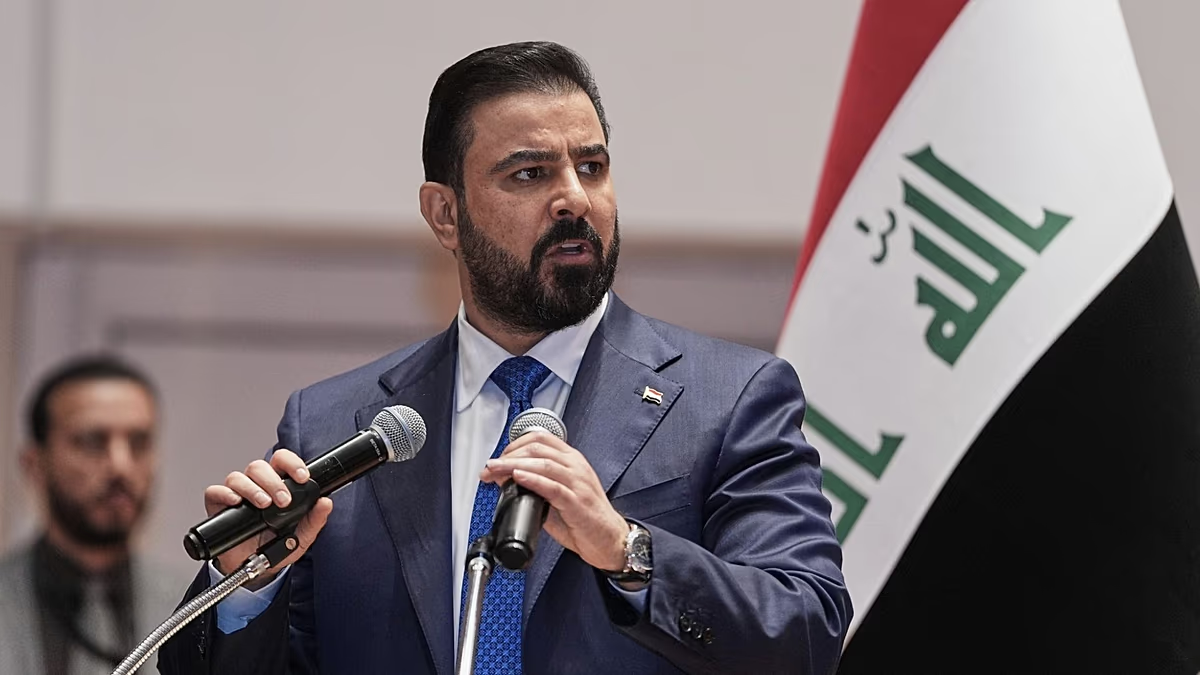
In a decisive move to break a prolonged political stalemate, Iraq’s parliament has approved a new government led by Prime Minister Ali al-Zaidi, who at forty becomes the nation’s youngest head of government. The vote, held just weeks after his designation, came amidst intense international pressure and internal fragmentation, underscoring the fragile state of Iraqi politics. Al-Zaidi’s immediate pledge was to assert a state monopoly over weapons—a direct response to growing U.S. demands to dismantle powerful Iran-backed militias that operate with significant autonomy. His broader vision, as outlined in a parliamentary program, is to position Iraq as a “balanced country” regionally and internationally, navigating the complex rivalries that define its geopolitics. However, the confidence vote itself revealed lingering divisions; only fourteen of twenty-three ministerial posts were approved, indicating that key political factions continue to negotiate over crucial portfolios, leaving the government’s full formation incomplete.
The ascent of Ali al-Zaidi marks a surprising turn in Iraqi leadership. A lawyer and businessman from Dhi Qar province, with backgrounds in finance and law, he previously chaired Al-Janoob Islamic Bank and built a career managing economic, educational, and medical institutions—but he had never held senior political office. His nomination emerged as a compromise after months of wrangling, notably following a U.S. veto of former Premier Nouri al-Maliki. American President Donald Trump had explicitly warned that U.S. support would be curtailed if figures closely aligned with Tehran returned to power. Al-Zaidi, while backed by the Coordination Framework—a ruling alliance of Shia groups with varying ties to Iran—is perceived as a figure who might bridge divergent interests. His selection thus reflects both domestic maneuvering and the undeniable weight of external influence, particularly from Washington.
Iraq’s geopolitical tightrope is immediately evident in the reactions from its two principal allies. Iran’s Foreign Minister Abbas Araghchi extended congratulations, emphasizing that strengthening “friendly and brotherly relations” with Baghdad remains a top priority. Simultaneously, senior U.S. diplomat Tom Barrack stated Washington’s readiness to work with al-Zaidi to advance shared goals of prosperity and the “elimination of terrorism.” This duality captures Iraq’s historical dilemma: since the 2003 invasion that overthrew Saddam Hussein, the U.S. has held major sway, but that same event paved the way for Tehran to embed its influence through Shia allies. The recent context is even more charged; after a U.S.-Israel intervention in Iran in late February, Tehran-backed groups in Iraq struck U.S. facilities over six hundred times before a ceasefire, prompting retaliatory American strikes. Washington’s pressure to disarm these groups is now a central, urgent demand.
Yet the path to a state monopoly on weapons is fraught with profound internal resistance. Several powerful Iraqi politicians have called for this consolidation, revealing sharp divisions. While some armed groups signal readiness to cooperate, others, like the Kataeb Hezbollah-linked parliamentary bloc head Hussein Mounes, vehemently oppose it. Mounes criticized the “clear and direct U.S. interference in shaping the political scene,” insisting that the issue cannot be resolved through external pressure. This stance underscores a core tension: for many groups, these militias are not merely armed factions but political and social entities woven into the fabric of post-2003 Iraq. Al-Zaidi’s pledge, therefore, is not just a policy shift but a potential reconfiguration of power that risks igniting serious conflict if not navigated with extreme delicacy and domestic consensus.
Beyond security, the new government faces monumental economic and diplomatic challenges. Al-Zaidi’s program prioritizes economic reforms, emphasizing diversification and investment in a country where oil accounts for nearly ninety percent of budget revenues. Recent disruptions in the Strait of Hormuz have already inflicted significant income loss, highlighting the vulnerability of this dependence. Diplomatically, Iraq must repair relations with Gulf countries, which have protested attacks by Iran-backed groups on their territory during the recent conflict. This requires al-Zaidi to perform a careful balancing act: reassuring Gulf neighbors of Iraq’s stability and sovereignty while managing the expectations and influence of Iran, all under the watchful eye of a demanding United States.
The installation of Ali al-Zaidi’s government thus represents both a fragile hope and a formidable test. It is a hope for breaking deadlock, for imposing state authority over a fractured security landscape, and for steering Iraq toward a more balanced and economically resilient future. But it is a test of whether a newcomer to high politics, supported by a fragmented coalition, can reconcile irreconcilable pressures—from within, where armed groups hold real power; from Tehran, which seeks continued influence; and from Washington, which demands demilitarization and alignment. The approval of his government is a first step, but the true measure of success will be in navigating these intersecting crises without triggering further instability. Iraq’s journey toward sovereignty and peace remains precarious, and al-Zaidi’s tenure will be defined by his ability to translate promises of balance into tangible, sustainable outcomes.