


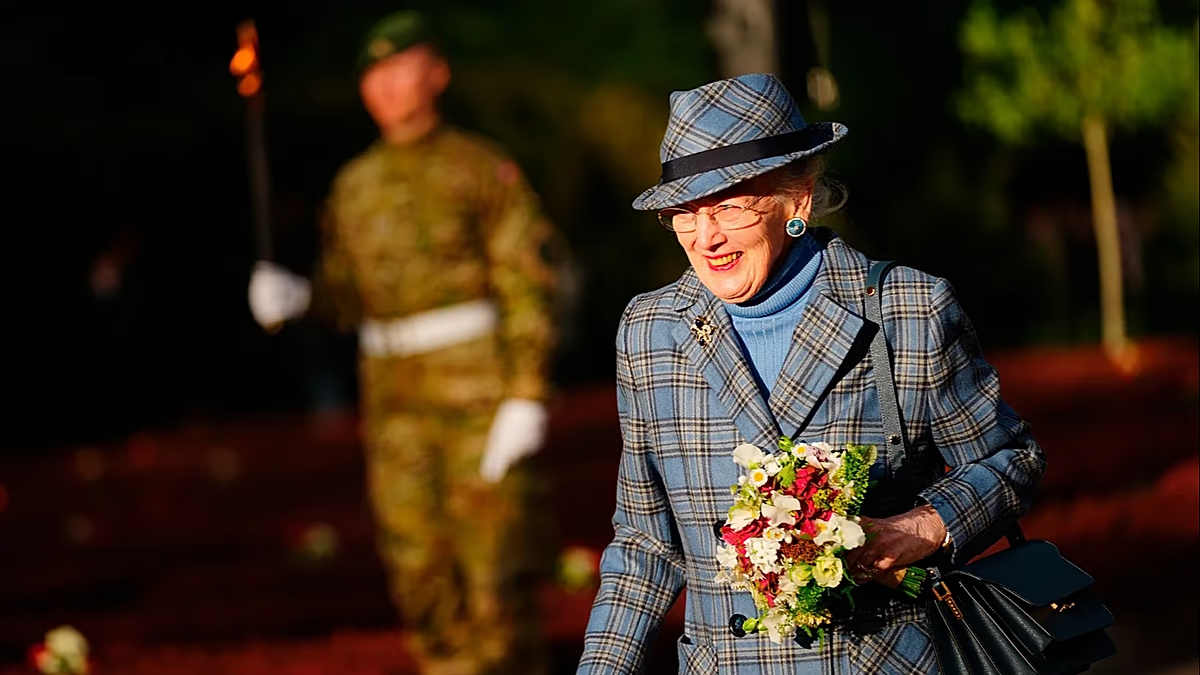
Following an unexpected hospitalization this week for chest pain, Denmark’s former sovereign, Queen Margrethe II, has successfully undergone an angioplasty procedure. The royal court announced on Friday that the 86-year-old queen, who abdicated just last year, had a “balloon dilation of a coronary artery” at Copenhagen’s Rigshospitalet. Admitted on Thursday, she was reported to be in good condition following the intervention, though she will remain under medical supervision for a few more days. This health update has understandably concerned the Danish public, for whom Margrethe remains a deeply beloved figure, even in her retirement from the throne. The news is a poignant reminder of the advanced age of Europe’s longest-serving monarch until her abdication, a status she held for 52 remarkable years.
This recent health episode inevitably brings the queen’s lifetime habit of chain-smoking into focus, a well-known and often-discussed aspect of her personal life. While the palace statement did not directly link her habits to the current cardiac issue, the association between prolonged smoking and heart health is universally understood. It adds a layer of very human complexity to a figure who has always defied simple royal archetypes. Notably, her commitment to duty was so profound that she had long and famously vowed never to abdicate. It was only after a major back surgery in 2023, which significantly limited her mobility and ability to fulfill her role, that she made the momentous decision to step down, passing the crown to her eldest son, King Frederik X, in January 2024.
Her abdication, however, did not signal a retreat from public life or her passions. Merely weeks before her hospitalization, the energetic former queen was spotted attending the 80th birthday celebrations of Sweden’s King Carl XVI Gustaf, demonstrating her enduring presence within European royal circles. This vitality in retirement aligns perfectly with the unique character she has always exhibited. Queen Margrethe was never a remote, ceremonial figurehead; she was, and remains, an intensely creative and intellectual force. Her reign was defined by a subtle but steadfast modernisation of the Danish monarchy, making it more accessible and relatable without sacrificing its dignity, which cemented her huge popularity across the nation.
To know Queen Margrethe is to appreciate her profound identity as an artist. Her creative pursuits are far from mere hobbies; they are central to her being and are pursued with professional rigor. She is an accomplished illustrator, having famously created delicate and insightful drawings for editions of J.R.R. Tolkien’s The Lord of the Rings. As a designer, her talents extend to the cinematic world, where she won a Robert Award (the Danish equivalent of an Oscar) for Best Costume Design in 2024. Furthermore, alongside her late husband, Prince Consort Henrik, she worked under a pseudonym as a literary translator, bringing works like Simone de Beauvoir’s All Men Are Mortal into Danish. This rich, artistic inner life provided a fascinating counterpoint to her royal duties.
It is this very blend of regal duty and profound humanity that has endeared her so deeply to the Danish people. They saw in her not just a queen, but a resilient, talented, and sometimes stubbornly individual woman who smoked in public, painted in her studio, and led the nation with a quiet, unwavering competence. Her decision to abdicate, though a break from her lifelong promise, was ultimately seen as a responsible and thoughtful act, ensuring the monarchy’s stability by transferring the role while she could still guide the transition. This final, major decision was made not for personal ease, but from a clear-eyed assessment of her physical limitations and the institution’s needs.
Therefore, the news of her angioplasty is met with a nation’s collective hope for her swift and complete recovery. It is a wish extended not just to a former head of state, but to a national treasure—a chain-smoking, Tolkien-illustrating, de Beauvoir-translating icon who redefined what a modern monarch could be. As she rests in Rigshospitalet, the thoughts of Denmark are with a woman who gave four decades of tireless service and who continues to inspire through her intellectual and artistic curiosity. Her legacy is already secure, woven into the fabric of Danish culture itself, and her current challenge is simply a reminder of the mortal frame that houses such an extraordinary spirit. The nation eagerly awaits the announcement that she is back on her feet, likely with a sketchbook in hand.