



Of course. Here is a humanized summary of the article in six paragraphs, capturing the key points and excitement of the mission.
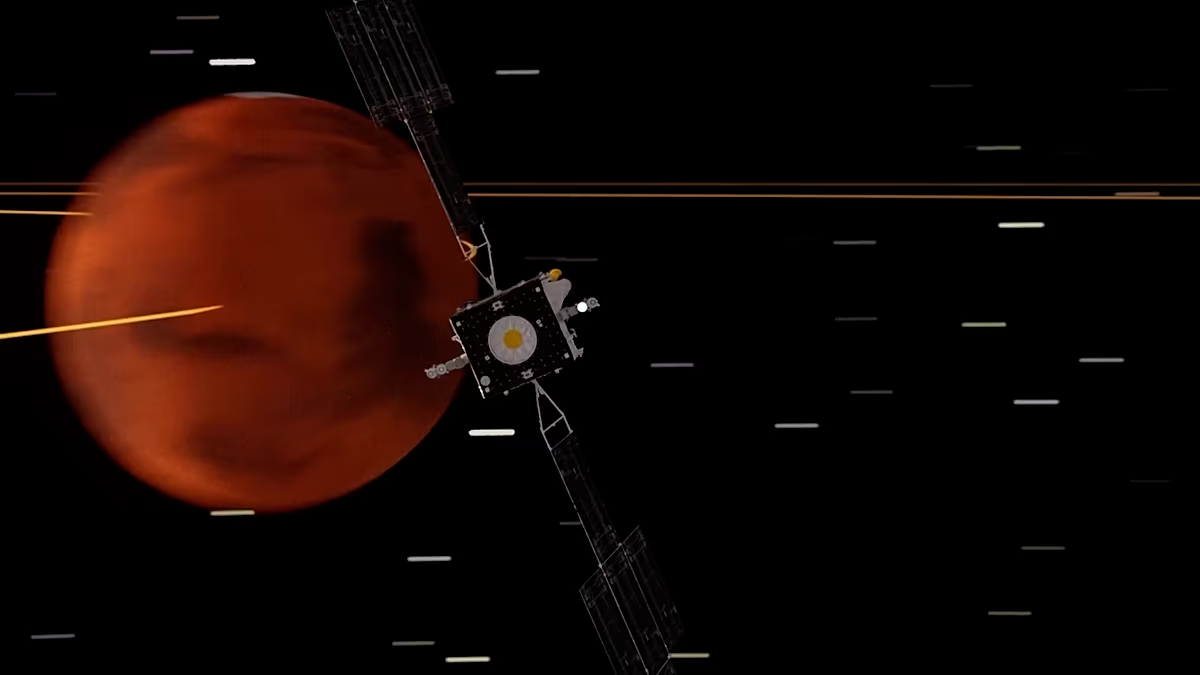
In a celestial dance of precision and ambition, NASA’s Psyche spacecraft is poised for a pivotal maneuver on Friday: a gravity-assisted flyby of Mars. This isn’t just a scenic detour; it’s a crucial step in the spacecraft’s long journey to rendezvous with its namesake, the rare metal-rich asteroid Psyche. The mission’s ultimate goal is profound—to unlock secrets about the violent birth of our own planet and others in the solar system. By harnessing Mars’s gravity, the spacecraft will gain both speed and a necessary change in trajectory, efficiently aligning itself for its path toward the asteroid belt between Mars and Jupiter. As Don Han, Psyche Navigation Team Lead, explains, this natural “slingshot” effect is far more efficient than attempting such a complex course change using rocket fuel alone.
As Psyche races past Mars at breathtaking speeds nearing 20,000 kilometers per hour, it will skim within 4,500 kilometers of the planet’s surface. This close encounter is not passive; it’s an active test and calibration opportunity. The spacecraft’s instruments will be fully engaged, capturing images of Mars as it transforms from a crescent to a nearly full sphere in the rear-view. Scientists will use these changing vistas to fine-tune their equipment. Furthermore, this event will become a coordinated scientific campaign, with NASA’s Martian rovers and orbiters from both American and European agencies conducting simultaneous observations. This allows for a rich comparison of data, cross-validating findings from different vantage points and technologies.
Launched in 2023, the Psyche mission is a marathon endeavor, expected to span approximately seven years. It is currently halfway through its epic voyage, with arrival at the asteroid slated for 2029. Upon reaching its target, the spacecraft will embark on a two-year orbital study, scrutinizing an object unlike any visited before. Scientists speculate that asteroid Psyche may be the exposed, metallic core of a primordial planetesimal—an early planetary building block—whose outer rocky layers were stripped away billions of years ago in the chaotic collisions of the young solar system. This hypothesis makes Psyche a unique relic, offering a direct look at a planetary interior otherwise inaccessible to us.
The implications of studying this metallic world are monumental. Researchers hope that by examining Psyche up close, they will gain unprecedented insights into what lies deep within Earth’s own core and refine our understanding of how rocky planets formed 4.6 billion years ago. Libby Jackson, Head of Space at the Science Museum, captures the collective anticipation: “No spacecraft has ever flown to this kind of asteroid before, something that’s really a big lump of metal.” The mission promises to answer fundamental questions about Psyche’s true nature and, by extension, the processes that shaped our cosmic neighborhood. Jackson adds, “I’m certain that whatever it is will tell us more about the evolution of planets in our solar system and the Earth.”
Asteroid Psyche itself is a fascinating subject. Discovered in 1852, it has captivated astronomers for over 170 years due to its unusual composition. While the asteroid belt contains millions of rocky and icy bodies, Psyche is among a rare few believed to be rich in metal. It is an immense object, roughly 280 kilometers across at its widest and spanning about 232 kilometers in length, with a surface area comparable to a large country. Believed to be one of the oldest observed objects in the solar system, its distance from Earth varies greatly as both follow their independent orbits around the Sun, ranging from about 186 million to over 372 million miles away.
The Mars flyby is thus a critical inflection point in a journey of discovery. It propels the Psyche spacecraft not only toward a distant, metallic asteroid but also toward answering some of our most enduring questions about planetary formation. As the mission progresses, each step—from this gravity assist to the final orbital analysis—brings us closer to understanding the violent, creative processes that forged Earth and the other rocky worlds of our solar system. The data gathered may very well rewrite chapters in the story of our cosmic origins, making this long voyage a foundational investment in the science of our past.