




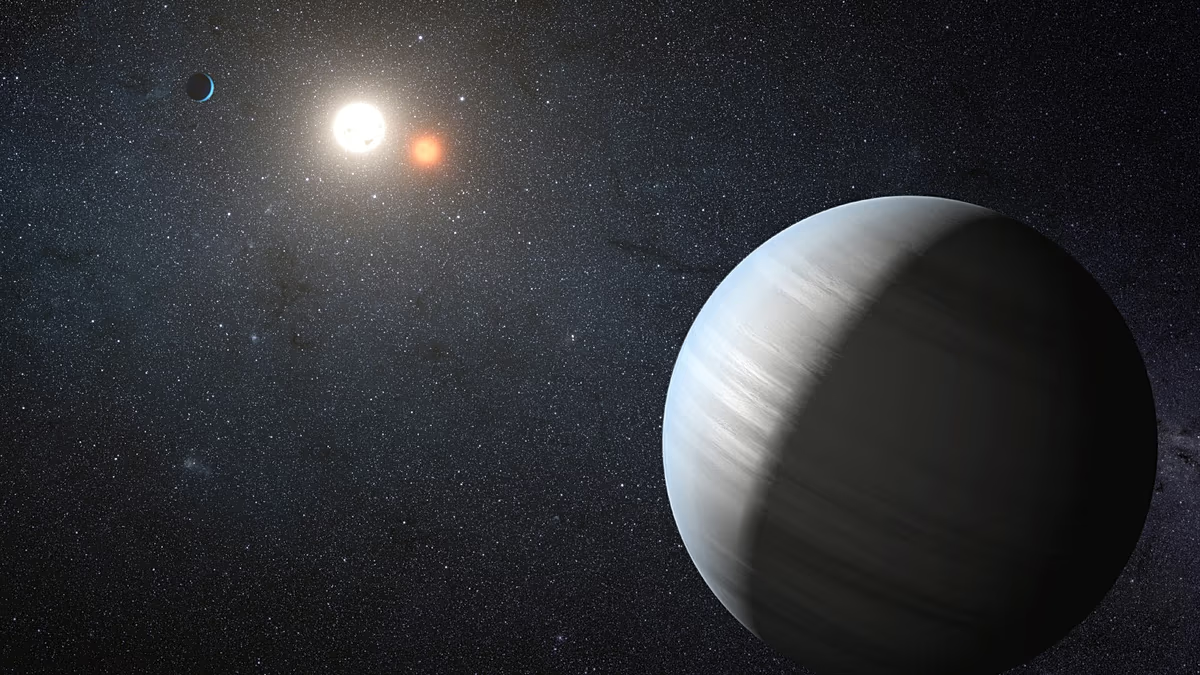
In the vast cosmic catalog of discoveries, astronomers have long been captivated by the possibility of planets orbiting two suns – a celestial scenario once confined to the realm of science fiction, immortalized by the twin-sunset on Luke Skywalker’s homeworld of Tatooine. For years, detecting these “circumbinary” planets has relied on a stroke of cosmic luck: the planet must pass directly in front of one of its stars from our viewpoint on Earth, causing a telltale dimming of light. This method, while successful, has a significant limitation. It requires a perfect alignment, leaving any system tilted even slightly away from our line of sight invisible to our telescopes. Consequently, only about 18 such planets have been confirmed to date, making them exceptionally rare finds. Now, a groundbreaking study led by Margo Thornton of the University of New South Wales and the SETI Institute has pioneered a radical new technique that bypasses this alignment problem entirely, potentially throwing open the doors to a hidden population of these exotic worlds.
The research, published in the Monthly Notices of the Royal Astronomical Society, employed a clever and indirect detective method. Instead of looking for a planet itself, the team used NASA’s Transiting Exoplanet Survey Satellite (TESS) to scrutinize the intricate dance of 1,590 pairs of eclipsing binary stars—systems where two stars orbit each other and periodically eclipse one another’s light. The key was to measure, with exquisite precision, the exact timing of these stellar eclipses over years of observations. The team was watching for a phenomenon known as apsidal precession, a gradual wobble or rotation in the elliptical orbit of the binary stars themselves. When an unseen planet orbits such a pair, its gravitational tug disturbs the stars’ delicate choreography, causing minuscule but cumulative shifts in the timing of their eclipses. By tracking these subtle changes—a method akin to noticing a clock running consistently fast or slow due to an unseen influence—the astronomers could infer the presence of a planetary companion without ever directly seeing it.
This meticulous forensic analysis of the stellar data yielded remarkable results. Out of the 1,590 systems studied, 71 showed signs of orbital changes that could not be explained by known astrophysical effects alone. Drilling down further, the team identified 36 cases where an additional gravitational influence was the most plausible cause. Of these, they concluded that 27 systems most likely host a planet-sized object. This represents a potential near-doubling of the known catalog of circumbinary planets in a single study. Notably, some of these candidate planets orbit hot, massive stars, environments where traditional transit methods struggle to find planets, demonstrating the unique power of this new timing technique. It reveals worlds that have been hiding in plain sight, their presence betrayed only by the barely perceptible hiccups in the clockwork rhythm of their twin suns.
The significance of this discovery extends far beyond simply adding new entries to a list. First and foremost, it validates a powerful new tool for planetary hunting. The eclipse timing variation method can uncover planets in systems that are not ideally aligned for transit observations, effectively allowing astronomers to peer into previously inaccessible cosmic architectures. This means we are no longer waiting for a fortunate geometric coincidence; we can actively probe the dynamics of binary systems. Furthermore, each new circumbinary planet provides a crucial data point for testing our theories of planet formation and survival. It is an enormously chaotic and energetic environment, with the gravitational pulls of two stars creating complex and often unstable zones. Understanding how planets coalesce and persist in such turbulent nurseries challenges and refines our models of planetary birth across the galaxy.
Looking ahead, the potential of this method is staggering. The researchers themselves note that their sample of 1,590 binaries is merely “a small fraction” of the estimated 2 million eclipsing binary systems cataloged by the European Space Agency’s Gaia mission. Their current findings are based on the observational baseline provided by TESS so far. As TESS and other missions continue to gather data over more years, these longer timelines will make the tiny timing signals even clearer and easier to distinguish. A systematic search through the vast Gaia catalog, guided by this proven technique, could unveil a torrent of new circumbinary systems in the coming decade. We may be on the cusp of discovering that planets with twin suns are not the rare marvels we once thought, but perhaps a common and fascinating variant in the diverse family of planetary systems.
In essence, this work represents a paradigm shift in how we search for other worlds. It moves from a passive observation of shadows to an active reading of gravitational whispers. By listening to the precise heartbeat of binary stars, astronomers have tuned into a new frequency for detecting planets, one that promises to reveal a richer and more complex symphony of celestial mechanics. Each candidate planet identified is not just a new world, but a testament to human ingenuity—our ability to devise ever-more clever ways to interpret the faint signals from the cosmos and piece together the hidden stories of distant star systems. The fictional sky of Tatooine now seems less like a cinematic wonder and more like a预告 of the profound diversity that awaits discovery in our very real universe.