



Of course. Here is a humanized and expanded summary of the provided content, crafted into six detailed paragraphs.
Paragraph 1: The Gravity-Defying Playground Near Bordeaux
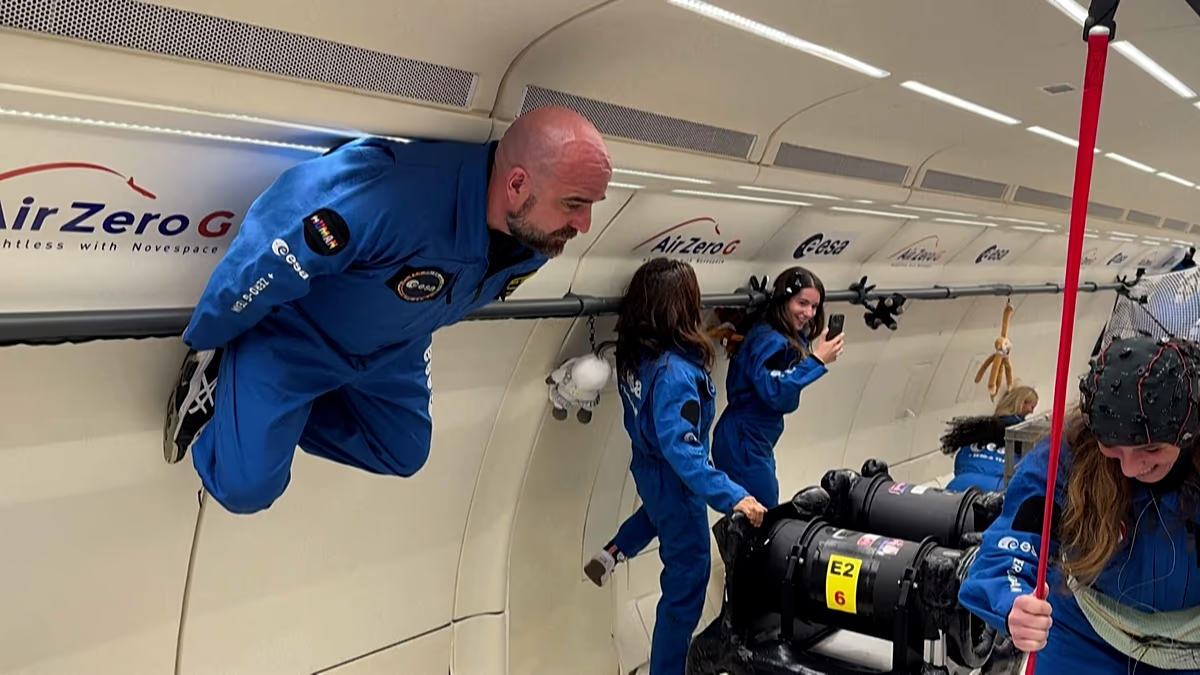
High above the vineyards of southwestern France, a remarkable scientific ballet is taking place. Near the city of Bordeaux, researchers are not confined to Earth-bound laboratories; instead, they are taking to the skies in a specially modified aircraft to literally flirt with the absence of gravity. These are parabolic “zero-gravity” flights, where an airplane flies in steep, roller-coaster-like arcs to create brief periods of weightlessness inside its cabin. For about 20 to 25 seconds at the apex of each climb and dive, everything and everyone inside is freed from Earth’s pull, floating in a state of simulated microgravity. This unique airborne laboratory provides a crucial and accessible testing ground for experiments that seek to understand how the fundamental force of gravity shapes life and physical processes.
Paragraph 2: A Laboratory in Motion, From Cells to Astronauts
The scope of research conducted on these flights is breathtakingly diverse, bridging biology, physics, medicine, and technology. Scientists are running experiments on everything from the intricate workings of human physiology to the strange behavior of fluids and materials in space. A major focus is on the human body itself, investigating profound questions: How do our internal fluids shift without gravity to guide them? What happens to our sense of balance and spatial orientation when the inner ear’s gravitational cues disappear? These are not merely academic questions but are vital for preparing astronauts for long-duration missions to the Moon or Mars, where prolonged weightlessness can lead to muscle atrophy, bone loss, and cardiovascular deconditioning.
Paragraph 3: The Human Body’s Cosmic Adjustments
Delving deeper into the physiological studies, the experiments on fluid shifts are particularly telling. On Earth, gravity pulls our bodily fluids downward, but in microgravity, fluids redistribute evenly, often migrating toward the head. This can cause the familiar “puffy face” seen in astronauts, increased intracranial pressure, and changes in eye structure and vision—a serious concern for space agencies. Simultaneously, scientists are meticulously studying human balance, or the vestibular system. By observing how test subjects—often researchers themselves—struggle to orient themselves, catch balls, or simply point accurately during those fleeting weightless moments, they gain insights that could lead to better training protocols and countermeasures to keep space explorers safe and functional.
Paragraph 4: Beyond Biology: Fluids, Flames, and Future Tech
The research extends far beyond human biology. The behavior of common substances becomes fascinatingly alien in microgravity. Without gravity-driven convection (where hotter fluids rise and cooler ones sink), flames form perfect spheres, and boiling occurs in unexpected ways. Scientists study these phenomena to develop safer life-support systems and more efficient combustion engines. Furthermore, the quiet environment of free-fall allows for the precise manipulation of materials. Researchers can mix alloys or grow protein crystals without the distorting effects of container walls or sedimentation, potentially leading to breakthroughs in pharmaceuticals and advanced manufacturing techniques for use both in space and back on Earth.
Paragraph 5: The Accessible Gateway to Space Science
What makes the Bordeaux flights so pivotal is their role as an accessible gateway to space research. While the International Space Station offers a permanent microgravity environment, getting an experiment there is costly, complex, and involves years of planning. Parabolic flights, operated by agencies like the French space agency CNES or commercial outfits like Novespace, offer a faster, more frequent, and relatively affordable alternative. They allow scientists to test the feasibility of their ideas, troubleshoot equipment, and gather preliminary data. For a young researcher or a university team, a parabolic flight campaign can be the first, thrilling step toward a future experiment on a satellite or a lunar base.
Paragraph 6: A Legacy of Discovery Pointing to the Future
In essence, these arcs in the sky over France represent a profound investment in our future as a spacefaring species. Every parabola flown is a step toward understanding the challenges of living beyond Earth, protecting the health of our explorers, and harnessing the unique environment of space for technological and scientific advancement. The work connects directly to upcoming missions, informing the design of spacecraft, habitats, and medical kits. As we stand on the cusp of a new era of lunar exploration and dream of voyages to Mars, the knowledge gained in these brief, repeated bursts of weightlessness will be foundational, ensuring that humanity can not only travel to the stars but thrive there.