




A Dream Spanning the Strait: Italy’s Quest for the World’s Longest Bridge
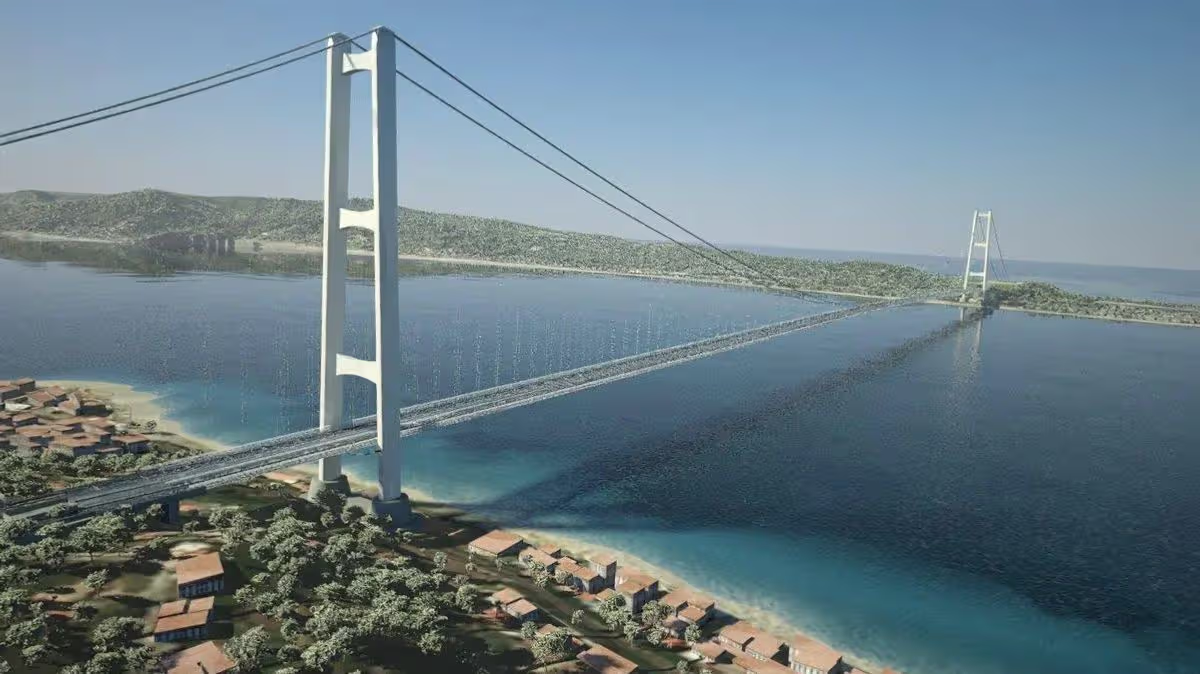
For decades, a dream has persisted in the Italian imagination: to physically unite the country’s mainland with the island of Sicily, bridging the tempestuous Strait of Messina. This vision, the Messina Bridge project, was reignited in 2025 when the Italian government, under Prime Minister Giorgia Meloni, granted formal approval to construct what would become the world’s longest suspension bridge. The ambition is staggering—to create a 3.3-kilometer (2.05-mile) architectural titan featuring twin towers soaring 400 meters high, with three lanes of traffic flanking two central railway lines. Proponents, like Pietro Salini of the lead engineering firm Webuild, hail it as a transformative national project, promising to stimulate growth, create 120,000 jobs annually, and bring economic revitalization to the historically underdeveloped regions of Calabria and Sicily. For travelers, especially Brits touring Italy, the bridge would revolutionize access, shrinking a cumbersome ferry journey—often plagued by long queues extending a short crossing into a multi-hour ordeal—into a seamless ten-minute drive.
A History of Hesitation and Hope
However, the path to this engineering marvel is fraught with historical skepticism and formidable challenges. The Messina Bridge is not a new concept; it is a specter that has loomed over Italian politics and infrastructure debates for generations, perpetually caught between grand aspiration and harsh reality. Each time plans have neared fruition, they have been scrapped due to a potent cocktail of concerns. Foremost among these is the fear of Mafia infiltration, with long-standing anxieties that the colossal budget—estimated at a staggering £11.7 billion—could become a target for fraud and siphoning by organized crime groups in Sicily and Calabria. Furthermore, the bridge’s location sits in one of the most seismically active zones in the Mediterranean, raising urgent questions about safety and structural resilience in the face of powerful earthquakes. Despite these persistent hurdles, the current government frames the project as a necessary challenge. Meloni has stated, “We like difficult challenges when they make sense,” positioning the bridge as an investment in Italy’s future.
The Colossal Challenge: Nature, Law, and Community
The project’s ambitions must contend with immense environmental, legal, and human obstacles. Environmental groups have repeatedly warned of irreversible damage to the unique ecosystem of the Strait of Messina, a critical migratory route for birds and marine life. In a significant blow in late 2025, an Italian court, the Court of Auditors, ruled that the project violated European Union environmental and public tender regulations, stating that its public interest justifications were “not supported by adequate documentation.” This ruling has placed the project on hold once again. Beyond bureaucratic and legal battles, there exists a profound human cost. Approximately 4,000 residents living on the banks of the strait face the potential demolition of their homes, promising fierce local opposition and complex legal battles over property rights and community displacement. The government must now navigate this intricate web of EU oversight, environmental advocacy, and community resistance to advance its goal.
The Current Record-Holder: A Bridge Between Continents
While Italy dreams of its future landmark, the current titleholder for the world’s longest suspension bridge resides in Turkey. The 1915 Çanakkale Bridge, opened in 2022, is a monumental feat in its own right, spanning the Dardanelles Strait to connect Europe and Asia. Its construction, which began in 2017, has had a transformative effect, slashing a 90-minute ferry journey to a mere six-minute drive—a 93% reduction in travel time. This bridge stands as a tangible example of how such infrastructure can reshape regional connectivity and economy. It serves as both an inspiration and a point of comparison for the Italian endeavor, demonstrating the achievable benefits while also highlighting the unique and perhaps even greater set of challenges presented by the Messina Strait’s volatile geology and deep-seated socio-political complexities.
The Unyielding Political Will
Despite the November 2025 court ruling, the Italian government has signaled a defiant determination to proceed. Transport Minister Matteo Salvini has publicly recommitted to the project, outlining a target completion window between 2032 and 2033. The political narrative frames the bridge as more than concrete and steel; it is portrayed as a symbol of national unity, technological prowess, and a catalyst for reclaiming the economic potential of the South. The government vows to carefully review the court’s objections and navigate the required approvals, suggesting a willingness to adjust plans to meet legal and environmental standards. This unyielding political will ensures the project remains alive, sustained by the promise of legacy and the potent allure of holding a global engineering record.
An Uncertain Future Across the Water
As of now, the Messina Bridge exists in a state of suspended animation—a spectacular vision caught between the drawing board and reality. Its fate hinges on the Italian government’s ability to convincingly address the legitimate concerns of courts, environmentalists, and local communities, all while securing unprecedented financial investment in a region shadowed by the threat of seismic activity and corruption. The project embodies the eternal clash between human ambition and natural and social constraints. Whether the dream of a ten-minute connection to Sicily will materialize by 2033, or join the long list of Italy’s postponed ambitions, remains one of Europe’s most captivating infrastructure sagas. The world watches to see if Italy can turn its decades-old dream into a record-breaking reality.