


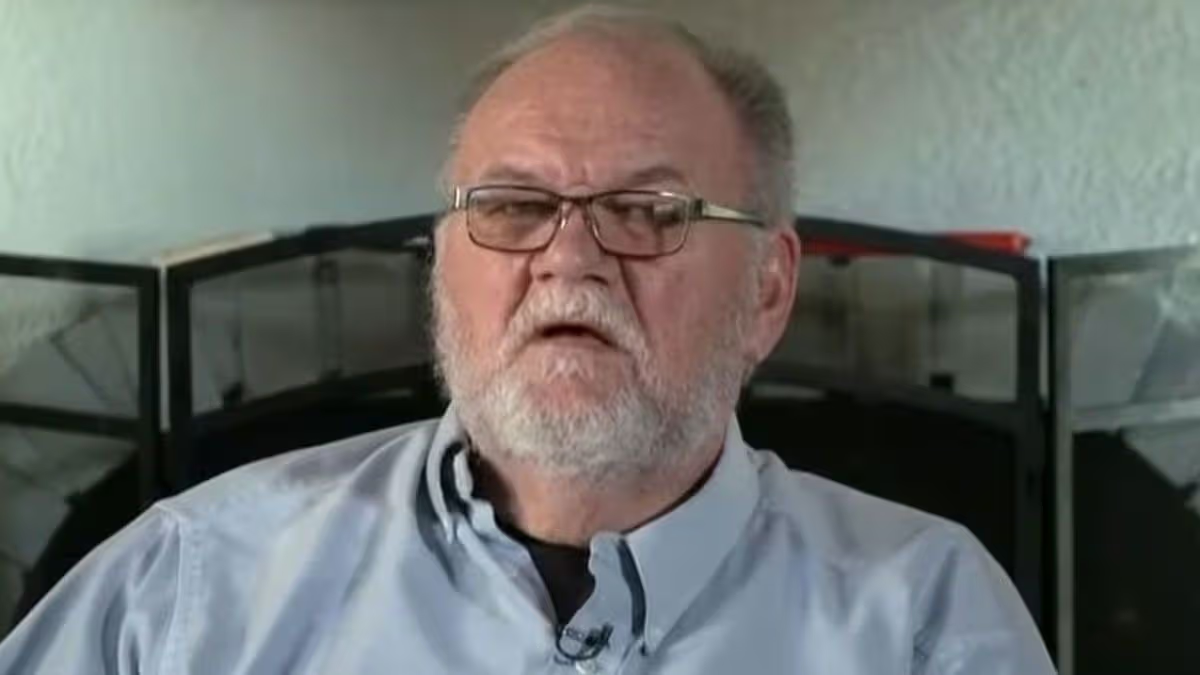
In May of last year, a report in The Sunday Mirror painted a poignant picture of Thomas Markle Sr., the 81-year-old father of Meghan, Duchess of Sussex. Having long been estranged from his daughter and the British Royal Family, he had sought a new life far from the glare of the international spotlight, relocating over 7,000 miles away to the island of Cebu in the Philippines. There, he was living a modest existence in a high-rise apartment costing roughly £500 per month, cared for by his son, Thomas Markle Jr. Photographs captured him sitting alone in the blistering heat, a world away from the opulence and ceremony of his daughter’s life. This move was portrayed as a final chapter of quiet solitude, a deliberate distancing from the painful, public rift that had defined his relationship with Meghan since just before her wedding to Prince Harry in 2018.
However, a devastating health crisis has dramatically altered that course. In December, Thomas Markle suffered a life-threatening medical emergency when a blood clot in his left thigh cut off circulation to his foot. To save his life, doctors in the Philippines were forced to perform a three-hour operation to amputate his leg below the knee. Following the surgery, he faced a grueling period of recovery and rehabilitation. While praising the “care and compassion” of the Filipino medical staff who saved him, the practical realities of his ongoing care—particularly the fitting of a sophisticated prosthetic limb—necessitated a major decision. This month, after nearly a year abroad, he has returned to the United States to access specialized medical treatment and to be closer to friends and family for support.
This return to American soil marks a significant personal and emotional transition. His elder daughter, Samantha Markle, has stated that while the amputation was a traumatic ordeal, it has also been a “positive spiritual experience” for their father. The focus now is squarely on his physical recovery: undergoing therapy, completing rehab, and being fitted with what his family calls a “state-of-the-art” prosthetic to help him walk again. Yet, this practical move is deeply interwoven with the unresolved emotional narrative of his estrangement. Thomas Markle has never met his son-in-law, Prince Harry, nor his two grandchildren, Archie and Lilibet. The fracture with Meghan remains, despite a brief moment of contact when, following his operation, Meghan’s representatives stated she had “reached out” with a letter delivered to his hospital bedside via embassy officials.
Financially, the situation appears strained. His son, Thomas Jr., has previously claimed that their father’s health insurance would not cover the considerable costs of his long-term care and prosthetic fitting, and he has asserted that Meghan has not contributed financially to her father’s medical needs. This adds a layer of pragmatic anxiety to an already difficult family dynamic. The goal, as stated by his family, is singular: to get him walking again. But this physical journey towards mobility exists in parallel with his expressed longing for an emotional reconciliation. He has openly told media of his desire to be reunited with Meghan before he dies, a wish that hangs over this new chapter of convalescence in the US.
His time in the Philippines was not defined solely by isolation or illness. During his recovery, Thomas Markle formed a close bond with a 46-year-old Filipino nurse named Rio Canedo, a divorced mother of two who cared for him in rehab. He credits her with helping him find the will to recover, lose weight, and regain his strength. Reports indicate she accompanied him to the airport for an emotional farewell as he departed for the United States, and they plan to maintain their connection through video calls, with hopes of her visiting him in America soon. This relationship, with a woman just two years older than his own daughter, represents a profound human connection forged in a period of extreme vulnerability, offering a counter-narrative of companionship and care amidst the family discord.
Thus, Thomas Markle’s story is one of stark contrasts and profound human experiences: from a self-imposed exile in a modest Philippine flat to a life-saving amputation; from a very public familial estrangement to a private bond with a caregiver; and now, from a planned quiet life abroad to an urgent return home for advanced medical care. His journey is no longer just about distance from royalty, but about survival, resilience, and the basic human needs for healing, support, and perhaps, before time runs out, forgiveness. As he settles into an undisclosed location in the US, surrounded by some family and focused on the arduous path to walking with a new prosthetic, his private hopes for reconciliation remain a powerful, unresolved subtext to this very public tale of an ordinary man caught in an extraordinary family saga.