

Here is a humanized and expanded summary of the content, structured into six paragraphs:
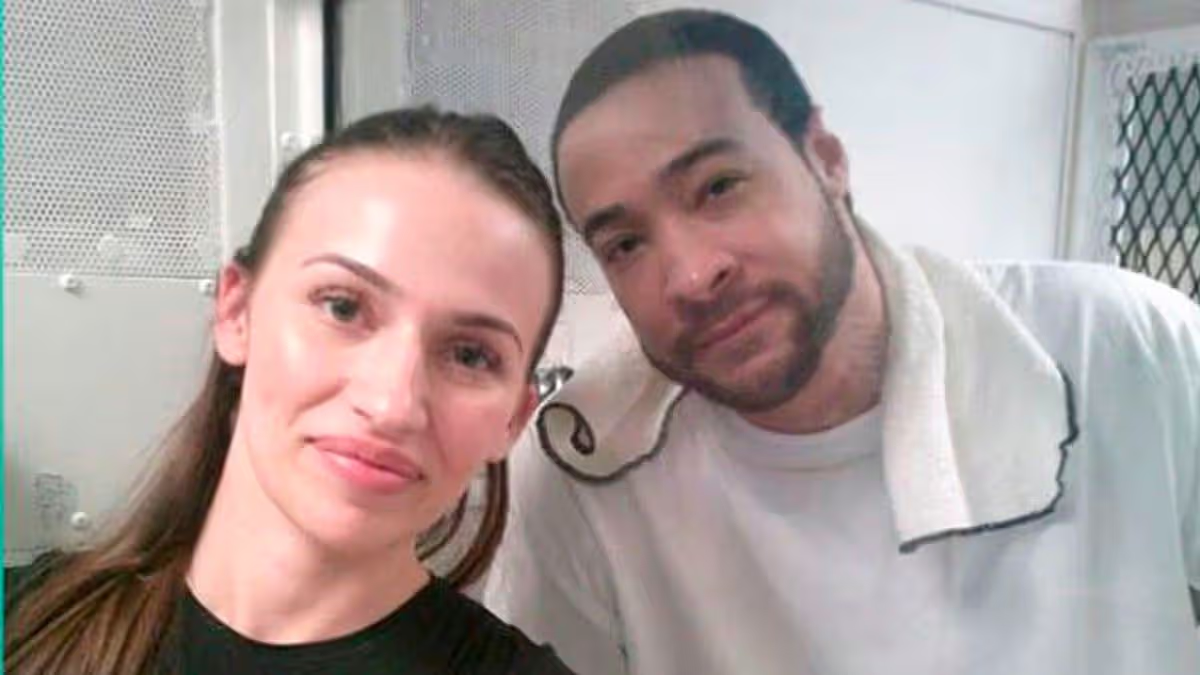
In a small, sterile room in a Texas prison, Tiana Krasniqi pressed her hands against the glass, her world collapsing into a single, brutal moment. Just hours earlier, the U.S. Supreme Court had denied the final appeal for her husband, James Broadnax, a convicted double murderer she believed was innocent. Now, as he lay strapped to the gurney for lethal injection, they locked eyes, communicating a lifetime of unsaid things in silent glances. His last words to her were a strained, “Don’t give up,” and “I love you.” Then, as the powerful sedative pentobarbital began its work, his head jerked back mid-sentence. He couldn’t finish his final word. His gaze fell upon her one last time before his eyes closed forever. Tiana’s anguished scream of “Open your eyes!” echoed in the witness chamber, a raw sound of love and profound failure. She crumbled to the floor, later writing, “The whole thing felt like the final destination movie,” a horrifying script from which there was no escape. She vehemently disputes official accounts that he died peacefully, recounting instead a visceral struggle: “I watched his lips go blue, his face go blue and then his veins on his forehead appeared. He suffered. His body struggled. So what part of that did he die peacefully?”
This devastating conclusion was the climax of a relationship born not from conventional romance, but from academic pursuit. Tiana, a 31-year-old law school graduate from Lewisham in South East London, first contacted Broadnax in late 2024 while researching her master’s dissertation on racial disparities in the U.S. death penalty. What began as a scholarly correspondence quickly evolved into a deep, unexpected connection. She found him to be intelligent, well-spoken, and possessing a moral compass that defied his death row status. “It was never something where you go on there and be like: ‘Hi, let’s be in a relationship,'” she explained. The intellectual and emotional bond grew so strong that she made the extraordinary decision to leave her young daughter in the UK with her father and move to Houston, Texas. There, she dedicated herself fully to his legal fight, enlisting lawyers and sacrificing months of motherhood for a man the world had condemned. “Nobody agrees with [the relationship]. And I don’t expect them to,” she admitted, fully aware of the incomprehension her choices would provoke.
Her conviction in his innocence stems from what she and his legal team argue were profound flaws in his 2008 trial. Broadnax was convicted for the murder and robbery of two music producers, Stephen Swan and Matthew Butler, in a Dallas recording studio car park. Prosecutors secured a death sentence by portraying him as a remorseless, future danger, partly by introducing his own rap lyrics—which alluded to violence, drugs, and robbery—as character evidence. Tiana contends the jury was improperly influenced, noting they asked to review the lyrics twice before deliberating on his “future dangerousness.” More critically, his defense argues his constitutional rights were violated through racial bias in jury selection. Allegations state prosecutors used a spreadsheet that bolded the names of every Black potential juror, systematically striking all seven from the panel until a court order reinstated one. This practice, if proven, would contravene the landmark Batson v. Kentucky ruling meant to prevent racial discrimination in jury selection.
Further complicating the narrative is a shocking, last-minute confession from Demarius Cummings, Broadnax’s cousin, who is already serving life without parole for the same crime. In a desperate, taped prison appeal to halt the execution, Cummings stated plainly, “I’m really gonna tell it like it’s supposed to be told, that it was me, that I was the killer. I shot Matthew Bullard, Steve Swan.” Broadnax’s legal team supported this claim with forensic evidence, asserting that Cummings’ DNA, not Broadnax’s, was found on the murder weapon. They also challenged Broadnax’s own initial confession to police, arguing it was made under the influence of PCP just hours after his arrest, a state in which he was incoherent and willing to accept blame. “He took the blame for something that he didn’t do,” Tiana stated, painting a picture of a drugged, vulnerable young man confronted by a relentless interrogation.
Despite these claims, the state of Texas and the victims’ families remained unmoved. Prosecutors stood by their case, insisting Broadnax was the true gunman and pointing to his own earlier statements. The families of Swan and Butler fiercely opposed any delay or clemency. Theresa Butler, Matthew’s mother, dismissed Cummings’ confession as a manipulative “stall tactic” by a “desperate defence team.” The state’s judicial machinery, having weighed the evidence for over a decade, proceeded with a grim certainty. As his final moment arrived, Broadnax used his last statement not to proclaim his love for Tiana, but to assert his innocence one final time to the witnesses: “I prayed to God for your forgiveness… But no matter what you think about me, Texas got it wrong. I’m innocent, the facts of my case should speak for itself. Period.”
In the aftermath, a heartbroken but resolute Tiana Krasniqi has returned to a life irrevocably altered. She carries the trauma of witnessing her husband’s death and the weight of a promise she made to him as he died: “Don’t give up.” Vowing, “I will not let this go. Texas got it wrong,” she has transformed from a student of human rights law into a living advocate for her husband’s legacy, determined to expose what she sees as a grave miscarriage of justice. Her mission now extends beyond personal grief; it is a fight against a system she believes is corrupted by racial bias and prosecutorial overreach. While the world may remember James Broadnax as a convicted killer executed by the state, Tiana is committed to ensuring the complex, contested story of his trial, the disputed evidence, and the human being she loved is not forgotten, turning her profound personal loss into a public plea for scrutiny and reform.