



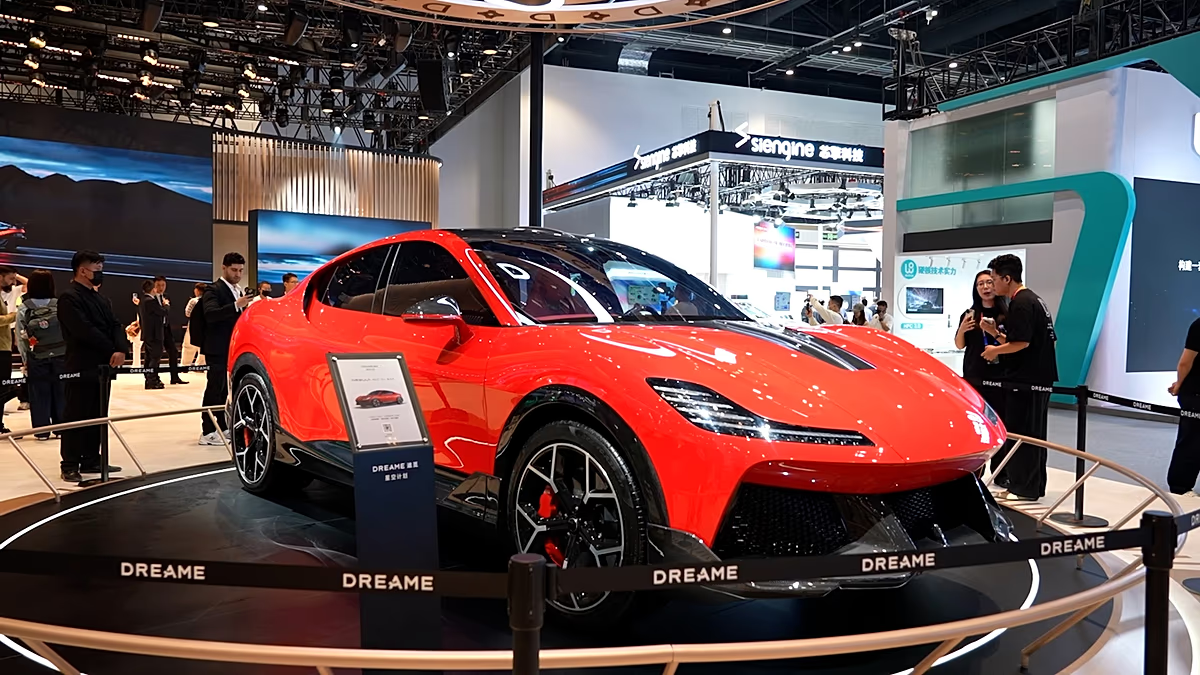
The sprawling showcase of Auto China 2026 in Beijing was not merely an exhibition of vehicles; it was a vivid declaration of a new era in global automotive dominance. Navigating the overcrowded halls across two massive venues—the China International Exhibition Center and the Capital International Convention and Exhibition Center—required genuine stamina from attendees, many of whom were European industry observers drawn to the seismic shifts occurring here. Under the theme “Lead the Era, Intelligent Future,” the event, spanning a record 380,000 square metres, was a physical manifestation of China’s relentless drive toward electrification and vehicle intelligence. This was not a quiet evolution but a loud, crowded, and intensely competitive revolution, drawing the world’s attention to Beijing as the new epicenter of automotive innovation and ambition.
On the exhibition floor, Chinese brands commanded the space with an assertive confidence that underscored their market leadership. BYD arrived in formidable force, presenting its full stable of marques—Dynasty, Denza, Yangwang, and Fangchengbao—while dedicating entire booths to showcase its proprietary Flash Charge and Sky Eye technologies. Rival Chery mirrored this ambition, grouping its iCAR, EXEED, Jetour, and Zongheng labels under one roof to unveil new models like the EXEED EX7 and the rugged Weilin R08 PRO pickup. Geely created a semi-exclusive hall for its Zeekr, Lynk & Co, Geely Galaxy, and China Star brands, focusing on unveiling its All-Domain AI 2.0 and Safety 2.0 tech systems. This unified, brand-centric showcasing highlighted a strategic shift: Chinese automakers are no longer selling individual cars but are presenting comprehensive, technology-infused ecosystems designed to captivate the modern consumer.
The influence of technology firms on automotive design was profoundly evident, blurring the traditional lines between industries. Xiaomi, a consumer electronics giant, showcased its expanding production lineup, including the new-generation SU7, and staged the Asian debut of its futuristic Vision Gran Turismo concept car. Roewe revealed an artificial intelligence-focused “Jiayue” product series developed with the tech firm Volcengine. These moves signaled that the car is increasingly perceived as a sophisticated smart device, a platform for digital life. This integration was the show’s underlying narrative, as noted by industry professionals who stressed that Chinese firms are selling integrated digital platforms, not just vehicles. The car is evolving into a connected technology hub that orchestrates services, entertainment, and daily tasks, a vision Chinese companies are realizing at a startling pace.
While Chinese brands dominated, Auto China 2026 retained its status as a truly international stage, with global heavyweights like BMW, Mercedes-Benz, Audi, Toyota, Volvo, and Ford presenting their latest flagship models. Their presence, however, served as a benchmark against which Chinese progress could be measured. The contrast was stark: where traditional manufacturers highlighted incremental advancements and luxury finishes, Chinese exhibitors emphasized radical technological integration, aggressive pricing, and rapid product cycles. This dynamic created a palpable sense of competitive pressure, underscoring that the global automotive landscape is being reshaped not through imitation, but through a fundamentally different approach to what a car represents and how it is brought to market.
This reshaping has direct and profound implications for markets worldwide, particularly in Europe. The show was a strategic window into China’s export-oriented future. Leveraging their unparalleled strengths in battery technology, software, and connected services, Chinese automakers are poised to flood international markets with vehicles that offer compelling value. Georg Mrusek, an automotive and China expert at Horváth, noted on the sidelines of the show that “Every second European consumer is open to buying a Chinese car as the next car.” Horváth’s analysis reveals that Chinese passenger-car market share in parts of Europe, like Norway, the UK, and Italy, is already above 10%, with their battery electric vehicles accounting for roughly 14% of the European BEV market. Mrusek predicts this share will reach 15–25% within four to five years, forcing European markets to expect intensified competition on price, features, and digital services, alongside more localized Chinese production and partnerships.
The trajectory suggested at Auto China 2026 points toward a future where Chinese brands could capture more than 30% of the European market over the next decade. This potential, however, hinges on their ability to address the practical challenges of international expansion: building robust after-sales networks, deepening localization efforts, and navigating complex regulatory environments. The show was a testament to their manufacturing and technological prowess, but the real test will be in translating that exhibition-floor spectacle into sustainable, trusted partnerships with consumers across the globe. As Auto China 2026 opened to the public, it offered a glimpse of an intelligent future where the lines between transportation, technology, and daily life are seamlessly woven together—a future being authored decisively in China.