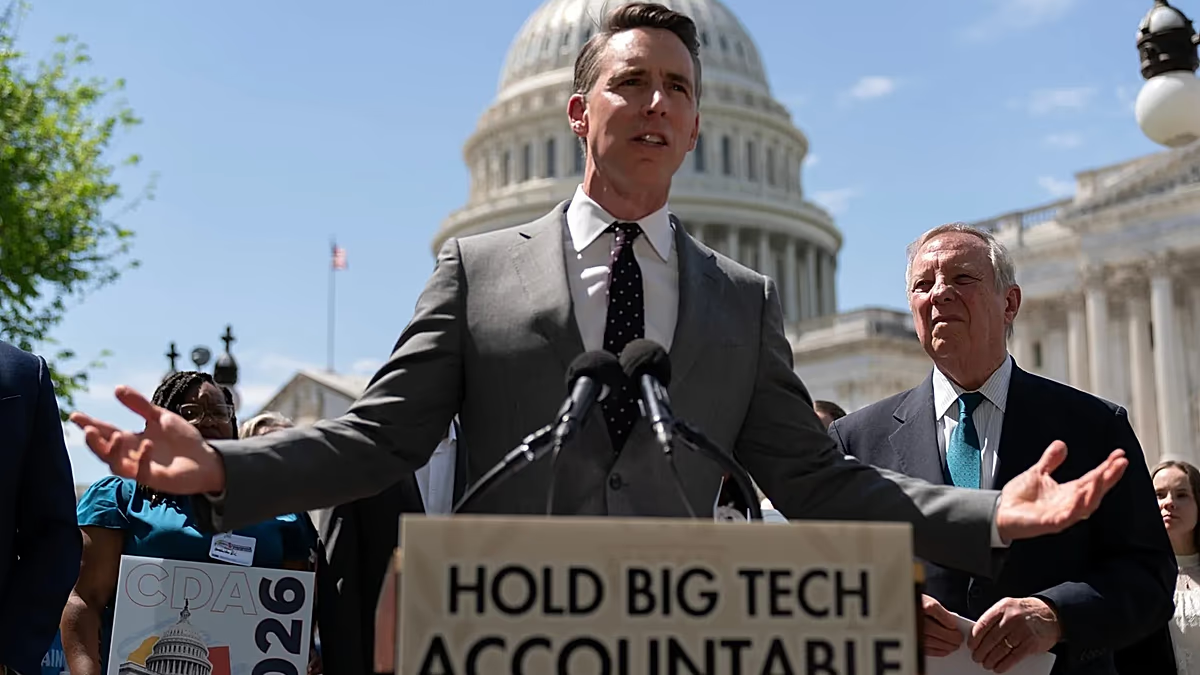




In a striking escalation of transatlantic tensions, former and now once again US President Donald Trump has issued a direct threat to the United Kingdom, warning of punitive tariffs unless it abolishes its Digital Services Tax (DST). Speaking from the Oval Office, Trump stated, “We can meet that very easily by just putting a big tariff on the UK, so they better be careful,” and clarified that any retaliatory measure would be “equal or greater than what they’re doing.” This confrontation highlights a long-standing and contentious issue: the global effort to tax the digital revenues of predominantly American tech giants, which Trump frames as an unfair exploitation of US companies. His rhetoric underscores a broader worldview that sees such taxes as targeted attacks on American economic supremacy, a stance he reaffirmed on his social media platform, vowing to “stand up to countries that attack our incredible American Tech Companies.”
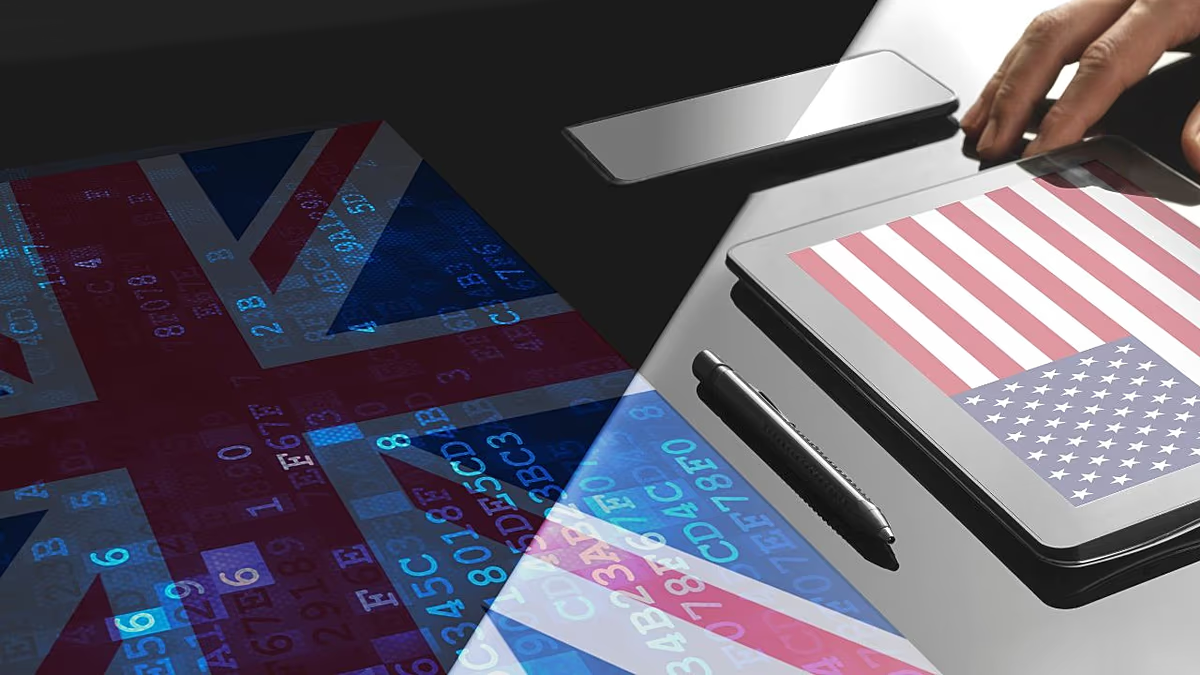
The UK’s Digital Services Tax, implemented in April 2020, is a 2% levy on revenues generated from UK users by large social media platforms, search engines, and online marketplaces. It targets companies with global digital revenues exceeding £500 million and more than £25 million from UK users. Designed as an interim measure, the tax was introduced pending a comprehensive international agreement on reforming global corporate tax rules—an agreement that has stalled. The UK government maintains that the DST is a business tax, not a country-specific one, and is neutral regarding a company’s headquarters. However, its practical impact falls heavily on American firms like Alphabet (Google), Meta, and Amazon. The tax’s financial significance has grown, collecting £944 million in 2025-26, a 17% increase from the previous year, demonstrating its effectiveness and the substantial digital economic activity within the UK.
Trump’s hostility toward the DST is not an isolated position; it reflects a continuous US policy concern spanning administrations. President Joe Biden also challenged the levy, though through different diplomatic channels. Trump’s argument, however, is characterized by a more adversarial and protectionist tone. He asserts that the tax unfairly targets “the top companies in the world,” which are predominantly American, and perceives it as an attempt by other nations to “make an easy buck” by “taking advantage of our country.” This perspective frames the issue in nationalistic terms, defending corporate interests as a matter of patriotic principle, regardless of individual opinions about the specific companies. The threat of tariffs is presented as a straightforward reciprocal action, a tool he has consistently favored to enforce his view of economic fairness.
The UK’s tax is part of a wider European and global trend. Several nations, including France, Spain, Italy, and Turkey, have implemented their own versions of a digital services tax. While many of these European taxes focus on revenues from online advertising, the UK’s scope is broader, encompassing social media, search engines, and online marketplaces. Furthermore, the European Union has enacted the Digital Markets Act, a regulatory framework aimed at ensuring fair competition among the largest digital players. To Trump, these collective measures—whether labeled as taxes, services legislation, or market regulations—represent a coordinated discriminatory front against American technology dominance. His promised retaliation against the UK is thus a warning shot to all nations pursuing similar policies.
The core of the dispute lies in a fundamental disagreement over taxation rights in the digital age. Traditional international tax rules are based on physical presence, making it difficult for countries to tax profits generated by digital services provided remotely by multinational giants. The DST and similar measures are attempts by nations to capture a fair share of tax revenue from economic activity occurring within their borders, even if the company has no substantial physical footprint there. The US, as the home country for most of these dominant firms, views this as an erosion of its own tax base and an unfair targeting of its economic champions. The UK’s stance that it is a business-level, agnostic tax clashes with the US perception of it as a de facto geopolitical levy on American success.
This confrontation presents a significant diplomatic and economic challenge. If enacted, Trump’s threatened tariffs could strain the special relationship between the US and UK, impacting trade beyond the digital sector. For the UK, scrapping the DST without a global alternative would mean sacrificing a substantial and growing revenue stream derived from a sector that profits immensely from its consumer base. The standoff exemplifies the difficulties of achieving international tax consensus in a fragmented world. The UK government’s commitment to remove the tax only upon a global solution remains, but Trump’s unilateral threat pressures it to act prematurely. Ultimately, this episode is more than a bilateral spat; it is a manifestation of the ongoing power struggle between national sovereignty and global corporate governance in the twenty-first century economy.