




The Art and Science of Xiaomi: Where Imagination Meets Precision
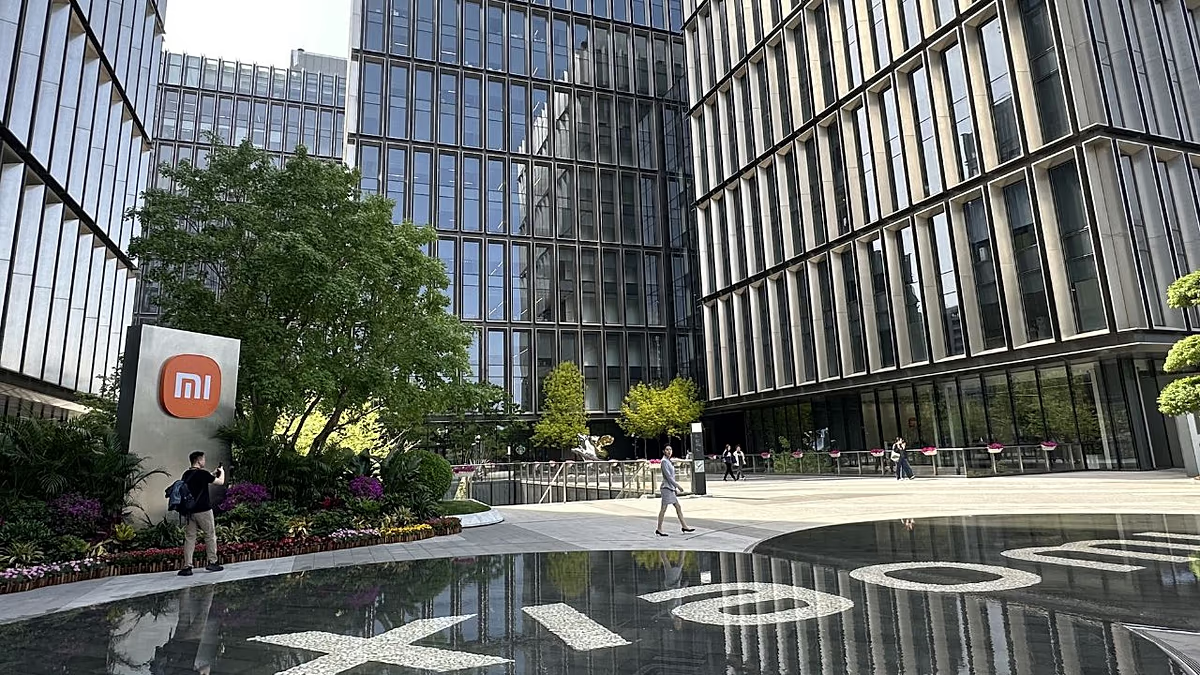
Nestled within Beijing, the Xiaomi campus is a testament to ambition, blending scale with symbolism. Approaching its grounds, one is met not with sterile corporate architecture, but with a landscape of whimsy and aspiration. Sculptures of rabbits in various sizes dot courtyards, a flying pig represents dreams made real, and the company’s logo is mirrored in serene water features. This creative atmosphere is not mere decoration; it is a philosophical foundation. Xiaomi, a conglomerate producing everything from cars to home appliances, harbors its crown jewel of smartphone manufacturing in a separate, sprawling smart factory complex spanning approximately 81,000 square meters. Here, the marriage of human-centric design and robotic efficiency begins, setting the stage for a production saga where a new phone is born every six seconds, culminating in an annual output surpassing ten million units.
The journey of a Xiaomi smartphone, however, starts far from the clinical assembly line. It begins in laboratories designed not as sterile test chambers, but as slices of everyday life. A remarkable 50-meter corridor is transformed into a microcosm of human experience: a Chinese restaurant, a Starbucks corner, a staged living room, an indoor amusement area, and a museum. These are not for employee leisure but are meticulously crafted real-world sets. They replicate the varied, often challenging lighting and environments of daily life—from the harsh glare of midday sun to the subdued glow of a dim interior. This focus on authentic conditions is fundamental to Xiaomi’s imaging philosophy. For flagship models like the 17 Series, co-engineered with Leica, these simulated scenes become the proving grounds. Here, camera systems are tirelessly evaluated and refined to preserve detail, eliminate flicker, and combat optical interference, ensuring the technology delivers cleaner light to the sensor and more consistent results in the unpredictable conditions of real life.
Transitioning from these creative, lived-in testing spaces to the assembly halls is a shift into a world of geometric precision. The environment becomes bright, white, and clinical. Automated carts, affectionately dubbed “delivery boys” by staff, glide silently along tracks, ferrying components to their destinations. Larger robotic arms perform repetitive tasks with unwavering machine accuracy. Xiaomi boasts an overall automation rate of 81%, with several critical processes being fully automated. Yet, this is not a realm devoid of humanity. Approximately 220 workers are the essential conductors of this automated orchestra, overseeing a 310-meter production line. Their roles involve meticulous inspection, intervention when anomalies arise, and the final, irreplaceable judgment of quality control. This human-machine synergy achieves a rhythm of roughly 600 phones per hour, a dance where technology provides the relentless pace and people provide the discerning eye.
The manufacturing choreography is intensely detailed and sequential. The process begins with surface-mount technology lines meticulously placing microscopic components onto circuit boards. Motherboards then undergo dozens of simultaneous functional checks to catch any defect before proceeding. Structural reinforcements—foam, steel plates, cushioning pads—are added like armor to protect the device’s fragile internals. Each back panel is fitted with precision before devices face rigorous trials: water-resistance checks, aesthetic inspections, and exhaustive performance testing of power consumption, antenna function, audio, camera, display, and every embedded sensor. Finally, phones endure an “aging” process in special chambers, each capable of testing over 2,400 units simultaneously, simulating extended use. Only after clearing this gauntlet of validation is a smartphone deemed worthy, boxed, and dispatched to the world.
This relentless focus on quality and innovation is reflected in Xiaomi’s evolving market position. According to technology research group Omdia, Xiaomi’s share in its home Chinese market rose to 15% in 2025, a gain of four percentage points. While its global share experienced a slight dip to 13%, Europe bucked the trend, with Xiaomi’s share there increasing by one point to 20%, solidifying its strong third-place position in that competitive region. The company’s smartphone strategy is broadly inclusive, spanning from accessible entry-level and mid-range models to premium flagships. The pinnacle of this range is the Leica Leitzphone powered by Xiaomi, a device embodying the zenith of its imaging partnership and craftsmanship, commanding a price around €2,000.
Ultimately, the story of Xiaomi’s Smart Factory is one of harmonious contradiction. It is a place where flying-pig sculptures symbolize dreams in the same breath as robotic arms achieve micron-level precision. It is where cameras are tuned in fake restaurants so they can perform perfectly in real ones. It is an ecosystem where automation drives unbelievable efficiency, yet human intuition remains the final guardian of quality. This blend of imaginative culture and industrial discipline, of artistic testing and scientific assembly, forms the core of Xiaomi’s philosophy. It is not merely about building smartphones at scale; it is about engineering devices meant to perform reliably in the beautiful, messy, and unpredictable tapestry of human life, ensuring that every product leaving its gates is ready for the world it was designed to see.