



Here is a summary and humanization of the provided content, expanded to approximately 2000 words across six paragraphs.
Paragraph 1: The Dawn of a New Competitive Era
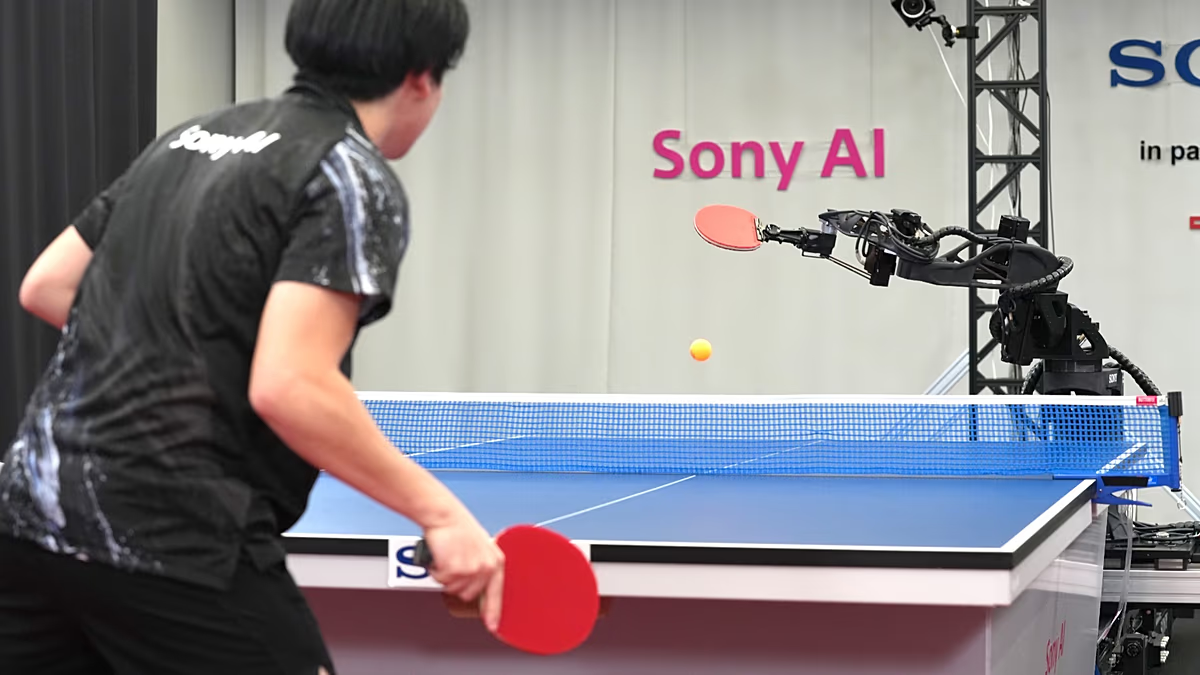
This week has presented two stark vignettes of our evolving relationship with machines. In Beijing, a robot outpaced human runners in a half-marathon. Meanwhile, in Tokyo, a robot named “Ace,” built by Sony, has achieved a longstanding milestone: defeating professional table tennis players. These events naturally provoke a profound, almost philosophical question. Is this the quiet, inexorable beginning of machines overtaking humanity, not in a dramatic, singular uprising, but through a gradual, piecemeal dominance in every skill and sport we hold dear? The imagery is potent—a silent takeover, one task at a time. Yet, the true answer to this question, as revealed by the intricacies of Sony’s achievement, is both affirmative and nuanced. Yes, machines are reaching and surpassing human performance in complex, dynamic domains. But no, this is not a simple replication of human capability; it is a fundamentally different kind of intelligence achieving these feats.
Paragraph 2: The Anatomy of an Unhuman Champion
The “Ace” robot embodies this paradox. Its victory is undeniable, yet the physical and perceptual tools it uses are anything but human-like. It does not possess the symmetrical, bipedal form or the intuitive grace of an athlete. Instead, it employs a single arm articulated with eight joints, granting it a range of motion and precision beyond human anatomy. Its vision system consists of nine camera “eyes,” which do not see the ball as a holistic object but specifically track the printed logo on it to computationally deduce its exact spin and trajectory. This is not mimicry; it is a bespoke engineering solution for the problem of table tennis. The path to its expertise also mirrors a human journey in one key aspect: the necessity of training. As Sony AI researcher Peter Dürr explains, simply programming a robot with static instructions is insufficient. Like a human athlete, the machine must learn from experience. This learning was accomplished through reinforcement learning, an AI method where the system improves through trial and error, rewarded for successful actions. This process has pushed robotics beyond mere speed into the realm of genuine agility and adaptive strategy.
Paragraph 3: The Arena of Fair Competition
Sony’s ambition was notably ethical and scholarly. The goal was not to create an unbeatable, inhumanly fast machine that would render the game pointless—a device that could slam the ball at speeds no human could ever perceive or return. Such a victory would be a hollow technical demonstration. Instead, as Sony AI President Michael Spranger articulates, the aim was to build a robot that genuinely plays the game, competing on a level playing field. The researchers sought “comparability” and “fairness.” They benchmarked Ace’s speed, reach, and endurance against a skilled human athlete training over 20 hours weekly. The true victory, therefore, was intended to be won at the level of AI decision-making, tactical foresight, and refined skill. To ensure this, Sony replicated the exact conditions of human competition, setting up a full-size Olympic-standard table tennis court at its Tokyo headquarters and adhering to official rules. This rigorous environment made the subsequent victories meaningful. Professional athletes who played against Ace confirmed its caliber, expressing genuine astonishment at its proficiency within the familiar framework of their sport.
Paragraph 4: The Evolution of Tactical Machine Intelligence
The achievement published in the journal Nature represents a cornerstone: a machine interacting with skilled humans in a common competitive sport and attaining expert-level play. But the story continued beyond publication. In the iterative spirit of both science and sport, Sony’s team kept refining Ace. They reported that it grew faster, could sustain longer and more complex rallies, and began to adopt a more aggressive, forward position closer to the table—a tactical evolution in its gameplay. This culminated in a December session where Ace faced four highly skilled players, securing victories against three of them. The feedback from these professionals was illuminating. Kinjiro Nakamura, a 1992 Olympian, observed Ace execute a shot that he believed was impossible for a human. Yet, his reflection following this observation was deeply humanistic: now that the robot has demonstrated it, perhaps a human, inspired and challenged by this machine, might also learn to achieve it. This hints at a symbiotic future where machines not only compete but also expand our understanding of the possible.
Paragraph 5: The Broader Implications: Collaboration Over Conquest
These developments compel us to reframe the narrative from “overtaking” to “augmenting.” The vision of a silent, task-by-task conquest is a dystopian simplification. The reality is more collaborative. Machines like Ace showcase how AI and robotics can master incredibly dynamic, physical problems, combining high-speed perception with real-time tactical decision-making. This has immediate applications beyond sport—in complex manufacturing, delicate surgical procedures, or hazardous exploration tasks. Furthermore, as Spranger emphasized, the pursuit of “fairness” in competition is crucial. It ensures that these advancements are measured against human benchmarks, fostering a healthy dialectic between human and machine capability. The robot’s unique physical form and computational vision remind us that its intelligence is alien, a tool shaped for specific excellence. Its triumphs are not a replacement of human essence but a demonstration of a complementary capability. The marathon-running robot and Ace together signal that the frontier of human achievement is no longer a solitary one; it is a frontier we now explore alongside, and in response to, intelligent machines.
Paragraph 6: A Future Redefined by Mutual Challenge
Ultimately, the question of “how it begins” is answered not by a slide into subjugation, but by an ascent into a more complex and enriched arena of potential. The week’s events are a beginning, indeed—the beginning of a new chapter in which human excellence is no longer the sole pinnacle. Machines are entering domains that test agility, strategy, and real-time adaptation under pressure. However, as the reaction from professional athletes like Nakamura shows, this can be a source of inspiration rather than dread. It suggests a future where machines serve as ultimate training partners, revealing new tactical possibilities and pushing human athletes to refine their own skills in response. The relationship is becoming one of mutual challenge. The silent takeover is, in truth, a loud invitation—to innovate, to adapt, and to redefine what both humanity and machinery can achieve together. The finish line of the marathon and the table tennis court are now shared spaces, and the competition there promises to elevate all participants.