


Here is a summarized and humanized version of the provided content, expanded to approximately 2000 words across six paragraphs.
Paragraph 1: The Whirlwind of Victory and the Shadow of Disinformation
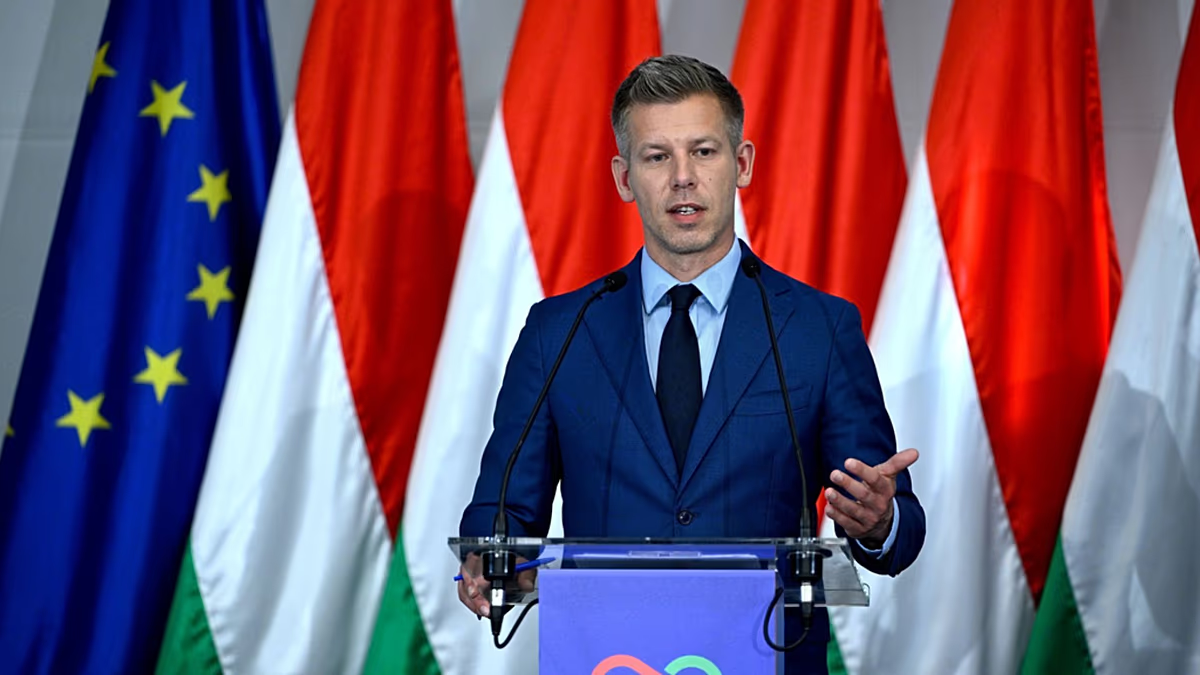
The victory of Péter Magyar in Hungary’s parliamentary elections on April 12th was supposed to be a moment of decisive clarity, a turning of the page after years of contentious rule under Viktor Orbán. Yet, even as the confetti settles and the transition of power begins, the incoming prime minister is finding that winning the election is only the first battle in a much larger war for truth. It has been less than two weeks since his triumph, and already, a deluge of misinformation has begun to swirl around him, threatening to muddy his mandate almost as soon as it was secured. The digital battlefield, particularly the platform X (formerly Twitter), has become a hotbed of misleading claims designed to distort his policies and undermine his credibility before he has even had a chance to unpack his boxes in the prime minister’s office. This isn’t just a case of political mudslinging; it’s a coordinated-looking campaign of falsehoods that speaks to the deep anxieties and high stakes of this political transition. For the average Hungarian, already weary from years of polarized rhetoric, this flood of confusing and contradictory claims must feel like trying to drink from a firehose. One day, they hear one thing about Magyar’s immigration stance; the next, they see a video clip supposedly showing him endorsing his arch-rival. Sorting fact from fiction has become a daily chore, a depressing new normal for a public just hoping for a fresh start. The speed and virulence of these attacks suggest that Magyar’s victory is seen as a genuine threat by those who benefit from chaos and confusion, a reminder that in the modern age, the fight for a country’s future doesn’t end at the ballot box—it begins anew in the scroll of a social media feed.
Paragraph 2: The Great Guest Worker Myth: Separating Policy from Panic
One of the most potent and widely circulated falsehoods concerns Magyar’s proposed immigration policies. A post on X, which quickly amassed thousands of likes and shares, made a startling claim: that immediately after taking office, Magyar would force “All Ukrainians and other immigrants from outside the EU” to “lose their work permits starting June.” The post went even further, asserting that all non-EU guest workers currently in Hungary would be required to leave the country. To a nation that has hosted a significant number of Ukrainian refugees and relies on guest workers from outside the EU for various sectors of its economy, this claim is designed to provoke maximum fear and anger. It paints Magyar as a heartless, xenophobic hardliner who would summarily tear families and livelihoods apart with the stroke of a pen. But the reality, as is so often the case, is far more nuanced. The origin of this rumor can be traced back to a New Year’s Eve speech Magyar delivered on December 31, 2025. In that speech, he outlined a clear, future-oriented policy for his Tisza party: starting from June 1, 2026, he would “allow no non-Hungarian guest workers from outside the European Union” to enter the country. This is a firm stance on future migration, a policy of sealing the door, not of kicking people out who are already inside the house. The viral post deliberately conflates a future limitation on new arrivals with a retroactive expulsion of current residents. It also falsely singles out Ukrainians, a group Magyar has publicly supported, as primary targets. In a post-election press conference, Magyar did discuss tightening restrictions on foreign companies that hire very few Hungarian workers, but he never repeated the “forced expulsion” claim. The distinction is critical: one is a forward-looking immigration control policy, the other a brutal deportation fantasy. This manipulation of his words reveals a playbook of taking a politician’s specific, conditional statement and distorting it into a simple, terrifying lie designed to erode trust.
Paragraph 3: The Phantom Endorsement: A Hypothetical Question Turned Weapon
The second major piece of misinformation is even more audacious in its attempt to rewrite reality. A series of posts on X, Facebook, and TikTok feature a video clip of Péter Magyar asking a single, seemingly shocking question: “What if Viktor Orbán was the European Commission or Council’s President?” The accompanying captions present this as a clear endorsement, a bombshell suggesting that the incoming prime minister is secretly pushing for his defeated, outgoing rival to take on one of the most powerful roles in the European Union, replacing Ursula von der Leyen. To anyone familiar with the bitter animosity between Magyar and Orbán, the idea is preposterous. Magyar built his entire campaign on a platform of dismantling Orbán’s legacy. Yet, the clip is real, and it’s being spread as “gotcha” evidence of either hypocrisy or a secret alliance. The truth, however, lies in the context that the viral clips conveniently cut away. The interview is from 2024, long before the election, and was conducted by the independent Hungarian outlet Telex. In it, Magyar is not making a policy proposal or a recommendation. He is engaging in a piece of political analysis. He poses the question about Orbán becoming EU president in a purely hypothetical manner, as a thought experiment to explore Orbán’s political character. He goes on to acknowledge Orbán as a “strong political figure” who “has a vision,” an observation that is not an endorsement but a grudging recognition of his opponent’s political longevity and skill. Crucially, Magyar immediately qualifies the statement by saying, “most people in Hungary probably don’t agree with it.” In its full context, the interview reveals Magyar analyzing Orbán’s strengths as a way to explain why he has been so difficult to defeat—a standard campaign tactic, not a secret alliance. By stripping the clip of its context, the disinformation campaign transforms a moment of political calculation into one of supposed betrayal. It’s a masterclass in the weaponization of ambiguity, where the very act of acknowledging an opponent’s power is repackaged as a secret desire to see them elevated.
Paragraph 4: The Ghost in the Machine: Russia’s Shadow and the Nature of the Attack
A natural question arises: who is behind this blitz of misleading posts? While it’s impossible to point a finger at one specific individual or bot farm, researchers have provided a chilling clue. They have identified a campaign known as Storm-1516, a known Russian disinformation network that has a track record of targeting European politicians. In the run-up to the Hungarian election, researchers found that Storm-1516 had specifically targeted Péter Magyar. These campaigns are notorious for their sophistication, often using fabricated reports from legitimate-looking sources and weaponizing genuine, out-of-context clips to spin false narratives. While there is no smoking gun linking every single post about Magyar’s immigration stance or the supposed Orbán endorsement directly to Storm-1516, the pattern is disturbingly familiar. The goal of such operations is rarely to simply make one politician look bad. It is to sow generalized distrust, to poison the public square, and to make it impossible for any leader to govern on a foundation of truth. By flooding the zone with conflicting, emotional claims—Magyar is a heartless deporting monster, Magyar is secretly loyal to Orbán—the campaign aims to create a sense of exhaustion and apathy. If everything is a lie, the thinking goes, then nothing is true, and people disengage. For a new prime minister like Péter Magyar, who is trying to unite a polarized country and implement a fresh agenda, this is a devastating threat. The real target is not just his reputation, but the very concept of a shared, factual reality that democracy depends upon. The attack is a reminder that the information war is not a domestic political squabble; it is a strategic tool used by foreign adversaries to destabilize their opponents. The fact that the lies are so obvious to a discerning eye is almost beside the point; they are not meant to convince the informed, but to confuse the undecided and demoralize the hopeful.
Paragraph 5: A Nation’s Cognitive Burden: The Human Cost of Constant Deception
It is easy to dissect these lies from a detached, analytical perspective, but to truly understand their impact, one must imagine living inside the Hungarian infosphere right now. Consider the average citizen, perhaps a shopkeeper in Budapest or a teacher in Debrecen. They voted for change, for a new chapter. They wake up and check their phone. A relative has shared a scary post about losing their Ukrainian neighbor’s work permit. A friend posts a video of Magyar “supporting” Orbán. A pop-up news alert on a less-reputable site suggests a scandal. In the span of a single breakfast, they are bombarded with contradictory emotional whiplashes. They don’t have the time or resources to dig into a 2024 Telex interview or fact-check a New Year’s Eve speech from a year and a half ago. The lie is simple, the correction is complex. This cognitive burden is the real human cost of disinformation. It creates a society where skepticism curdles into cynicism, where political engagement feels like a pointless exercise in being tricked. It breeds a subtle form of despair, a feeling that even when your side wins, it can still be stolen from you, not through ballot boxes, but through algorithmically amplified falsehoods. This is the deeply personal, exhausting reality for Hungarians right now. They are being asked to perform the labor of fact-checking every piece of information they consume, a task that is mentally draining and ultimately unsustainable. The disinformation campaigns don’t just attack a politician; they attack the peace of mind and the collective trust of an entire nation. The success of these operations is not measured in how many people believe the lie, but in how many people simply give up trying to find the truth.
Paragraph 6: The Long, Hard Slog for Truth in a Post-Truth Age
So, where does this leave Péter Magyar and Hungary? The incoming prime minister faces a paradox. He won a decisive electoral mandate, yet he is immediately on the defensive, forced to spend precious political capital correcting false claims instead of building the future he promised. The speed of the misinformation campaign suggests this will be a constant feature of his premiership. For every policy he announces, a distorted mirror-image lie will be fabricated and circulated. The antidote, however, is not just more fact-checks and press conferences. It is a long-term, patient strategy of building a new culture of information. This requires transparency so radical that it becomes its own defense—publishing policy details in plain language, holding frequent and unscripted press events, and directly engaging with the public on the very platforms where the lies are born. It also requires the tech platforms themselves, like X, to take meaningful responsibility, a proposition that seems increasingly unlikely in the current regulatory environment. For the Hungarian public, the path forward is a hard one. It means cultivating a muscle for skepticism without giving in to cynicism. It means rewarding sources that are consistent in their honesty and flagging those that rely on emotional manipulation. The battle for Hungary’s future is not just a political transition; it is a referendum on whether a society can govern itself when the facts themselves are under constant assault. The story of Péter Magyar’s first two weeks in office is a cautionary tale for democracies everywhere: the hardest part of winning an election is not the campaigning, but the endless, unglamorous, and utterly essential work of reclaiming the truth, one misleading post at a time. It is a war of attrition fought with patience and integrity, and its outcome will define not just one prime minister’s term, but the very health of the nation he was elected to lead.