

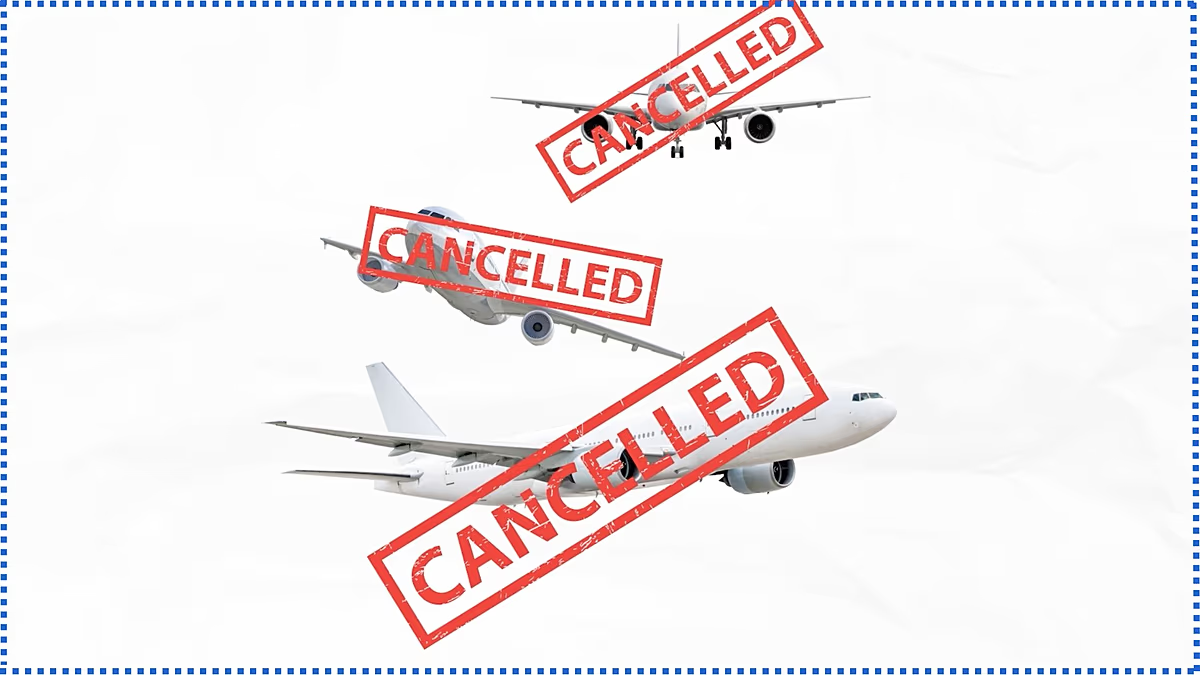
In a quiet yet growing crisis, Europe’s travel industry is sounding alarms over severe jet fuel shortages, even as EU officials try to downplay the severity. Scandinavian Airlines has cancelled roughly a thousand flights, Lufthansa has cut 20,000 routes, and Air France-KLM has implemented a €100 surcharge on long-haul tickets—a clear signal that airlines are bracing for turbulent times. These disruptions stem from a precarious supply chain: about 70% of the EU’s jet fuel is refined within the bloc, with the remainder typically imported from the Middle East. However, the recent closure of the Strait of Hormuz—a vital maritime passage—has drastically reduced imports, sending jet fuel prices soaring to double their previous levels and threatening the continuity of air travel across the continent.
The International Energy Agency delivered a stark warning last week, indicating that Europe’s jet fuel reserves might only last another six weeks, potentially leading to widespread flight cancellations. Despite this, the European Commission has pushed back, attributing the flight cuts not to fuel scarcity but to airlines’ own profitability struggles. This divergence in perspectives highlights a troubling gap between the assessments of independent energy experts and the political narrative from Brussels. In an effort to preempt a full-blown crisis, the Commission has launched AccelerateEU, an initiative designed to coordinate emergency fuel supplies and encourage member states to share their remaining reserves—a move that acknowledges the underlying fragility even as public reassurances continue.
Compounding the challenge, the EU is exploring alternative sources, including increased imports from the United States. However, this solution is not without complications: U.S. jet fuel adheres to slightly different chemical standards than European specifications, potentially requiring adjustments or waivers to be used effectively in EU aircraft. This technical hurdle illustrates the complexities of hastily rearranging global energy supply lines. Meanwhile, ahead of an informal summit of EU leaders in Cyprus, transport ministers have proffered advice that feels detached from reality for many travelers: they suggest Europeans “neutralise demand” by opting for public transport and electric bicycles.
While the suggestion to shift toward sustainable transport is well-intentioned, it starkly overlooks the practicalities of long-distance and international travel. As one observer wryly noted, you cannot simply ride an e-bike from Brussels to Ibiza. For families planning holidays, business professionals with international commitments, and individuals relying on air travel for personal emergencies, such alternatives are hardly viable. This gap between high-level policy suggestions and on-the-ground realities risks eroding public trust, especially as citizens watch flight cancellations mount and surcharges increase.
The energy crisis is set to be a central topic at the EU leaders’ informal summit in Cyprus, though the irony of discussing fuel shortages at a gathering that likely required significant air travel has not gone unnoticed. The discussions will need to balance immediate contingency planning with longer-term strategies for energy resilience. Key questions remain: How can the EU better shield its transport sector from geopolitical disruptions? Can emergency stockpiling and diversification of suppliers prevent such shortages in the future? The summit represents a critical juncture for EU leaders to move beyond reassuring rhetoric and implement concrete, cooperative measures.
As the situation develops, passengers face uncertainty and higher costs, while airlines navigate between operational viability and regulatory pressures. The true test will be whether the EU’s coordinated efforts can mitigate the shortage before further disruptions unfold. For now, the contrasting narratives—between the urgency expressed by airlines and the calibrated calm of institutions—reflect the delicate act of managing both a physical shortage and public perception. The days ahead will reveal whether Europe can successfully steady its skies or if travelers will need to prepare for more grounded realities.