



Germany is once again being described as the “sick man of Europe,” a troubling label that recalls the economic stagnation of the late 1990s. The diagnosis today includes chronic weak growth, a steep fall in vital exports to China, and profound struggles within cornerstone industries like mechanical engineering and automotive manufacturing. A palpable sense of deindustrialization hangs over the nation, compounded by a demographic squeeze and a persistent shortage of skilled workers. Perhaps most alarmingly, productivity—the engine of long-term prosperity—has flatlined for years. While these systemic issues have been widely acknowledged for a long time, there has been a palpable lack of decisive action to address them. This inertia raises two critical questions: why does Germany find it so difficult to enact necessary reforms and modernize its economy, and what would the consequences of a permanently weakened Germany be for the broader European project?
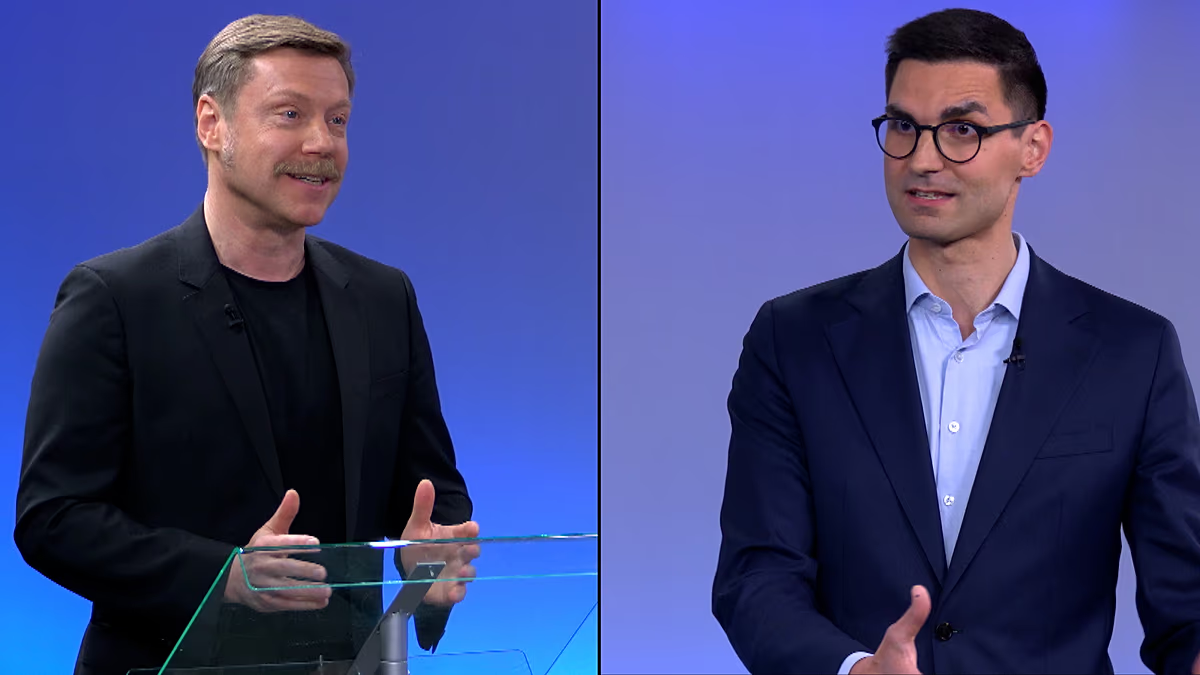
To explore these questions, a debate hosted by Euronews titled “The Ring” featured two German politicians from opposing ends of the ideological spectrum. Sepp Müller, vice chairman of the Christian Democrats in the Bundestag, and Martin Schirdewan, co-chair of The Left group in the European Parliament, confronted the central issue of how Germany can emerg from its current crisis. Both agreed that the roots of the problem lie in delayed modernization, chronically insufficient investment in future-oriented sectors, and a rigid adherence to an outdated export-oriented economic model. However, their prescriptions for recovery diverged sharply, reflecting deep philosophical divides about the purpose and structure of the economy.
From the left, Martin Schirdewan argued that the crisis is fundamentally a social one, born from a economic model that has prioritized corporate and export interests over the well-being of citizens. “People simply aren’t earning enough money,” he stated, framing Germany’s famed “cheap exports” strategy as a direct trade-off that has sacrificed worker wages and living standards. He pointed to a broad deficit in investment, not only in private industry but crucially in public infrastructure, education, and social services, which he views as the core issues requiring urgent attention. For Schirdewan, the solution lies not in doubling down on global competition, but in rebuilding the domestic economy to serve its people, implying greater public investment, stronger labor protections, and a move away from dependency on volatile export markets.
Conversely, Sepp Müller from the center-right emphasized the imperative of restoring Germany’s international competitiveness. He defended the export model by noting its deep embeddedness in the national fabric, stating that one in four manufacturing jobs directly depends on exports. Müller acknowledged that some reform measures have been undertaken, but he framed the current setbacks as largely external, driven by a complex and hostile geopolitical landscape. He pointed to challenges from a potential Trump administration in the United States, political tensions with China, and the “dirty games” of powers like Russia, which he claims disproportionately harm low and middle-income Germans. For Müller, the path forward involves navigating these external threats while securing Germany’s place in global trade, rather than fundamentally restructuring the economic model.
Their disagreement crystallized most clearly around the topic of free trade agreements. Müller presented them as indispensable tools for securing foreign markets, safeguarding national prosperity, and protecting jobs linked to the export sector. In his view, opening markets is a defensive necessity in a turbulent world. Schirdewan, however, saw these agreements as mechanisms that accelerate inequality, arguing that workers are the primary victims of a system designed to lower costs and increase corporate mobility at the expense of social stability. This fundamental clash—between viewing the economy as an international competition to be won or as a domestic community to be nurtured—extended into other policy areas like taxation and housing, though the debate highlighted trade as the central fault line.
The conversation, anchored by Stefan Grobe, underscores that Germany’s path out of its current malaise is not merely a technical question of economic policy, but a profound political choice about its future identity. The persistent reform paralysis suggests a nation caught between two compelling but incompatible visions: one seeking to reclaim its status as a global export powerhouse by adapting to geopolitical realities, and another aiming to re-anchor the economy in domestic welfare and resilience. The outcome of this internal debate will resonate far beyond Germany’s borders. As the largest economy and traditional engine of the European Union, a chronically underperforming Germany would weaken the entire bloc’s economic stability, political cohesion, and global influence. Therefore, the resolution of Germany’s “sickness” is not just a national concern, but a European imperative.