


The relentless rhythm of the modern 9-to-5 work culture, with its constant connectivity and performance pressures, is increasingly being recognized not just as a professional challenge, but as a profound threat to our overall wellbeing. The World Health Organization formally classifies burnout as an occupational syndrome, characterized by exhaustion, cynicism, and reduced efficacy. Yet, as many know all too well, these feelings do not simply vanish when we log off for the day. They seep into our personal lives, coloring our relationships and our sense of self. Recent surveys, such as one from Mental Health UK indicating that nearly 90% of Brits experience high stress levels, confirm this is a pervasive issue. Experts rightly dismiss the notion that burnout can be solved by simply “powering through”; the solution is not more work, but a fundamental recalibration of our relationship to work and rest. In response, a cultural conversation is growing around the necessity of truly disconnecting, of seeking refuge from the endless ping of emails, video calls, and digital noise to reclaim our mental space.
This search for respite is fueling a transformative approach to travel, moving beyond mere physical relocation to intentional psychological escape. The concept, popularly termed “deadzoning,” involves consciously seeking disconnection while on holiday, whether by choosing destinations with limited cellular signal or rigorously silencing work notifications. As Dr. Birgit Trauer, a tourism expert, explains, travel has always been driven by “push-pull” motivations—we are not only drawn to new places but are actively pushing away from workplace stressors and routines that drain us. The goal of deadzoning is regeneration: to reignite our innate human capacity for connection—with others, with our surroundings, and most importantly, with ourselves. It is a deliberate act of stepping away from the digital personas and performance metrics that can obscure our authentic selves, creating a sacred space for stillness and self-reconnection.
While the term “deadzoning” may feel contemporary, popularized by millennials and Gen Z as a conscious rebellion against an algorithm-driven culture, the essence of the practice is timeless. Dr. Trauer notes that the academic study of such disconnection is not new, and history is rich with examples, from the Hippie Trails of the mid-20th century where travelers journeyed for weeks in blissful incommunicado. What distinguishes the current trend is its intentionality; it is not a wholesale rejection of technology, but a strategic rebalancing. The benefits are substantiated: reducing the “cognitive load” of constant digital engagement can lower stress and anxiety, improve sleep, enhance mindfulness, and foster more present, meaningful social interactions. It is a therapeutic reset that allows our overloaded minds to process, decompress, and restore.
However, this profound disconnect can present its own challenges upon re-entry. Dr. Trauer highlights the phenomenon of “reversed culture shock,” where travelers return with a renewed perspective or a calmer state of mind, only to find their home environment and routines unchanged. This dissonance can be jarring, creating a sense of not fitting into one’s old life and potentially fostering a cycle of escapism rather than integration. The true test, then, is not just in the escape itself, but in the ability to carry fragments of that peace and intentionality back into daily life, to reshape routines and boundaries to protect the wellbeing that was so carefully nurtured abroad.
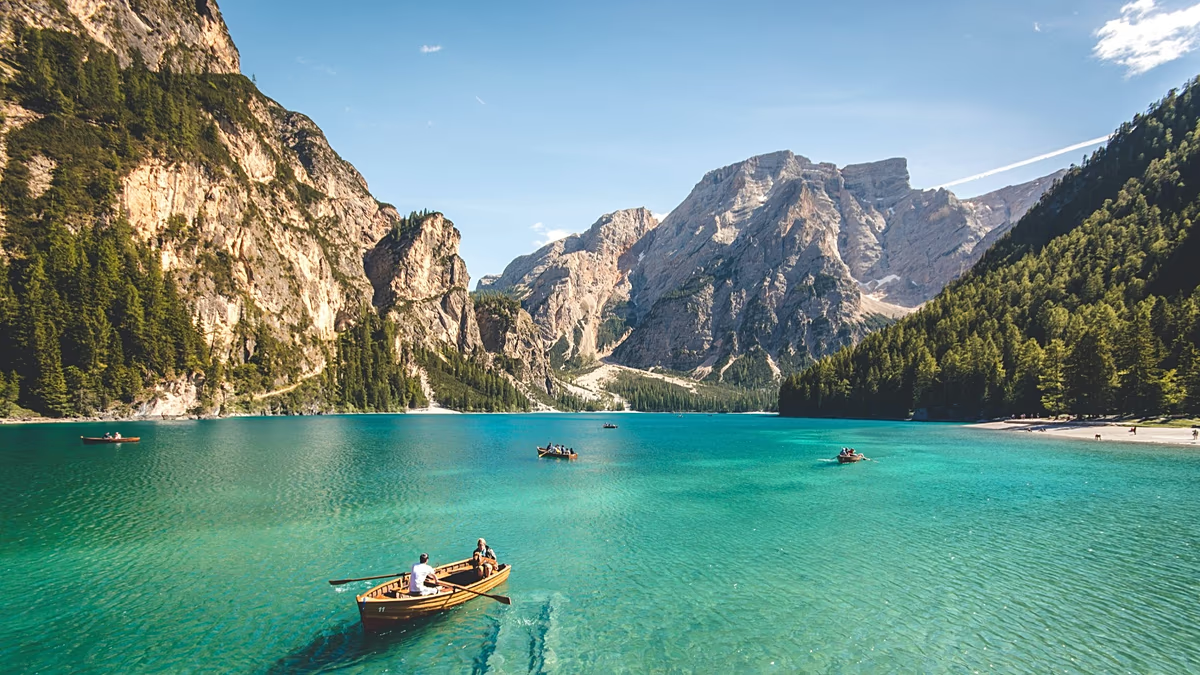
Fortunately, the path to disconnection need not be a logistically daunting or prohibitively expensive long-haul journey. As Dr. Trauer emphasizes, deadzoning can begin much closer to home. Europe, in particular, offers a wealth of accessible sanctuaries that facilitate a deep unplugging. Beyond the famous bustling capitals and tourist hubs lie pockets of serene stillness. On the Greek island of Amorgos, for instance, villages like Aegiali Ormos maintain a tradition of slow living, where time is measured by fishing boats in the port and long walks along ancient paths like The Old Strata. Similarly, Romania’s Via Transilvanica, a 1,400-kilometre hiking and cycling route, offers a moving meditation through forests, mountains, and historic regions, its very name meaning “the road that unites.” In Denmark, the tranquil fjords like Roskilde offer a journey back in time across calm waters, under expansive skies, past Stone Age and Viking settlements—a powerful reminder of a world before digital saturation.
In conclusion, the question of whether the 9-to-5 rat race hampers our wellbeing is answered by the growing collective urge to periodically leave it behind. Deadzoning represents more than a travel trend; it is a vital form of modern self-preservation. It acknowledges that our always-on work culture comes at a significant cognitive and emotional cost, and that recovery requires a deliberate, physical, and digital boundary. By seeking out these quiet alternatives, whether in a remote European village or on a local trail, we engage in an act of resistance against perpetual productivity. We affirm that our worth is not tied to our immediate responsiveness, and that in the quiet spaces—away from the screens and the schedules—we rediscover the essential human capacities for wonder, connection, and peace that the rat race so quietly erodes.