



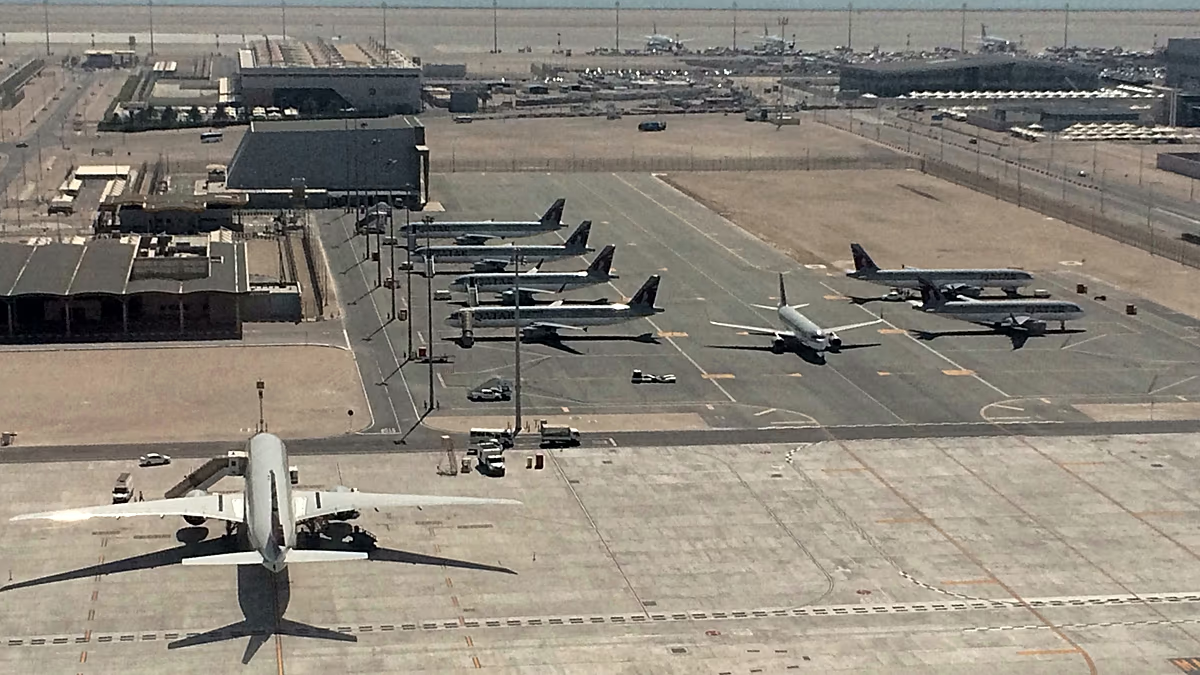
After a period of significant disruption stemming from regional tensions, the skies above Qatar are poised to become busier once more. Foreign airlines are now preparing for a phased return to the country’s airspace, marking a crucial step in reconnecting the Qatari capital with the global aviation network. This resumption of international carrier operations into and out of Hamad International Airport (HIA) signals a move towards normalcy, following a temporary shutdown that had left the national carrier, Qatar Airways, as the primary operator during this sensitive period. The decision, confirmed by the Qatar Civil Aviation Authority (QCAA), underscores a careful and measured approach to reopening, prioritizing coordination and readiness above all else.
The QCAA’s announcement came with firm assurances of safety and operational integrity. The authority emphasized that the decision followed a comprehensive assessment involving all relevant national entities, ensuring the highest levels of readiness before welcoming foreign carriers back. Crucially, they affirmed that all flight operations would adhere to the most stringent internationally recognized safety and security standards, with every necessary precaution in place to protect both passengers and aviation personnel. This structured, phased resuming with the confidence that their well-being and that of aviation personnel are safeguarded by all necessary precautions. This phased restart represents an evolution from the “partial resumption” initiated in early March, which was primarily focused on facilitating essential evacuation, repatriation, and cargo flights.
The earlier, limited operational phase served as a vital lifeline. During that time, Qatar Airways operated designated “limited relief corridor” flights to key European hubs like London, Paris, Frankfurt, Madrid, and Rome. These services were strictly managed, requiring pre-allocation for passengers most affected by the widespread travel disruptions. This controlled approach allowed for the careful movement of people and essential goods while broader diplomatic and logistical evaluations were underway. That period of restricted access now gives way to a more expansive vision, as the restoration of foreign airline access dovetails with Qatar Airways’ own ambitious plans for network growth.
Indeed, the reopening of Qatar’s airspace aligns perfectly with the national carrier’s strategy to reclaim and expand its global footprint. Just days before the QCAA’s announcement, Qatar Airways unveiled an extensive summer schedule, effective from mid-June, that will see it flying to over 150 destinations worldwide. This ambitious plan includes new routes and increased frequencies across all continents, from European cities like Copenhagen, Milan, and Vienna to African capitals such as Abuja and Dar es Salaam, and major hubs across Asia, the Americas, and Oceania. The clear intent is to “connect more passengers to more of the world this summer,” leveraging HIA’s strategic location as a global transit point.
This coordinated revival of aviation activity is set against the backdrop of Hamad International Airport’s proven capacity as a world-class hub. The airport’s impressive infrastructure, which handled over 282,000 aircraft movements and welcomed 54.3 million passengers last year, is more than ready to support this influx. The record-breaking traffic, with monthly figures exceeding five million passengers, demonstrates the facility’s ability to manage high volumes efficiently. As foreign airlines gradually reintegrate into the schedule, HIA is well-prepared to restore its role as a central crossroads for international travel, facilitating not just tourism and business, but also the vital cultural and familial connections that global aviation enables.
In conclusion, the phased return of foreign airlines to Qatar’s airspace is more than a simple logistical update; it is a symbol of re-engagement and recovery. By meticulously planning this restart with an unwavering commitment to safety, Qatar is methodically rebuilding the bridges that connect it to the world. Coupled with Qatar Airways’ simultaneous network explosion, this move promises to rejuvenate the flow of commerce, tourism, and personal journeys through the heart of the Gulf. For travelers, airlines, and the global aviation community, it represents a welcome return to connectivity, choice, and the boundless possibilities that come with an open sky.